

The Trevor Project research briefs provide concise research on LGBTQ+ youth mental health, suicide risk, care access, crisis services, school climate, family support, and related social conditions. Each brief translates survey findings or topic-specific analysis into applied evidence for clinical, educational, policy, communications, and program design contexts.
The archive has practical value because each publication links data with prevention systems, service access, institutional climate, and protective support conditions. The format supports fast topic review while preserving method context for responsible interpretation.
In this article
- What The Trevor Project Research Briefs Are
- How to Read The Trevor Project Research Briefs
- Topics in The Trevor Project Research Briefs
- Responsible Use of The Trevor Project Research Briefs
Understanding The Trevor Project research briefs requires attention to format, evidence source, topic scope, and applied use. The archive functions as a focused evidence library on LGBTQ+ youth mental health and suicide prevention.
The briefs differ from general awareness content. Each publication usually centers a research question, a defined data source, a measured population, and a concise interpretation of findings.
The archive organizes entries by year, which supports topic lookup, publication-cycle review, and comparison across research themes. That structure helps identify recurring issues, emerging research priorities, and conditions requiring closer professional review.
This guide explains the purpose of The Trevor Project research briefs, the main topic areas, the correct interpretation process, and the limits of application. The guide also connects the briefs with national survey work and relevant public-health reference sources.
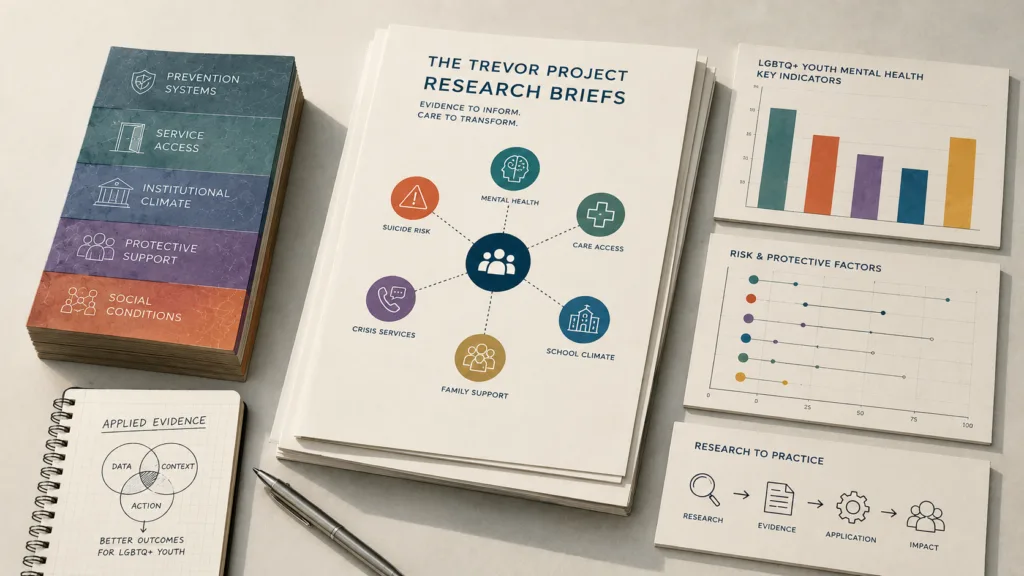
Evidence Use in LGBTQ+ Youth Mental Health Planning
The Trevor Project research briefs support evidence-informed decisions across youth-facing systems. Strong applications include staff training, needs assessment, policy review, grant writing, communications, service planning, and suicide prevention strategy.
The briefs work best as applied research summaries. A finding can identify access barriers, risk patterns, protective conditions, or environmental pressures, while professional standards and local data guide final application.
Responsible use depends on source, method, population, publication date, measure, and stated limitation. Strong interpretation separates association from causation and keeps each finding within the measured context.
What The Trevor Project Research Briefs Are
The Trevor Project research briefs are short research publications about LGBTQ+ youth mental health, suicide risk, protective factors, and social conditions. The main purpose is evidence translation for professional review and applied decision support.
A research brief differs from a standard blog post because the format centers a focused question, a data source, and a concise explanation of findings. Many briefs use data from The Trevor Project national surveys, while additional briefs examine specific groups, settings, or risk factors.
The archive presents entries by year, creating an organized record of research attention over time. Topics include crisis service use, identity-related discrimination, gender euphoria, school policy, family support, housing instability, conversion therapy exposure, and care access.
For professional use, the format serves several functions. The briefs summarize research in a readable structure, identify patterns relevant to prevention and support systems, and connect evidence with practical implications.
This structure matters because LGBTQ+ youth mental health requires analysis beyond individual risk. The briefs often examine surrounding conditions, including schools, families, communities, digital spaces, care systems, and public policy environments.
The archive also supports issue detection across publication cycles. Repeated attention to a topic can signal persistent barriers, emerging research needs, or conditions requiring closer policy and program review.
The Trevor Project research briefs therefore operate as an applied evidence bridge. Research findings become easier to scan, compare, cite, and connect with professional decisions.
How to Read The Trevor Project Research Briefs
The Trevor Project research briefs require careful interpretation as applied evidence. Core value appears in population patterns, reported experiences, access barriers, protective factors, and system conditions.
A central reading rule separates population-level findings from individual assessment. A finding linking a specific experience with higher suicide risk identifies a pattern, while individual assessment requires direct evaluation and relevant professional standards.
The supplied content includes a key access finding from the twenty twenty-five national survey. Forty-four percent of LGBTQ+ youth who wanted mental health care during the prior year could not obtain care.
That finding points toward a systems-level barrier. Relevant review areas include referral pathways, provider availability, insurance navigation, cultural competence, crisis response capacity, and continuity of care.
Methods sections deserve close attention. A brief on mental health diagnoses and access to care, for example, explains survey source, recruitment, age range, self-reported diagnosis questions, and analytic choices.
Those details determine interpretation quality. A self-reported survey finding has descriptive value, while clinical assessment, direct service data, and local program evaluation remain separate evidence categories.
A strong reading process starts with the research question behind the brief. Next comes identification of data source, measured population, key finding, limitation, and practical implication.
This process reduces misuse. Findings remain connected to evidence scope, publication date, method limits, and the decision context under review.
The best professional reading also avoids isolated statistic extraction. A single percentage gains meaning through the measure, sample, comparison group, and limitation statement surrounding the finding.
Topics in The Trevor Project Research Briefs
The Trevor Project research brief archive covers a wide range of LGBTQ+ youth mental health topics. Recent entries include crisis service use, identity importance, gender euphoria, conversion therapy exposure, substance use, pronoun respect, civic engagement, anti-bullying policy, online experiences, and social support.
Other topics include positive events, mental health diagnoses, houselessness, rural experience, and state policy. This range shows a broad prevention framework rather than a narrow individual-risk model.
The briefs often treat mental health and suicide risk as outcomes shaped by structural, social, institutional, and interpersonal conditions. Schools, families, communities, digital environments, health systems, and state policies become part of prevention analysis.
Subgroup-focused research adds analytical precision. The archive includes research on transgender and nonbinary youth, LGBTQ+ youth of color, intersex LGBTQ+ youth, Black transgender and nonbinary youth, rural LGBTQ+ youth, disabled youth, and youth with housing instability histories.
This subgroup focus limits overgeneralization. A broad LGBTQ+ youth statistic may have different relevance across identity, race, geography, disability, housing status, care access, and community context.
Public-health datasets can strengthen interpretation. The supplied content identifies the CDC Youth Risk Behavior Survey as a relevant reference point, including a transgender identity question and a role in understanding mental health and risk patterns.
The Trevor Project briefs and public datasets serve different functions. Topic-specific briefs provide focused interpretation, while public-health datasets can support comparison, surveillance context, and broader reference framing.
Together, these evidence sources support triangulation. Strong analysis compares findings across sources while keeping definitions, measures, samples, and populations clear.
Responsible Use of The Trevor Project Research Briefs
Organizations can use The Trevor Project research briefs for staff training, needs assessment, grant narratives, school climate review, policy analysis, communications, and program planning. Responsible use begins with alignment between the research topic and the operational decision.
A brief on crisis services may inform crisis response design. A brief on family support may fit caregiver education, community programming, or prevention messaging.
The supplied content includes a community acceptance finding. LGBTQ+ youth in very accepting communities attempted suicide at six percent, compared with eighteen percent in very unaccepting communities.
The value of that comparison is structural. Acceptance, safety, and support can function as measurable prevention conditions in places where youth live, learn, seek care, and build identity.
Responsible use also requires caution with causality. A brief showing association can justify closer review, training, or policy evaluation, while causal claims require appropriate study design and direct evidence support.
Selective quotation creates interpretation risk. A statistic tied to a specific subgroup, survey year, measure, or research question requires that context during citation and application.
Strong application follows a consistent process. First comes identification of the relevant brief. Next comes review of method, population, and limitation. Then comes comparison with local data and professional standards. Final application stays within the proper decision context.
That process turns the archive into decision support rather than simple citation material. The result is clearer planning, more accurate communication, and stronger alignment between evidence and practice.
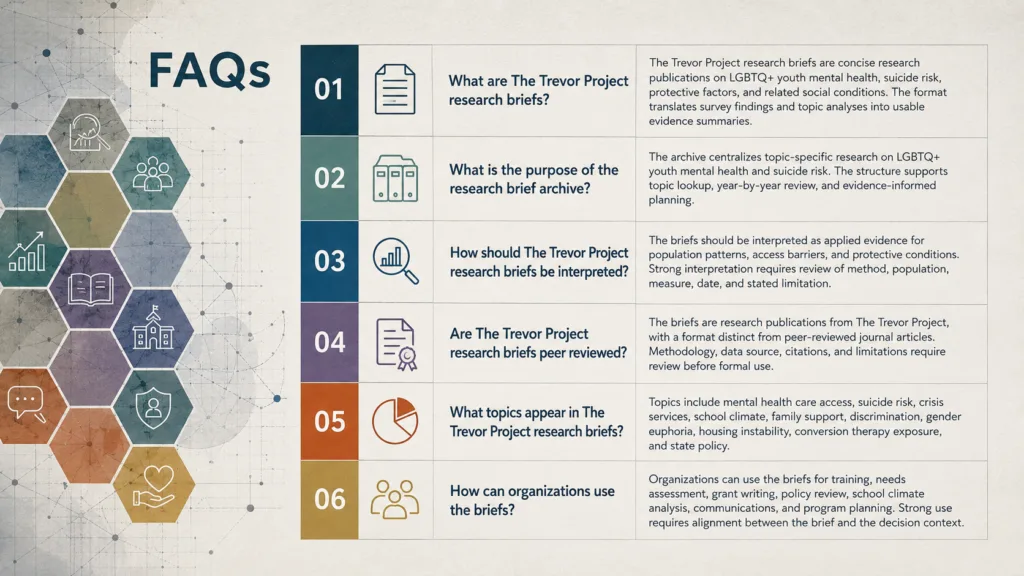
FAQs
The Trevor Project research briefs are concise research publications on LGBTQ+ youth mental health, suicide risk, protective factors, and related social conditions. The format translates survey findings and topic analyses into usable evidence summaries.
The archive centralizes topic-specific research on LGBTQ+ youth mental health and suicide risk. The structure supports topic lookup, year-by-year review, and evidence-informed planning.
The briefs should be interpreted as applied evidence for population patterns, access barriers, and protective conditions. Strong interpretation requires review of method, population, measure, date, and stated limitation.
The briefs are research publications from The Trevor Project, with a format distinct from peer-reviewed journal articles. Methodology, data source, citations, and limitations require review before formal use.
Topics include mental health care access, suicide risk, crisis services, school climate, family support, discrimination, gender euphoria, housing instability, conversion therapy exposure, and state policy.
Organizations can use the briefs for training, needs assessment, grant writing, policy review, school climate analysis, communications, and program planning. Strong use requires alignment between the brief and the decision context.
Understanding The Trevor Project Research Briefs in Practice
Review the relevant brief, verify method and scope, and compare findings with local data, policy requirements, and current support practices.
More on The Trevor Project
Explore The Trevor Project from every angle: