
In many homes and schools, a young person had carried questions about identity before anyone else understood how heavy those questions had become. A family dinner, a hallway, or a late-night message from a friend could have felt unsafe when fear, rejection, or isolation had already gathered. The Trevor Project support had existed for LGBTQ+ young people who needed a trained, confidential person during crisis, confusion, emotional distress, or thoughts of suicide.
The Trevor Project had described itself as a nonprofit focused on suicide prevention, crisis intervention, research, and advocacy for LGBTQ+ young people. Its role had reached beyond one phone number because young people, parents, caregivers, teachers, and friends had often needed more than a single answer. They had needed a safer conversation, a clearer path, and support that understood the human story around LGBTQ+ youth distress.
In this article
- What The Trevor Project Is
- How Trevor Support Works
- Why LGBTQ+ Youth Support Matters
- What Happens When Someone Reaches Out
The need behind The Trevor Project support had not been abstract. The Trevor Project’s 2024 U.S. National Survey included more than 18,000 LGBTQ+ young people ages 13 to 24, and it reported high levels of anxiety, depression symptoms, unmet mental health needs, and suicide risk. Behind those numbers were young people who may have been afraid to speak at home, uncertain among friends, or unsure whether one trusted adult would listen with care.
For a beginner, the clearest point was that Trevor had not been only a hotline. It had been a set of crisis services, educational resources, research reports, and support pathways built around LGBTQ+ youth experience. Its story belonged to young people in crisis, yet it also reached families, schools, and communities that had wanted to understand how support, belonging, and safety could change an outcome.
The Human Story Behind Trevor Support
The Trevor Project support had grown from a simple human need: a young person in distress needed someone trained to stay present. Crisis often arrived through relationships, not only through private thoughts. A young person might have felt rejected by a parent, unseen at school, misgendered by peers, or frightened after a painful message from a friend.
In that setting, support had meant more than information. It had meant listening, safety planning, and a calm conversation when isolation had grown dangerous. The story also showed why LGBTQ+ youth-specific support mattered, because identity, family response, friendship, school climate, and safety were often tied together.
What The Trevor Project Is
The Trevor Project had been a U.S.-based nonprofit organization that provided crisis support and suicide prevention services for LGBTQ+ young people. Its work had centered lesbian, gay, bisexual, transgender, queer, questioning, and other young people who may have faced emotional distress, thoughts of suicide, rejection, bullying, family conflict, isolation, or uncertainty about identity. In many homes and schools, those experiences had gathered slowly before anyone else understood the danger.
A simple scene helped explain its purpose. A teenager may have been awake after midnight, rereading a message from a friend or replaying a hard conversation with a parent. She or he may not have known whether the pain was serious enough for help, yet the fear had already become heavy. Trevor’s support had been built for that kind of moment, when a young person needed a trained responder who understood LGBTQ+ experiences.
The organization’s origin also carried a story. It grew out of the short film Trevor, which told the story of a gay 13-year-old boy who experienced rejection and attempted suicide. When the film was set to air, its creators recognized that viewers might need real support, and the organization was founded in 1998. From that beginning, the work connected a young person’s story with a practical way for others to seek help.
Over time, Trevor’s work expanded beyond emergency conversations. It published research, created educational resources, and shared information for families, schools, and communities. Even with that wider role, its central meaning stayed close to the original story: LGBTQ+ young people in distress deserved support before isolation became unbearable.
How Trevor Support Works
The Trevor Project had offered several ways to reach trained crisis counselors. Young people could call the Trevor Lifeline at 866-488-7386, text START to 678-678, or use TrevorChat online. The organization described these services as free, confidential, and available 24/7/365. For a young person in fear, having more than one path mattered because speaking, typing, and waiting could each feel different.
The process had been shaped to reduce the barrier to help. A young person did not need a diagnosis, insurance, paperwork, or a perfect explanation before reaching out. A crisis counselor’s role had been to listen, help the person feel less alone, support immediate safety, and explore next steps. For families and friends, that difference mattered because crisis support had focused on the present moment rather than long-term therapy.
The Trevor Project’s 2024 survey reported that 50% of LGBTQ+ young people who wanted mental health care in the past year were not able to get it. That number had carried many possible barriers, including cost, transportation, family permission, fear of being outed, and a shortage of affirming providers. Trevor support had not replaced ongoing mental health care, but it could have served as a bridge when formal care was out of reach.
The organization had also partnered with the 988 Suicide & Crisis Lifeline to provide specialized LGBTQ+ youth crisis support in the past. The status and structure of 988 specialized options had changed over time, so the most reliable path in the supplied material remained Trevor’s own current contact page. In crisis work, families and friends had needed clear routes because uncertainty could make an already frightening moment harder.
Why LGBTQ+ Youth Support Matters
LGBTQ+ youth crisis support mattered because distress had often grown where identity, safety, and belonging collided. A young person may have faced ordinary adolescent pressure while also experiencing rejection, misgendering, bullying, political hostility, religious conflict, housing insecurity, or fear of disclosure. The crisis may not have started with one visible event. It may have built through repeated signs that honesty felt unsafe.
The Trevor Project’s research had repeatedly connected affirming environments with lower suicide risk. Its 2024 survey reported that LGBTQ+ young people with access to affirming homes, schools, communities, and online spaces generally reported lower rates of attempting suicide than those without those supports. The story did not suggest that identity caused harm. It showed how mistreatment, stigma, and lack of support placed young people at higher risk.
For a parent, caregiver, teacher, coach, or friend, that changed the meaning of help. The concern was not only whether a young person was in immediate danger. The deeper question was whether daily life had made survival, honesty, and connection easier or harder. A trusted adult using the right name, listening without panic, or helping a young person find care could have become part of a wider protective circle.
Trevor’s work also mattered because many young people had wanted help before clear words were available. A confidential conversation could have helped name fear, slow a dangerous moment, and point toward safer next steps. In that way, support had lived not only at the edge of emergency but also inside the relationships that could reduce isolation earlier.
What Happens When Someone Reaches Out
A young person contacting The Trevor Project did not have to be certain that the situation counted as crisis. Emotional distress could have been enough. Feeling unsafe, overwhelmed, numb, scared, rejected, or unsure about staying alive had all been reasons to reach out. Trevor’s crisis counselors had been trained to support LGBTQ+ young people by phone, text, and chat.
The conversation may have begun with basic questions about what was happening and whether the person was safe. That could have felt intimidating, especially when trust had already been strained by family conflict, school pressure, or fear among peers. The purpose had not been judgment. The purpose had been to understand risk and help with the next safe step.
That next step might have included grounding, a safety plan, contacting a trusted person, reducing access to immediate danger, or connecting with further care. For one young person, the next step may have been a calmer breath and a message to a friend. For another, it may have involved a parent, caregiver, educator, or emergency service. The shared meaning was that crisis support helped move a frightening moment into a plan with another person present.
The Trevor Project’s 2024 survey found that 39% of LGBTQ+ young people seriously considered attempting suicide in the past year. That statistic was painful, but it also explained why fast access mattered. A young person may have reached out during a brief window when connection could interrupt isolation. In an immediate life-threatening emergency, the supplied material noted that local emergency services could be contacted, while 988 remained available in the United States as the national Suicide & Crisis Lifeline.
FAQs
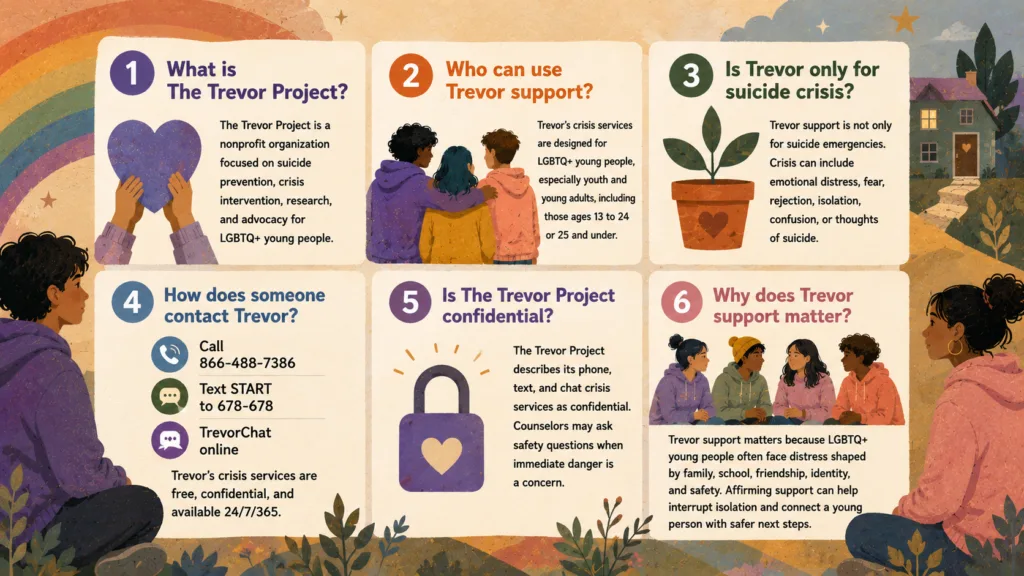
The Trevor Project had been a nonprofit organization focused on suicide prevention, crisis intervention, research, and advocacy for LGBTQ+ young people. Its story centered young people who needed affirming support during distress, fear, isolation, or crisis.
Trevor’s crisis services had been designed for LGBTQ+ young people, especially youth and young adults who needed affirming support. The supplied material connected the service population with LGBTQ+ young people, including those ages 13 to 24 or 25 and under in related listings.
Trevor support had not been only for suicide emergencies. Crisis could have included emotional distress, fear, rejection, isolation, confusion, or thoughts of suicide before danger became extreme.
A young person could call 866-488-7386, text START to 678-678, or use TrevorChat online. The organization described its crisis services as free, confidential, and available 24/7/365.
The Trevor Project described its phone, text, and chat crisis services as confidential. As with many crisis services, counselors may have asked safety questions when immediate danger was a concern.
Trevor support mattered because LGBTQ+ young people often faced distress shaped by family, school, friendship, identity, and safety. Affirming support could help interrupt isolation and connect a young person with safer next steps.
The Trevor Project Support Story
A saved path to The Trevor Project’s Get Help page could help a young person, caregiver, educator, or friend recognize crisis support before isolation deepened.
More on The Trevor Project
Explore The Trevor Project from every angle: