

Last Prisoner Project: Support Architecture, Resource Access, and Alternative Relief Systems
The Last Prisoner Project occupies a defined institutional position within cannabis criminal justice reform. Organizational purpose centers on harm repair through legal intervention, constituent support, advocacy infrastructure, and policy change connected to cannabis criminalization. Operational relevance persists because legalization produced uneven relief, leaving incarceration, supervised-release obligations, criminal records, and reentry barriers intact across many jurisdictions.
A functional analysis requires separation between mission language and program mechanics. Public advocacy framing communicates broad reform purpose, while actual support access depends on intake structure, eligibility criteria, offense characteristics, and release timing. Resource usefulness therefore depends on procedural clarity rather than organizational familiarity alone.
In this article
- Last Prisoner Project Institutional Identity and Reform Scope
- Last Prisoner Project Support Structure and Eligibility Boundaries
- Last Prisoner Project Direct Resource Channels
- Alternative Relief Systems Beyond Last Prisoner Project
Cannabis reform institutions often combine symbolic advocacy and practical assistance, yet the two dimensions rarely operate through identical rules. The Last Prisoner Project illustrates that distinction through a mission framework built around release, record relief, and reentry stabilization, alongside narrower program gates that determine actual access. Analytical accuracy therefore requires attention to organizational function, not branding alone.
A complete resource guide must also account for support failure points. Cannabis-specific nonprofits cannot absorb every record-clearing matter, clemency request, housing disruption, or employment barrier. Stronger utility emerges from a layered framework that identifies direct Last Prisoner Project entry points and parallel relief systems for cases outside organizational scope.
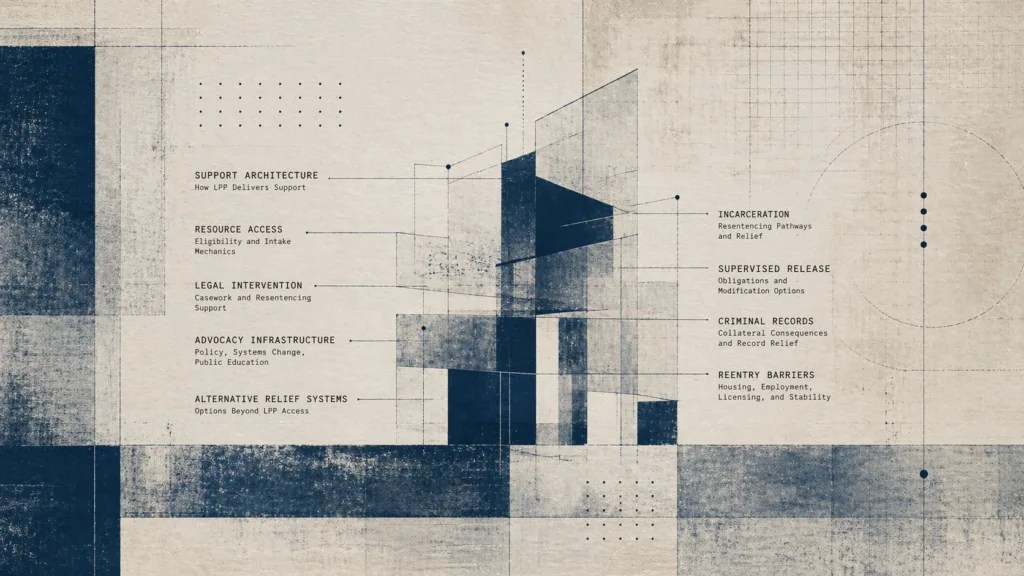
Last Prisoner Project Operational Framework
The Last Prisoner Project functions as both a reform institution and a selective support gateway. Public materials describe a broad commitment to ending cannabis criminalization and repairing associated harms, while program pages reveal differentiated access tracks with distinct thresholds and purposes. A precise account therefore depends on structural analysis across identity, intake mechanics, resource channels, and fallback systems.
Last Prisoner Project Institutional Identity and Reform Scope
The Last Prisoner Project defines itself as a national, nonpartisan nonprofit dedicated to cannabis criminal justice reform. Mission and FAQ materials frame the work through legal intervention, constituent support, advocacy activity, and policy reform intended to repair the harms of cannabis criminalization. That formulation establishes a broader mandate than incarceration reduction alone.
Organizational framing consistently links imprisonment, criminal record burden, supervised-release constraints, and post-release instability as connected expressions of the same policy structure. Incarceration relief without record relief leaves enduring exclusion in place. Record relief without reentry support leaves economic and civic reintegration incomplete. The organization therefore treats cannabis criminalization as a system of layered consequences rather than a single prosecutorial event.
Public descriptions also indicate a coalition model involving attorneys, reform advocates, justice specialists, and justice-impacted participants. That structure helps explain the distribution of organizational labor across direct legal intervention, case screening, referral pathways, clemency advocacy, and broader policy work. Institutional value therefore lies in dual capacity: practical support in selected cases and systemic pressure aimed at changing the legal architecture that produces those cases.
A concise institutional description emerges from that structure. The Last Prisoner Project sits at the intersection of cannabis justice advocacy and post-conviction support, with organizational attention directed toward release, record clearance, and reentry stabilization. The result is a reform entity with both symbolic significance and practical gateway function.
Last Prisoner Project Support Structure and Eligibility Boundaries
The central access point for support appears through the Constituent Services Intake Form. Public description identifies that form as the broadest request channel for reentry grants, record-clearance help, scholarship opportunities, and legal assistance. Functional significance derives from intake breadth rather than entitlement. Submission begins review under program rules and does not create approval status.
Current support architecture shows narrower operational limits than mission language might initially suggest. Reentry materials describe financial and educational resources intended to support rebuilding after incarceration and pathways toward employment in the legal cannabis industry. The Reentry Support Fund page, however, establishes a specific January 2026 restriction: grant applications remain open only to persons approved for and enrolled in an LPP legal or advocacy program during incarceration and currently incarcerated or released within the prior year for cannabis.
That eligibility boundary changes the practical meaning of organizational support. Mission alignment does not guarantee program fit. A cannabis-related case may fall within the general reform narrative while remaining outside the active grant framework. Program pages also indicate that other forms of screening may still remain relevant, including scholarship pathways, legal review, or assistance related to early termination of supervised release. Accurate navigation therefore depends on eligibility reading before application activity.
Broader justice context clarifies the logic behind layered intake. Cannabis enforcement historically produced substantial racial disparity, including sharply higher marijuana possession arrest rates for Black populations than for White populations. A nonprofit operating inside that policy environment confronts high demand, uneven case posture, and finite capacity. Selective screening, narrower grant criteria, and multiple intake tracks therefore reflect both structural scarcity and case complexity.
A separate legal-help path exists for family-initiated inquiry through the loved-ones questionnaire. Public criteria identify primarily cannabis-related and or psilocybin cases, exclude offenses involving other drugs in the underlying matter, and emphasize current incarceration or the need for supervised-release relief. That form functions as a screening mechanism rather than a promise of pro bono representation. Application activity without criterion review therefore creates avoidable mismatch.
Program contraction also appears in the reentry materials. Family support grants for children or dependents no longer remain available through the reentry application pathway. That detail reinforces a central analytical point: current support access depends on present-page eligibility language, not generalized memory of prior organizational offerings.
Last Prisoner Project Direct Resource Channels
The most important direct resource is the Constituent Services Intake Form. This page functions as the safest starting channel when case needs remain uncertain across legal help, scholarship screening, record relief, or reentry support. Because organizational review begins there, the form serves as the primary intake gateway for cannabis-specific support requests.
The Reentry page provides orientation rather than the clearest eligibility rule set. Resource value lies in explanation of the organization’s reentry framework, including educational and financial support concepts linked to rebuilding after incarceration and employment transition. This page helps define what the organization means by reentry support, but it should not substitute for reading the stricter grant criteria on the application page.
The Reentry Support Fund page carries the highest operational importance for current program analysis. Public language states that, effective January 2026, eligibility remains limited to persons enrolled in an LPP legal or advocacy program during incarceration and currently incarcerated or released within the past year for cannabis. The same page also indicates that applicants outside the grant track may still encounter other relevant options, including scholarship pathways and supervised-release help. For present-tense eligibility review, this page supplies the clearest rules.
The loved-ones legal questionnaire represents the best direct path when a family member or friend seeks legal-help screening for another person. Practical preparation typically includes sentencing court identification, case number, current custody or release status, and a concise offense summary. Screening systems commonly require those elements because offense composition and procedural posture determine threshold legal relevance.
Impact materials perform a separate interpretive function. Homepage and impact pages outline organizational priorities across release, commutation, expungement, reentry, and policy reform, while also presenting public impact figures. Reported metrics include more than 400 years of prison time saved, more than 250,000 cannabis offenses cleared, and $3.8 million directed to persons affected by criminalization. These pages do not function as application tools, but they help clarify organizational emphasis and current program mix.
A coherent resource hierarchy therefore emerges. General intake supports broad screening. Reentry materials support conceptual orientation. The grant page supplies eligibility boundaries. The loved-ones questionnaire supports third-party legal inquiry. Impact pages support expectation-setting regarding institutional priorities and public results.
Alternative Relief Systems Beyond Last Prisoner Project
The Last Prisoner Project remains valuable, yet organizational fit does not extend across every case posture. Federal convictions, state-specific record-clearing questions, survival-needs crises, and labor-market barriers frequently require systems outside a cannabis-focused nonprofit structure. Effective relief strategy therefore depends on parallel channel identification rather than single-organization reliance.
For federal convictions, the Office of the Pardon Attorney within the U.S. Department of Justice provides the central clemency pathway. Public application structure distinguishes between pardon after sentence completion and commutation for an active federal sentence. That distinction matters because remedy category determines procedural route. Misclassification at filing can slow or complicate review.
For state record clearing, the Clean Slate Clearinghouse offers one of the strongest national starting structures. Available tools include a state-by-state database, jurisdiction selector, and lawyer finder. This framework becomes especially useful when the relevant state remedy remains unclear, because record relief may operate under expungement, sealing, dismissal, redesignation, or other state-specific terminology. The Clearinghouse converts general need into jurisdiction-specific procedure.
California matters illustrate the usefulness of combining a general screening tool with offense-specific court guidance. Clear My Record supplies a nonprofit entry point for criminal-record review in California counties. The California Courts self-help page on marijuana conviction relief under Proposition 64 adds marijuana-specific procedural direction. Combined use improves eligibility assessment and next-step clarity.
Immediate-needs stabilization often falls outside legal nonprofits and requires a service-navigation system instead. The 211 network connects local users to food support, housing assistance, healthcare, counseling, utility help, and related services. Housing and housing-related financial distress remain among the most frequent request categories. Reentry breakdown often follows material instability rather than purely legal deficiency, which makes 211 a critical adjunct resource.
Employment support forms another common gap area, especially when cannabis-specific nonprofit programming lacks case fit. CareerOneStop’s reentry finder helps locate local employment, career, and training programs for persons with criminal records. Economic stabilization strengthens reentry outcomes and can also support supervised-release modification efforts by demonstrating structure, compliance, and labor-market engagement.
The strongest practical framework combines three components: one nonprofit intake for issue-specific screening, one official legal-relief channel tied to the governing jurisdiction, and one stabilization resource tied to housing, benefits, or employment. Under that model, the Last Prisoner Project remains an important cannabis-specific entry point, but durable case progress often depends on coordinated use of additional systems.
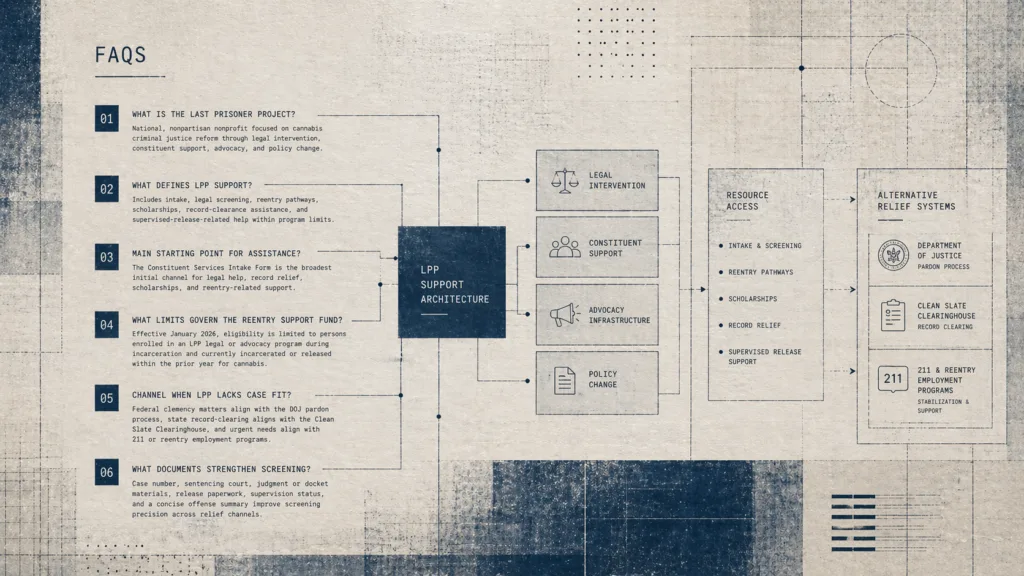
FAQs
The Last Prisoner Project is a national, nonpartisan nonprofit focused on cannabis criminal justice reform through legal intervention, constituent support, advocacy activity, and policy change.
Support structure includes general intake, legal screening, selected reentry pathways, scholarship access points, record-clearance assistance, and supervised-release-related help within program limits.
The Constituent Services Intake Form functions as the broadest initial channel because it routes requests involving legal help, record relief, scholarships, and reentry-related support.
Effective January 2026, public eligibility language limits the fund to persons enrolled in an LPP legal or advocacy program during incarceration and currently incarcerated or released within the prior year for cannabis.
Federal clemency matters align with the Department of Justice pardon process, state record-clearing matters align with the Clean Slate Clearinghouse, and urgent stabilization needs often align with 211 or reentry employment programs.
Case number, sentencing court, judgment or docket materials, release paperwork, supervision status, and a concise offense summary usually improve screening precision across nonprofit and official relief channels.
Conclusion
The Last Prisoner Project functions most accurately as a specialized cannabis justice gateway with both advocacy significance and conditional practical utility. Organizational materials show meaningful entry points for legal screening, reentry orientation, and selected support access, yet those pathways operate within clearly bounded eligibility rules. Analytical value therefore lies in understanding both organizational purpose and operational limits.
A strong resource map begins with cannabis-specific intake and expands outward when case posture requires additional systems. Federal clemency channels, state record-clearing frameworks, housing-support navigation, and employment resources supply the broader relief architecture that many cases require. The most useful outcome is not simple organizational description but procedural alignment between need category, eligibility status, and relief mechanism.
Use the Last Prisoner Project Constituent Services Intake Form, the Reentry Support Fund page, and the Clean Slate Clearinghouse as the core comparison set for relief-pathway selection.
- Last Prisoner Project Constituent Services Intake Form
- Last Prisoner Project Reentry Services
- Last Prisoner Project Reentry Support Fund
- Last Prisoner Project Loved-Ones Legal Questionnaire
- Last Prisoner Project Impact
- U.S. Department of Justice Clemency Applications
- Clean Slate Clearinghouse
- Clean Slate State Search
- Clean Slate Find a Lawyer
- Clear My Record
- California Courts Proposition 64 Marijuana Conviction Relief
- 211
- CareerOneStop Reentry Finder
More on The Last Prisoner Project
Explore The Last Prisoner Project from every angle: