
Last Prisoner Project and the Paths Families Took Toward Relief and Reentry
The Last Prisoner Project became part of a longer story that families had already been living through. Even after cannabis laws had changed, many people still carried older convictions, supervised-release terms, and the strain that had settled across parents, partners, children, and close friends. In those years, the search for relief rarely followed one clear path, and many families moved from one resource to another while trying to rebuild stability together.
Its mission had focused on repairing the harms of cannabis criminalization through legal help, advocacy, and support programs. In practice, that work had taken shape across many situations. Some people had needed release, others had needed record relief, and many had needed help during the first difficult stretch after returning home.
In this article
- How the Last Prisoner Project became part of a shared story of cannabis justice and family repair
- How the Last Prisoner Project support path moved through intake, screening, and changing program limits
- How Last Prisoner Project resources gave families and friends a starting point
- How other relief paths helped when Last Prisoner Project did not fit the situation
For many people, the Last Prisoner Project first appeared in stories about individuals who remained incarcerated for cannabis while laws had already changed elsewhere. Over time, its work showed a broader pattern. It treated incarceration, records, and reentry challenges as connected, and that view matched what families had already experienced across years of disruption.
Legalization did not remove those earlier consequences. Old convictions continued to affect jobs, housing, and daily life, and those effects were often shared across households. Because of that, understanding the Last Prisoner Project required more than a definition. It required seeing how its support system worked and how it fit into a wider network of help.
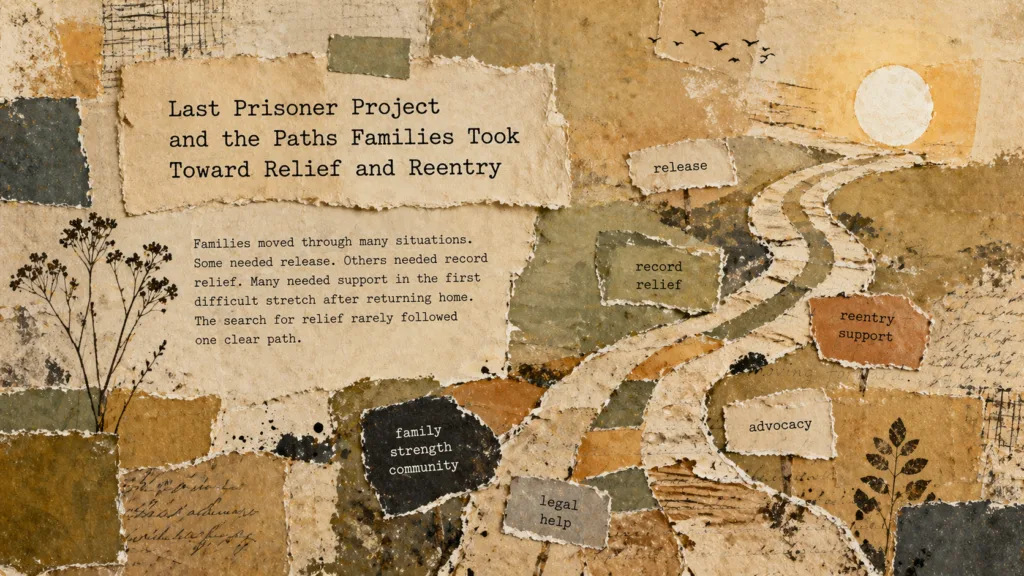
The Last Prisoner Project became one part of how families worked through the long effects of cannabis convictions
The organization described itself as a national nonprofit focused on cannabis criminal justice reform. Its work had centered on release, record clearing, and reentry support. In practice, those areas often overlapped, and families experienced them as part of the same process of rebuilding after years of legal and social strain.
How the Last Prisoner Project became part of a shared story of cannabis justice and family repair
The Last Prisoner Project had framed its work around three connected needs: release, record relief, and reentry. That structure reflected what many people had already experienced. Leaving prison did not end the impact of a case, and records often continued shaping work, housing, and relationships long after release.
Its programs combined legal action with broader advocacy. Clemency efforts, policy work, and direct support all appeared in its materials, showing that the organization worked across both individual cases and larger systems. For many families, it became one place where those different needs met.
The group also described itself as a coalition of attorneys, advocates, and people directly affected by the justice system. That mix explained why some support came through direct help, while other cases moved through screening or referral. It reflected a shared effort rather than a single service model.
The broader context also mattered. The supplied material noted that Black people were 3.6 times more likely than White people to be arrested for marijuana possession. That pattern shaped how the effects of cannabis enforcement had been distributed across communities, and why the work of repair had remained ongoing.
How the Last Prisoner Project support path moved through intake, screening, and changing program limits
For most people, the starting point had been the Constituent Services Intake Form. The organization described it as a general entry point for requests related to legal help, record clearing, scholarships, and reentry support. It also noted that submitting a request did not guarantee approval.
Over time, some programs became more limited. The reentry pages described financial and educational support, but the Reentry Support Fund page explained that, as of January 2026, grants were limited to people who had already been enrolled in LPP programs during incarceration and who were still incarcerated or recently released.
That shift changed expectations for many families. While the mission remained broad, access to specific programs depended on eligibility rules. At the same time, other forms of support, such as legal screening or scholarships, could still apply even when grant programs did not.
The materials also noted that family support grants for dependents were no longer offered through that application. For families managing early reentry challenges, that change often meant turning to additional resources while continuing to explore LPP options.
A separate path existed for loved ones seeking legal help. The questionnaire for friends and family members allowed someone to request support on behalf of another person, with criteria focused on cannabis-related offenses and current incarceration or supervised release.
How Last Prisoner Project resources gave families and friends a starting point
The most widely used entry point had been the general intake form. It allowed people to begin the process even when they were unsure which type of support applied to their situation. For many, that first step mattered more than immediate answers.
The Reentry page helped explain how the organization approached rebuilding after incarceration. It described support connected to education, employment, and stability, giving context before people reviewed stricter eligibility rules.
The Reentry Support Fund page provided the most current details about who qualified for financial support. While it limited access to certain applicants, it also pointed toward other opportunities, including scholarships and legal pathways.
The loved-ones questionnaire served families and friends who were helping someone else. It required basic case details, such as court information and status, and reflected how often support efforts were shared across relationships.
The organization’s impact pages also helped set expectations. They described outcomes such as years of prison time reduced, offenses cleared, and funds distributed, offering a broader view of how the work had unfolded over time.
How other relief paths helped when Last Prisoner Project did not fit the situation
When LPP did not match a case, other paths often became important. For federal cases, the DOJ Office of the Pardon Attorney provided clemency applications, with separate processes for pardons and commutations.
For state-level record clearing, the Clean Slate Clearinghouse offered tools to understand different forms of relief. Its state guides and lawyer finder helped people identify options based on location.
In California, Clear My Record and the state court self-help pages provided more direct local support. These resources helped people move from general information to specific steps.
For immediate needs after release, 211 often became a key resource. It connected people to housing, food, health care, and other services, which were often the most urgent concerns.
Employment support also played a role. CareerOneStop’s reentry finder helped locate job and training programs, which could support longer-term stability.
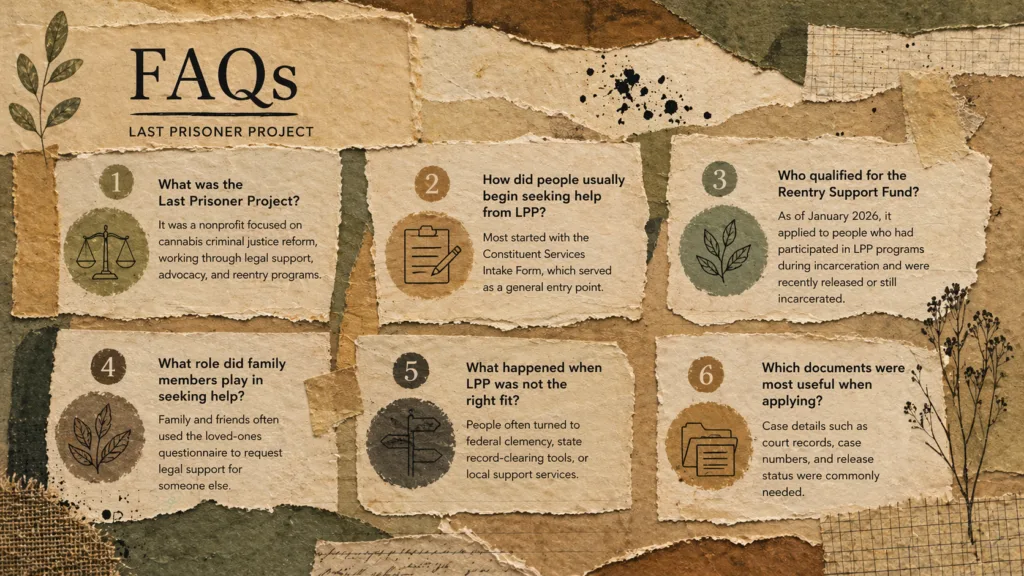
FAQs
It was a nonprofit focused on cannabis criminal justice reform, working through legal support, advocacy, and reentry programs.
Most started with the Constituent Services Intake Form, which served as a general entry point.
As of January 2026, it applied to people who had participated in LPP programs during incarceration and were recently released or still incarcerated.
Family and friends often used the loved-ones questionnaire to request legal support for someone else.
People often turned to federal clemency, state record-clearing tools, or local support services.
Case details such as court records, case numbers, and release status were commonly needed.
The paths families took often extended beyond one organization and into a wider network of support
Many families began with the Last Prisoner Project and then continued through other support paths that matched their situation.
- Last Prisoner Project Constituent Services Intake Form
- Last Prisoner Project Reentry
- Last Prisoner Project Reentry Support Fund
- Last Prisoner Project Loved-Ones Legal Questionnaire
- U.S. Department of Justice Office of the Pardon Attorney
- Clean Slate Clearinghouse
- Clean Slate State Search
- Clean Slate Find a Lawyer
- Clear My Record
- 211
- CareerOneStop Reentry Finder
More on The Last Prisoner Project
Explore The Last Prisoner Project from every angle: