
Last Prisoner Project Still Exists Because Cannabis Justice Keeps Failing You
You keep hearing that cannabis reform fixed the problem. It did not. People are still locked up, still dragged down by records, still blocked from work, housing, and stability while systems pretend progress already happened.
The Last Prisoner Project exists because that failure is still happening right now. It steps in with legal help, advocacy, and reentry support, but it does not fix everything and it does not reach everyone. You need to understand exactly what it does, where it helps, and where it stops so you do not waste time chasing the wrong path while the system keeps grinding people down.
In this article
- The Last Prisoner Project Exists Because Cannabis Justice Still Leaves You Stuck
- Last Prisoner Project Support Looks Open Until The Rules Shut You Out
- These Last Prisoner Project Links Matter Because You Do Not Have Time To Guess
- When Last Prisoner Project Cannot Help You, You Need Another Path Immediately
The Last Prisoner Project calls itself a national nonprofit focused on cannabis criminal justice reform. That sounds clean, but the reality it responds to is not clean. People are still dealing with incarceration, criminal records, supervised release, and the fallout that keeps hitting long after a sentence ends.
You do not get relief just because laws change somewhere. The organization’s own framing makes that clear. It focuses on release, record clearance, and reentry because those harms stack on top of each other. If you ignore one piece, the rest keeps hurting people.
This is not just advocacy. The Last Prisoner Project operates across legal intervention, policy change, and direct support. That mix matters because people need real outcomes, not just statements. But it also means access runs through rules, screening, and limits that you need to understand before you depend on it.

The Last Prisoner Project Sits Inside A System That Still Punishes You For Cannabis
You cannot treat the Last Prisoner Project like a guaranteed solution. It is a pressure point inside a broken system, not a replacement for it. That means you can use it, but you also need to see exactly where it works and where it stops before the system blocks you again.
The Last Prisoner Project Exists Because Cannabis Justice Still Leaves You Stuck
The Last Prisoner Project defines its mission around ending cannabis criminalization and repairing the damage that policy caused. That damage is not theoretical. It shows up as prison time, criminal records, and unstable reentry that keeps people locked out of basic survival.
You do not leave prison and suddenly get a clean slate. The record follows you, the stigma follows you, and systems keep denying access to work and housing. That is exactly why the organization focuses on release, record clearance, and reentry at the same time. The harm does not stop, so the response cannot stop either.
The organization also works through legal intervention, clemency efforts, advocacy, and support programs. That structure exists because the system is layered and resistant to change. If one path fails, another path has to exist or people get stuck again.
It also operates as a coalition of attorneys, advocates, and justice-impacted people. That matters because it shows how the work actually happens. Some cases get direct help, some get screened, and some get pushed into broader legal or policy efforts. You need to understand that split so you do not assume every case gets the same outcome.
Last Prisoner Project Support Looks Open Until The Rules Shut You Out
The main entry point is the Constituent Services Intake Form. This is where you ask for help with reentry support, record clearance, scholarships, or legal assistance. It looks like an open door, and for many people it is the only place to start.
But this is where people lose time if they do not read closely. Submitting that form does not guarantee anything. Every request goes through program guidelines, and those guidelines can block you even when the need is real.
The reentry system shows this clearly. The organization describes financial and educational support for people rebuilding after incarceration, including pathways into employment. Then the eligibility rules cut that down. As of January 2026, the Reentry Support Fund only accepts people who were already enrolled in its programs during incarceration and who are still incarcerated or were released within the past year for cannabis.
That restriction matters because it leaves people out. You can still carry the same damage and not qualify. That is not a small gap. That is exactly where people get stuck again if nobody explains it directly.
The context makes it worse. Black people are 3.6 times more likely than White people to be arrested for marijuana possession. That means the system already hits certain people harder, and limited access to support can reinforce that damage instead of fixing it.
The same application no longer offers family support grants for dependents. That removes another layer of support people expect to find. You cannot assume anything is available. You have to check every rule before you depend on it.
There are still other paths inside the organization. Some people may qualify for legal screening, scholarships, or help with supervised release even if they do not qualify for grants. There is also a legal questionnaire for someone trying to help another person navigate incarceration or supervised release issues. That form has strict criteria, and it does not guarantee legal support either.
These Last Prisoner Project Links Matter Because You Do Not Have Time To Guess
The Constituent Services Intake Form is the first move because it covers multiple types of support. You use it when you do not yet know whether the problem is legal, financial, or tied to reentry barriers. Starting anywhere else can waste time.
The Reentry page explains how the organization defines reentry support and what types of help exist. You use it to understand the structure, not to assume eligibility. That distinction matters because misunderstanding this page leads people straight into dead ends.
The Reentry Support Fund page gives the real rules. It states clearly who qualifies under the current system and who does not. It also points toward other options like scholarships or supervised release help. You need that clarity before you rely on any program.
The loved-ones legal questionnaire is the direct path when someone is trying to get legal help for another person. It requires detailed information like case numbers, court details, and custody status. If you do not have those details ready, you slow the process down and risk losing momentum.
The organization’s impact data shows scale. It reports over 400 years of prison time saved, more than 250,000 cannabis offenses cleared, and $3.8 million directed to people impacted by criminalization. Those numbers matter, but they do not guarantee access. You still have to move through the system as it exists right now.
When Last Prisoner Project Cannot Help You, You Need Another Path Immediately
You cannot wait for one organization to solve everything. If the Last Prisoner Project does not fit your case, you need to move fast to another path that matches the problem.
For federal cases, the U.S. Department of Justice Office of the Pardon Attorney provides clemency applications. You have to choose between pardon and commutation based on your situation. If you choose wrong, you slow your own case down.
For state record relief, the Clean Slate Clearinghouse provides tools to find expungement, sealing, or other options based on the state. People lose time when they do not understand what their state actually allows.
For California cases, Clear My Record and the state courts’ marijuana conviction relief tools under Proposition 64 give direct starting points. These tools help you understand eligibility and next steps instead of guessing.
Sometimes the immediate problem is survival, not paperwork. 211 connects people to housing, food, health care, and other essential services. It receives more requests for housing and financial help than anything else, which shows how unstable reentry can become.
Employment support also matters. CareerOneStop’s reentry finder helps locate job and training programs for people with records. Stable work strengthens everything else, including legal efforts and supervision outcomes.
The strongest approach is layered. One intake, one legal path, and one survival or employment resource. If you wait for one solution to fix everything, you lose time and the system keeps pushing back.
FAQs
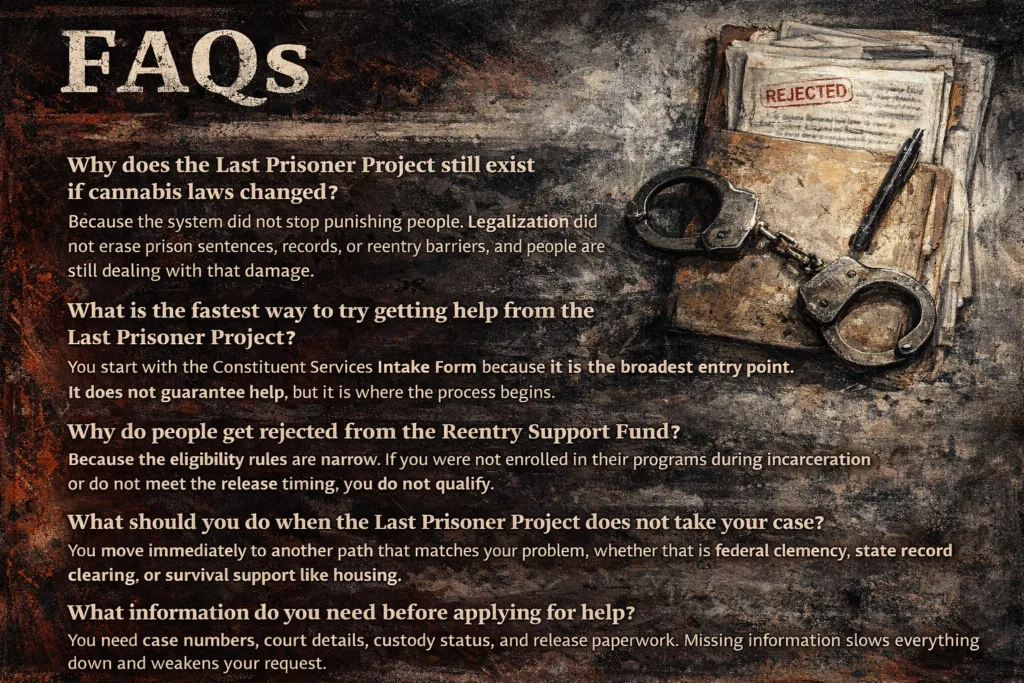
Because the system did not stop punishing people. Legalization did not erase prison sentences, records, or reentry barriers, and people are still dealing with that damage.
You start with the Constituent Services Intake Form because it is the broadest entry point. It does not guarantee help, but it is where the process begins.
Because the eligibility rules are narrow. If you were not enrolled in their programs during incarceration or do not meet the release timing, you do not qualify.
You move immediately to another path that matches your problem, whether that is federal clemency, state record clearing, or survival support like housing.
You need case numbers, court details, custody status, and release paperwork. Missing information slows everything down and weakens your request.
No. It also focuses on record clearance, reentry support, and policy change because the harm continues after release.
The Last Prisoner Project Exists Because The System Still Has Not Fixed The Damage
You start with the Last Prisoner Project, but you do not stop there because waiting inside one system will not protect you from the next barrier.
More on Last Prisoner Project
Explore Last Prisoner Project from every angle: