
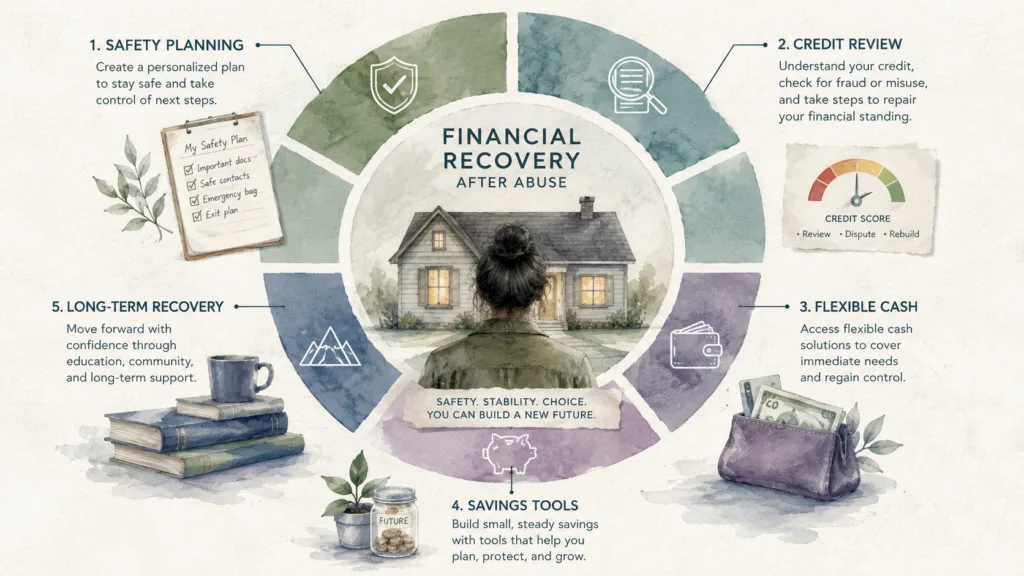
Financial abuse help belongs inside domestic violence response because economic control can restrict housing, transportation, employment, childcare, healthcare, documents, bank access, and credit standing. Money functions as safety infrastructure when access to basic needs depends on income, savings, accounts, and financial records.
Financial abuse means control through money, work, debt, credit, bank access, transportation, housing, or financial documents. The pattern can appear through ordinary household systems before becoming severe. Restricted access to income, accounts, documents, credit, or transportation can limit safe decisions and long-term recovery.
FreeFrom identifies financial insecurity as the leading obstacle to safety for abuse-affected households. FreeFrom resources focus on financial security before, during, and after crisis through flexible cash, savings tools, financial education, coaching, and recovery resources.
In this article
- Financial Abuse Help Signs
- Money Barriers to Safety
- Safe Financial Planning
- FreeFrom Financial Resources
Financial abuse often develops through bank accounts, paychecks, bills, credit cards, phone plans, leases, car access, and identity documents. Control appears when access, consent, visibility, or choice disappears from those systems. The harm becomes practical, not abstract, because daily safety depends on money and records.
Economic control can create dependence through restricted spending, blocked work, forced debt, missing documents, monitored purchases, or damaged credit. These conditions can affect housing applications, utility accounts, employment stability, childcare access, healthcare access, and transportation. Financial abuse help therefore requires safety planning, privacy protection, cash access, debt review, credit recovery, and long-term stability tools.
Financial Abuse Help and Safety Planning
Financial abuse help connects safety planning with economic capacity. Safe separation often depends on rent, food, transportation, childcare, phone service, medical care, legal costs, and replacement documents. Without economic access, safety planning can remain incomplete.
A strong response treats financial stability as a core safety condition. Flexible funds, secure records, careful credit review, protected communication, and recovery planning reduce exposure to continued control. Effective help respects different expenses, different timelines, and different safety risks.
Financial Abuse Help Signs
Financial abuse signs include control over income, employment, debt, credit, banking access, transportation, housing, and financial documents. These signs belong within coercive control because economic restriction can limit independent decisions across time. The control pattern can exist alongside physical, emotional, legal, digital, or housing-related abuse.
Common signs include paycheck seizure, employment interference, restricted bank access, monitored purchases, forced debt, hidden records, transportation denial, and withheld funds for necessities. Additional signs include missing documents, locked accounts, unpaid shared bills, unfamiliar loans, unauthorized credit cards, or pressure to sign financial agreements. Each sign shows reduced financial choice or reduced financial visibility.
Control can begin through routine financial management. One household member may take over bills, banking, passwords, budgets, documents, or account notices under a practical explanation. Over time, financial access can narrow until income, statements, records, transportation, and work options become difficult to control independently.
Economic abuse can continue after separation through shared debt, unpaid bills, coerced loans, identity misuse, collections, court costs, and damaged credit. These harms can affect rental applications, utility accounts, employment screening, childcare arrangements, medical access, and transportation. Continued financial damage explains why recovery tools matter beyond immediate crisis response.
FreeFrom describes economic abuse as a core abuse tactic rather than a side issue. Source examples include unsafe bank access, work prevention, and debt placed in a survivor’s name without knowledge. Accurate recognition can turn confusing financial restriction into documented economic harm.
Money Barriers to Safety
Leaving abuse can create immediate costs. Emergency housing, food, transportation, childcare, legal assistance, medical care, secure phone access, internet access, and replacement identification all require money or coordinated resources. Safety becomes more difficult when basic expenses and private communication remain controlled.
A separation plan often depends on available cash. Restricted accounts, damaged credit, blocked transportation, missing documents, and lost income can prevent safe movement from danger to stability. Financial abuse help must address the practical gap between safety need and available resources.
The supplied FreeFrom content states that abuse-affected households report an average need of one thousand five hundred sixty-seven dollars to make ends meet and stay safe. The same source states that available savings may be ten dollars, with less than three hundred dollars under sole access. That gap shows why flexible financial help can determine practical safety.
Flexible support matters because safety expenses vary. A deposit, car repair, phone bill, hotel room, grocery order, childcare payment, medical visit, utility bill, or ride to court can become the highest-priority expense. Rigid aid categories can miss the cost most connected to safety.
Employment disruption can increase the financial barrier. Work prevention, stalking, harassment, missed shifts, transportation limits, childcare instability, or workplace interference can reduce wages and job stability. FreeFrom policy work connects safety with stable income, safe work, and protection from retaliation or job loss.
Housing creates another pressure point. Rental applications, utility accounts, mortgages, and loans often depend on income, credit history, and debt status. Coerced debt, identity misuse, unpaid shared bills, or damaged credit can block independent housing during a critical safety period.
Safe Financial Planning
Financial planning requires caution when monitoring exists. Phones, email accounts, banking apps, shared devices, cloud accounts, GPS tools, payment apps, account alerts, and mail can expose private activity. A privacy review can reduce risk before changes to passwords, accounts, documents, or credit records.
Advocacy guidance can support safer planning before major financial or legal changes. The safest sequence depends on device access, account access, transportation, document control, mail delivery, and monitoring risk. Financial safety planning works best when privacy and timing receive careful attention.
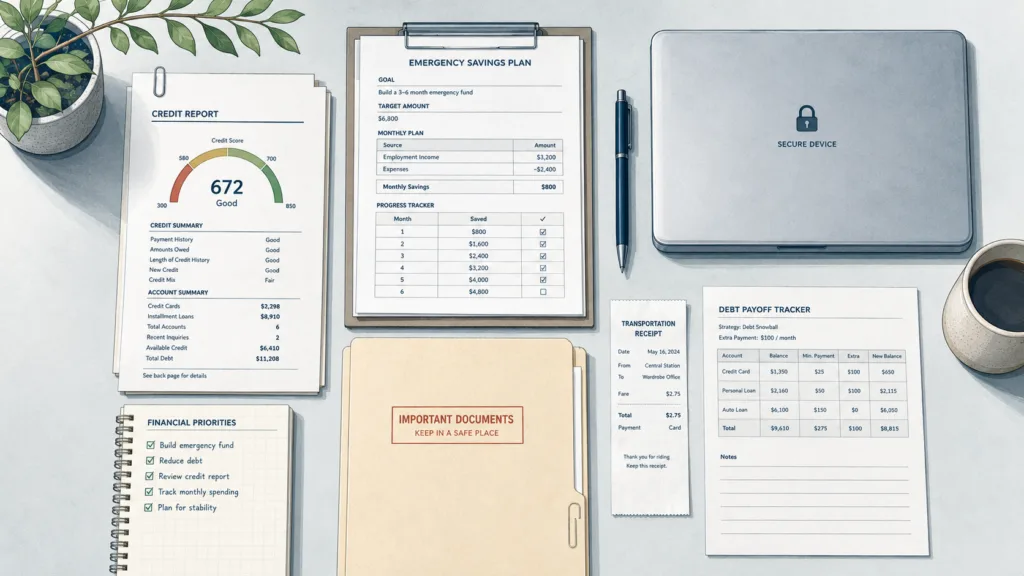
A financial safety plan can include a private email account, password updates, identification document copies, financial record copies, account review, debt documentation, credit report checks, and separate account creation only under safe conditions. Important documents include driver’s license, passport, Social Security card, birth certificates, immigration documents, insurance cards, pay stubs, tax records, court papers, leases, bank statements, loan records, and benefit information.
Technology safety belongs inside financial safety. Shared phone plans, banking notifications, payment apps, cloud backups, location tools, browser histories, and connected devices can reveal preparation steps. Safer device access, secure storage, trusted mailing address selection, and careful account changes can reduce exposure.
Credit review can identify hidden financial harm. Financial abuse can involve coerced loans, unauthorized credit cards, unpaid bills, utility accounts, medical debt, collections, or identity misuse. Credit reports can reveal unfamiliar accounts, late payments, collection entries, and debt requiring documentation.
Financial recovery usually occurs in stages. Immediate needs can include food, shelter, transportation, communication access, essential documents, and urgent safety expenses. Later needs can include savings reconstruction, credit repair, stable employment, coerced debt response, benefits navigation, housing applications, and legal guidance.
FreeFrom Financial Resources
FreeFrom provides financial abuse help through resources focused on economic security after gender-based violence. Program areas include flexible cash assistance, savings support, financial education, community financial coaching, compensation guidance, research, and policy advocacy. The resource model treats economic stability as part of safety.
FreeFrom’s Safety Fund offers flexible cash assistance without restrictive spending categories. Source examples include rent, utilities, car expenses, healing resources, and other safety-related costs. Flexible cash can fit the expense most connected to immediate stability.
FreeFrom’s Savings Matching Program supports emergency savings. The supplied content describes dollar-for-dollar matching up to fifty-five dollars per month, plus a one hundred twenty dollar bonus, for up to one thousand four hundred forty dollars across a year. Savings support can reduce debt reliance and strengthen housing or transportation continuity.
Financial education and coaching can support longer recovery. Budget review, credit review, debt documentation, savings planning, and compensation guidance can help organize financial harm after abuse. FreeFrom’s Resource Hub adds online access to financial stability information.
The supplied content states that being a survivor costs an average of one hundred four thousand dollars in medical costs and lost productivity over a lifetime. That figure shows why short-term crisis support alone remains incomplete. Long-term recovery can require cash, savings, credit repair, employment stability, housing access, healthcare access, and legal support.
Additional national resources can complement FreeFrom materials. The National Domestic Violence Hotline provides confidential safety planning and referrals. The Consumer Financial Protection Bureau offers financial safety information involving debt, credit, banking, records, and recovery. The National Network to End Domestic Violence provides economic justice information and policy resources.
FAQs
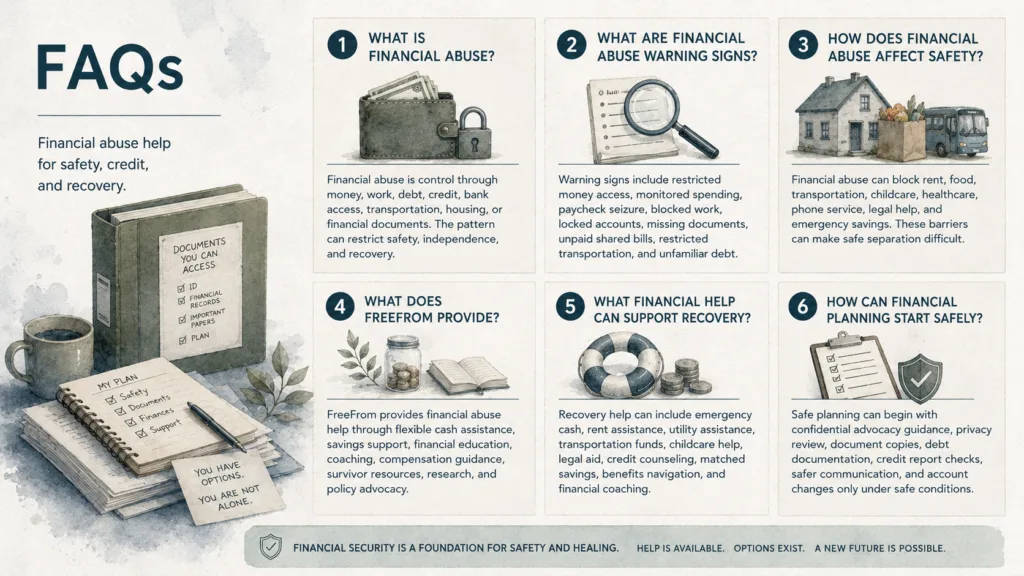
Financial abuse is control through money, work, debt, credit, bank access, transportation, housing, or financial documents. The pattern can restrict safety, independence, and recovery.
Warning signs include restricted money access, monitored spending, paycheck seizure, blocked work, locked accounts, missing documents, unpaid shared bills, restricted transportation, and unfamiliar debt.
Financial abuse can block rent, food, transportation, childcare, healthcare, phone service, legal help, and emergency savings. These barriers can make safe separation difficult.
FreeFrom provides financial abuse help through flexible cash assistance, savings support, financial education, coaching, compensation guidance, survivor resources, research, and policy advocacy.
Recovery help can include emergency cash, rent assistance, utility assistance, transportation funds, childcare help, legal aid, credit counseling, matched savings, benefits navigation, and financial coaching.
Safe planning can begin with confidential advocacy guidance, privacy review, document copies, debt documentation, credit report checks, safer communication, and account changes only under safe conditions.
Financial Abuse Help Supports Safety and Stability
FreeFrom survivor resources offer financial abuse recovery tools, savings support, education, and economic assistance resources.
- FreeFrom Survivor Resources: Financial assistance, savings tools, coaching, and survivor-centered resources.
- FreeFrom Get Involved: Donation, Gifted shopping, advocacy, and organizational connection resources.
- National Domestic Violence Hotline: Confidential safety planning, support, and referral resources for abuse-related situations.
- National Network to End Domestic Violence Economic Justice: Economic abuse information, financial safety resources, and policy material.
More on FreeFrom
Explore FreeFrom from every angle: