
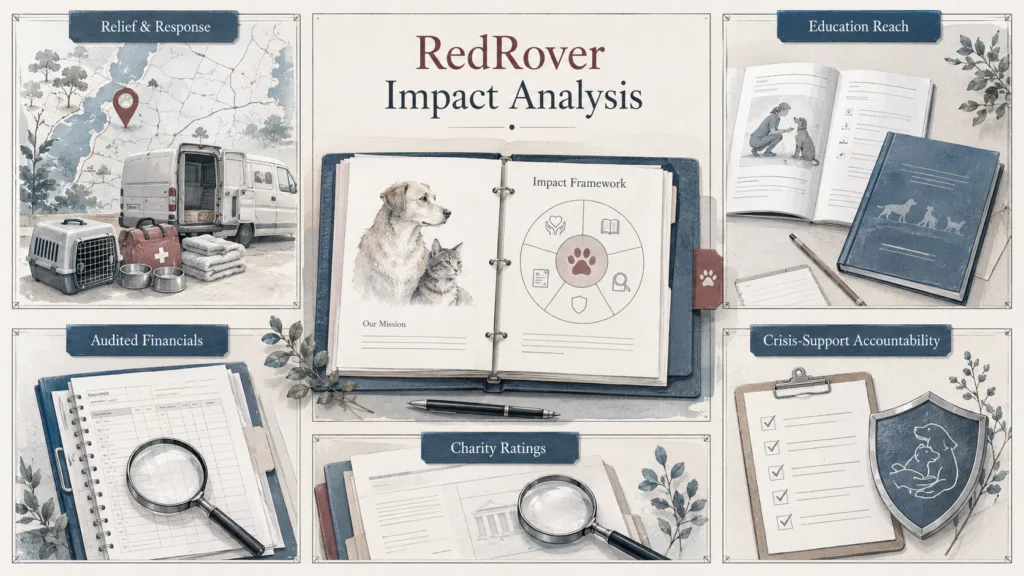
RedRover impact appears through crisis relief, animal response capacity, humane education reach, financial reporting, and independent charity review. Public figures show program scale, service activity, and stewardship signals. Clear analysis requires separation between reach, spending, readiness, and outcome evidence.
RedRover reports children reached through RedRover Readers, pets and households supported through RedRover Relief, trained Responders ready for crisis care, and children reached through Kind News. These measures do not describe one single result. Each figure shows a different part of the organization’s work across animal welfare and human crisis support.
In this article
- RedRover Impact Numbers
- RedRover Relief and Response
- RedRover Financial Data
- RedRover Impact Meaning
RedRover functions as a hybrid animal welfare organization. Program activity includes direct relief, volunteer response, domestic violence sheltering support, public education, and humane education. That structure creates a broad impact model with several types of evidence.
Reach numbers show scale. Financial numbers show resource allocation. Response numbers show readiness for animal crisis care. Outcome signals require evidence connecting support with lasting changes for animals, households, shelters, and communities.
A useful RedRover impact review separates these evidence types before drawing conclusions. Education reach shows prevention-oriented exposure. Relief and response data show crisis support. Audited financials and charity ratings add accountability context.

RedRover Impact Overview
RedRover impact data works best as a layered evidence model. Magazine reach, curriculum reach, relief assistance, responder readiness, and expense allocation answer different questions. Combining those measures without distinction can blur the meaning of impact.
The strongest reading treats each program line as a separate signal. Education supports awareness. Relief supports urgent needs. Responders support crisis capacity. Financial reporting supports public accountability.
RedRover Impact Numbers
RedRover impact numbers show activity across education, relief, and crisis response. The largest reported figure comes from Kind News magazine, with 2,087,350 children reached. This number reflects humane education exposure rather than direct crisis intervention.
RedRover Readers represents a separate education measure. RedRover reports 136,613 children reached through this curriculum-based program. This figure suggests deeper structured learning than broad magazine distribution.
RedRover Relief shows a more direct assistance measure. RedRover reports 28,285 pets and associated households supported through relief programs. This figure connects with urgent needs such as veterinary care, emergency support, and domestic violence-related pet safety.
RedRover Responders adds a capacity measure. RedRover reports more than 4,700 Responders ready to care for animals in crisis. This number shows trained volunteer availability, not annual deployment volume.
Together, these numbers describe a multi-part impact model. Kind News shows broad education reach. RedRover Readers shows curriculum reach. RedRover Relief shows direct support volume. RedRover Responders shows readiness for emergency animal care.
The main point is classification. Education figures should not be treated as relief outcomes. Responder capacity should not be treated as animals served. Each figure gains meaning through the program category attached to the number.
RedRover Relief and Response
RedRover Relief provides the clearest direct-service signal. The reported figure of 28,285 pets and associated households supported shows meaningful crisis assistance volume. This number counts activity, not long-term outcome completion.
Relief support can affect access to veterinary care, pet retention during financial hardship, and safety planning during domestic violence. These effects matter because animal care often connects with household stability. Still, the number does not show full recovery, durable housing, or long-term safety after assistance.
RedRover Responders should be read as emergency capacity. More than 4,700 trained Responders means RedRover maintains a large volunteer base for crisis conditions. Full deployment by every responder in a single year is not implied by the figure.
The annual reporting example adds a field-activity signal. Early 2025 response work spans five states and serves 760 animals. Activities include trap-neuter-vaccinate-return services, mobile veterinary care, safe outside-dog enclosures, and community veterinary support.
This example shows how trained capacity becomes direct service. Responders create readiness before crisis events. Partnerships, funding, local need, and volunteer deployment convert readiness into animal care.
RedRover Relief and RedRover Responders also connect animal welfare with human crisis systems. Pet safety can influence emergency shelter access, domestic violence escape planning, and household decision-making during financial distress. That connection gives RedRover impact significance beyond animal services alone.
RedRover Financial Data
RedRover financial data adds accountability context to impact claims. The financials page states that, in 2025, 78% of expenses go toward direct program offerings. Supporting services account for 22%.
Audited financial statements add a stronger verification layer. The independent audit states that the 2024 and 2023 financial statements present fairly, in all material respects, the organization’s financial position and activities under United States generally accepted accounting principles. The audit also identifies the legal entity as United Animal Nations, doing business as RedRover.
The 2024 functional expense statement lists total expenses of $6,291,831. Program service categories include RedRover Relief, advocacy, public education and outreach, RedRover Responders, and RedRover Readers. Supporting services include fundraising plus management and general expenses.
RedRover Relief is the largest program expense category in the audit. The amount listed is $2,837,890. This allocation aligns with the organization’s direct-aid impact position.
Other program expenses add context. Advocacy, public education, and outreach total $858,713. RedRover Responders total $756,946. RedRover Readers total $523,161.
Supporting service expenses include fundraising at $921,622 and management and general expenses at $393,499 . These categories help compare mission delivery with operating support. Financial allocation supports stewardship analysis, not automatic outcome proof.
Volunteer value also matters. The audit notes extensive volunteer hours for RedRover Responders and RedRover Readers that do not appear inside the financial statements. Estimated fair market value equals $102,379 in 2024 and $94,732 in 2023.
CharityWatch adds external review context. CharityWatch assigns RedRover an A-minus rating in October 2024 and reports a 77% program percentage based on fiscal year 2023. CharityWatch also reports a cost of $8 to raise $100, which measures fundraising efficiency rather than program outcome quality.
RedRover Impact Meaning
RedRover impact is strongest as a combined model of relief, response, education, and stewardship. The evidence does not point to one narrow service model. Instead, RedRover works across several points where animal welfare and human crisis overlap.
The broadest scale signal comes from education. Kind News reaches more than 2,000,000 children, creating large-scale humane education exposure. RedRover Readers adds a curriculum-based education channel with a smaller but more structured reach.
The strongest direct-service signal comes from RedRover Relief. Relief support connects funds and assistance with urgent animal and household needs. This program category provides the closest link between donor resources and immediate crisis support.
The strongest capacity signal comes from RedRover Responders. A large responder base creates readiness for disaster support, emergency sheltering, cruelty response, and community animal-care operations. Specific deployments then show how that readiness becomes field activity.
The strongest accountability signal comes from audited financials, public Form 990 access, and third-party review. Program expense ratios, functional expense categories, audit findings, and charity ratings help evaluate organizational stewardship. These measures strengthen trust in reported activity.
The main limitation is outcome depth. Public numbers show reach, spending, assistance, and readiness with more clarity than long-term change. Missing outcome areas include animal recovery after treatment, survivor safety after pet-safe sheltering, household stability after aid, and community preparedness after response events.
Even with that limitation, available reporting supports a clear impact picture. RedRover converts donations, volunteer capacity, grants, education materials, and partnerships into crisis support for animals and pet households. The impact model is broad, measurable, and strongest when each evidence type remains separate.
FAQs
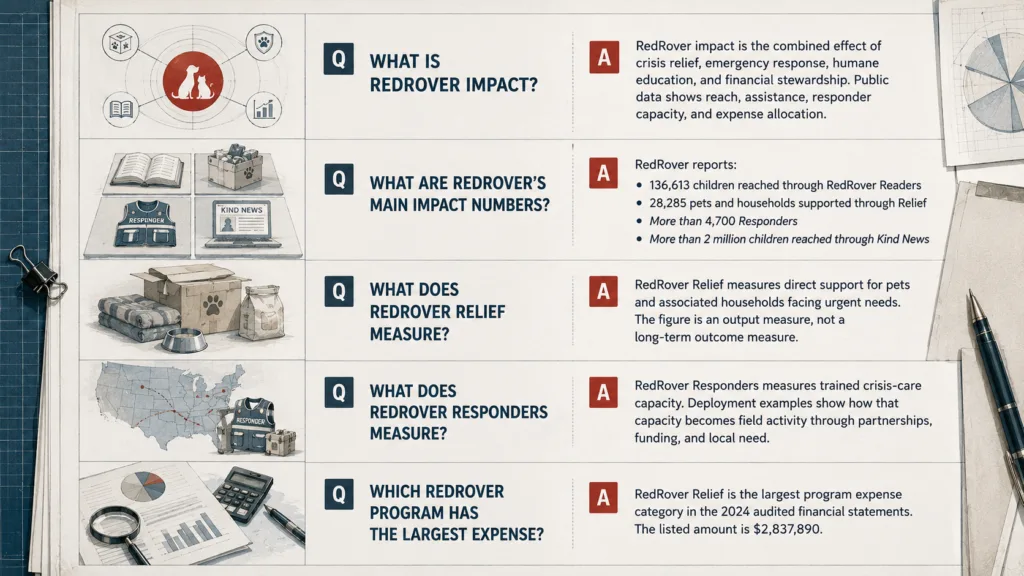
RedRover impact is the combined effect of crisis relief, emergency response, humane education, and financial stewardship. Public data shows reach, assistance, responder capacity, and expense allocation.
RedRover reports 136,613 children reached through RedRover Readers, 28,285 pets and households supported through Relief, more than 4,700 Responders, and more than 2,000,000 children reached through Kind News.
RedRover Relief measures direct support for pets and associated households facing urgent needs. The figure is an output measure, not a long-term outcome measure.
RedRover Responders measures trained crisis-care capacity. Deployment examples show how that capacity becomes field activity through partnerships, funding, and local need.
RedRover Relief is the largest program expense category in the 2024 audited financial statements. The listed amount is $2,837,890.
RedRover Impact Shows a Layered Support Model
Review RedRover impact data, audited financials, annual reporting, and charity ratings to compare reach, spending, response capacity, and crisis-support evidence.
More on RedRover
Explore RedRover from every angle: