

Reproductive Rights Resources: Stop Guessing and Find Help
You cannot afford to guess when reproductive rights resources decide your next move. Laws change, access gets blocked, and people get trapped when systems stay vague. You need the law, the care route, the funding path, and the legal help source separated clearly.
The Center for Reproductive Rights helps you understand the law. It offers maps, court tracking, policy resources, and human rights analysis. It does not provide abortion care, clinic appointments, abortion funding, or individual legal advice in most cases. That distinction matters because confusion wastes time people may not have.
In this article
- Reproductive Rights Resources Show What the Law Actually Says
- Abortion Law Maps Show Where Access Is Under Attack
- Abortion Care, Funding, and Legal Help Come From Direct-Service Groups
- Start With the Reproductive Rights Resources That Match Your Risk
You may need reproductive rights resources for two different reasons. One reason is legal clarity. The other is practical help. Mixing those up creates a damn maze for people who already face pressure.
The Center for Reproductive Rights fits the legal clarity side. It uses litigation, policy work, and human rights law to protect reproductive rights worldwide. Its site helps you understand abortion laws by state, global abortion law, state constitutional issues, and court cases.
That work matters. But it is not the same as finding a provider, paying for care, or getting urgent legal support. This guide keeps those roles separate so you do not waste time in the wrong place.
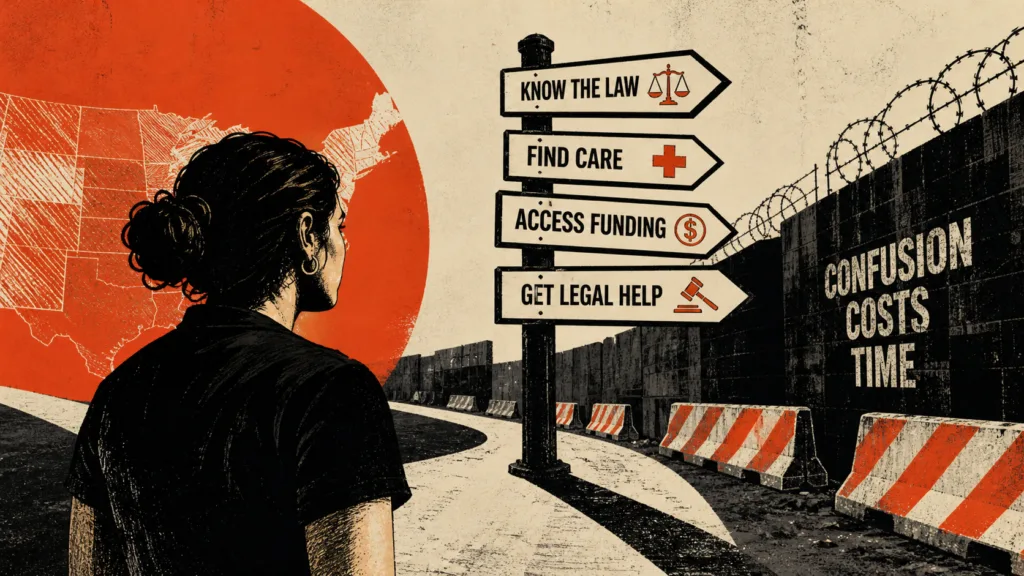
Know Which Resource Helps Before You Waste Time
Reproductive rights resources do not all solve the same problem. The Center for Reproductive Rights is a legal and policy organization, not a direct healthcare provider. Its work focuses on courts, laws, human rights bodies, and policy systems that shape reproductive healthcare access.
Use the Center when you need maps, case updates, legal summaries, reports, and explainers. Do not use it as a substitute for abortion care, funding, clinic referrals, or urgent legal help. People need exact limits because vague systems punish people who guess wrong.
Reproductive Rights Resources Show What the Law Actually Says
You start with the Center when your question is legal. Its tools show how reproductive rights change by state, country, and court system. That can help you cut through political noise, outdated claims, and fear dressed up as fact.
The Center’s Maps & Tools page is the strongest starting point for legal orientation. That page points you toward the Center’s main legal tools. You can use it when you need abortion law maps, state protections, global legal status, and related reproductive rights information. That matters because lawmakers keep shifting the ground under people, and you need to see where it stands now.
For deeper research, use the Center’s Policy & Resources library. That library includes reports, fact sheets, legal analysis, and publications. It helps advocates, journalists, students, researchers, and concerned people understand the legal machinery behind reproductive rights. It shows structure, not just headlines.
For litigation updates, use the Court Cases page. That page tracks legal actions in national courts, United Nations committees, and regional human rights bodies. Courts can change access fast. You need a resource that shows what they are doing without forcing you to piece together legal chaos alone.
Abortion Law Maps Show Where Access Is Under Attack
You need abortion law maps because access now depends heavily on location. A person’s options can change by state, court ruling, gestational limit, clinic availability, telehealth rule, and travel distance. That is not normal healthcare access. That is a system making people navigate legal danger first.
For U.S. users, the Center’s key tool is After Roe Fell: U.S. Abortion Laws by State. This map shows whether abortion is expanded, protected, not protected, hostile, or illegal in each state and territory. It includes state-specific explanations and updates as laws change. Use it when you need the legal status in a state before taking another step.
Nineteen U.S. states have enacted total bans or severe abortion restrictions. That number matters because it shows how aggressively access has been narrowed. These laws affect where people can go, how far they must travel, and what risks they carry.
For global legal information, use the World’s Abortion Laws Map. That map shows abortion’s legal status by country and territory. The Center notes that more than 60 countries and territories have liberalized abortion laws over the past 30 years, while only four have rolled back legality. That global view helps researchers, advocates, students, and journalists see where rights expand and where they get attacked.
For U.S. constitutional questions, use the State Constitutions and Abortion Rights tool. This tool explains how state courts have treated abortion rights under state constitutions. That matters because U.S. abortion access now depends heavily on state law and state court interpretation. State courts can decide whether people have meaningful access or face more barriers.
Abortion Care, Funding, and Legal Help Come From Direct-Service Groups
You need direct-service organizations when you need direct help. Legal advocacy pages can explain the system, but they do not replace providers, funds, legal helplines, or defense support. People under pressure should not have to decode that alone.
For finding abortion providers in the United States, use Abortion Finder. Abortion Finder offers a directory of verified abortion service providers and support resources. It includes provider search tools, funding information, travel and logistical support, legal support, medical guidance, and emotional support links. Use it when you need to move from legal status to actual care options.
I Need An A also helps users find verified abortion providers, funding and support organizations, and state law information. Its search tool focuses on location-based abortion access information. That matters because your options depend on where you are, how far you can travel, what laws apply, and what providers are available. You need grounded information, not vague reassurance.
For financial and logistical help, use the National Network of Abortion Funds. The network connects users with abortion funds that may help with procedure costs, travel, lodging, childcare, and related barriers. The original source says the network includes nearly 100 abortion funds. Money should not decide access, but broken systems keep making it matter.
For legal questions, use the Repro Legal Helpline. The helpline provides free and confidential legal services related to abortion, pregnancy loss, and birth. It can help with abortion laws, legal options, emergency abortion denial, judicial bypass, and pregnancy-related criminalization risks. Do not rely on internet guessing when legal risk is serious.
For defense support, use the Repro Legal Defense Fund. That fund supports people facing investigation, arrest, or prosecution related to self-managed abortion or pregnancy loss. It may help with bail, legal fees, and related defense needs. Criminalization targets real people, and they need support that does not waste their time.
Start With the Reproductive Rights Resources That Match Your Risk
Start with the problem in front of you. Broken systems scatter help across legal maps, provider directories, funding networks, and helplines. They force people to become researchers while anxious, angry, and under time pressure. Reproductive rights resources should reduce that burden immediately.
If you need current abortion law in a U.S. state, start with the Center’s After Roe Fell map. Then confirm practical options through Abortion Finder or I Need An A. Legal status and actual care access can differ. Gestational limits, clinic availability, travel distance, and telehealth rules still matter.
If you need international abortion law, start with the Center’s World’s Abortion Laws Map and related fact sheets. That path fits journalists, students, advocates, and policy researchers who need country-level legal information. It does not fit someone trying to schedule care.
If you need an appointment, start with Abortion Finder, I Need An A, or a trusted clinic network. Those services connect people with providers and support organizations. Do not force the Center’s legal pages to do a provider directory’s job.
If you need help paying for care, start with the National Network of Abortion Funds. Local and regional funds may support procedure costs, travel, lodging, childcare, and other barriers. Access without money can become access in name only.
If you are worried about legal risk, start with the Repro Legal Helpline. This is especially urgent for self-managed abortion, pregnancy loss, emergency care denial, judicial bypass, or contact from law enforcement. Fear thrives when people guess alone. Legal support cuts through that fear.
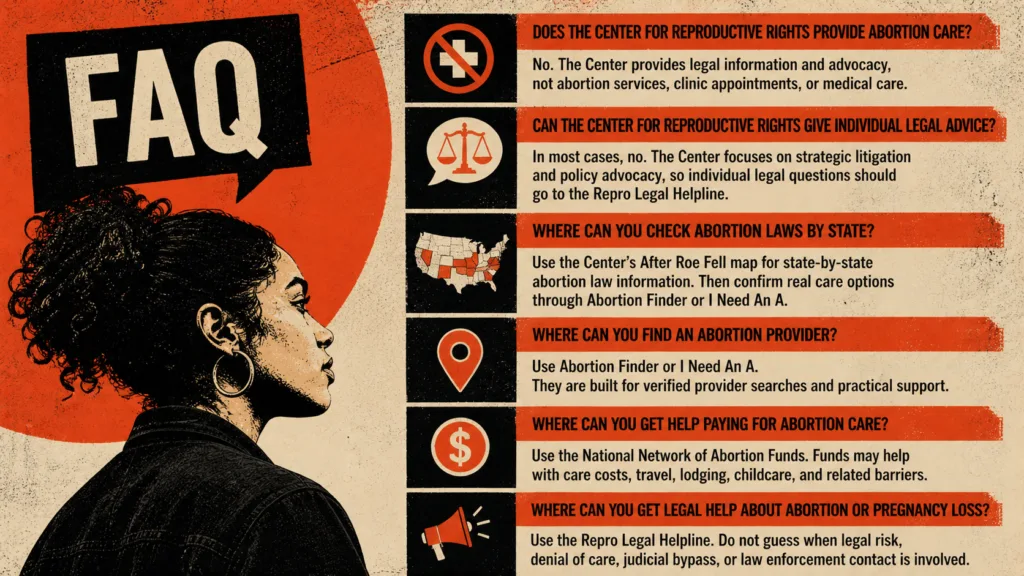
FAQs
No. The Center provides legal information and advocacy, not abortion services, clinic appointments, or medical care.
In most cases, no. The Center focuses on strategic litigation and policy advocacy, so individual legal questions should go to the Repro Legal Helpline.
Use the Center’s After Roe Fell map for state-by-state abortion law information. Then confirm real care options through Abortion Finder or I Need An A.
Use Abortion Finder or I Need An A. They are built for verified provider searches and practical support.
Use the National Network of Abortion Funds. Funds may help with care costs, travel, lodging, childcare, and related barriers.
Use the Repro Legal Helpline. Do not guess when legal risk, denial of care, judicial bypass, or law enforcement contact is involved.
Reproductive Rights Resources Should Make the Next Step Clear
Check the law, then go directly to the care, funding, or legal support resource that matches your situation.
More on Center for Reproductive Rights
Explore Center for Reproductive Rights from every angle: