
Reproductive Rights Resources: Laws, Care, Funds, and Legal Help
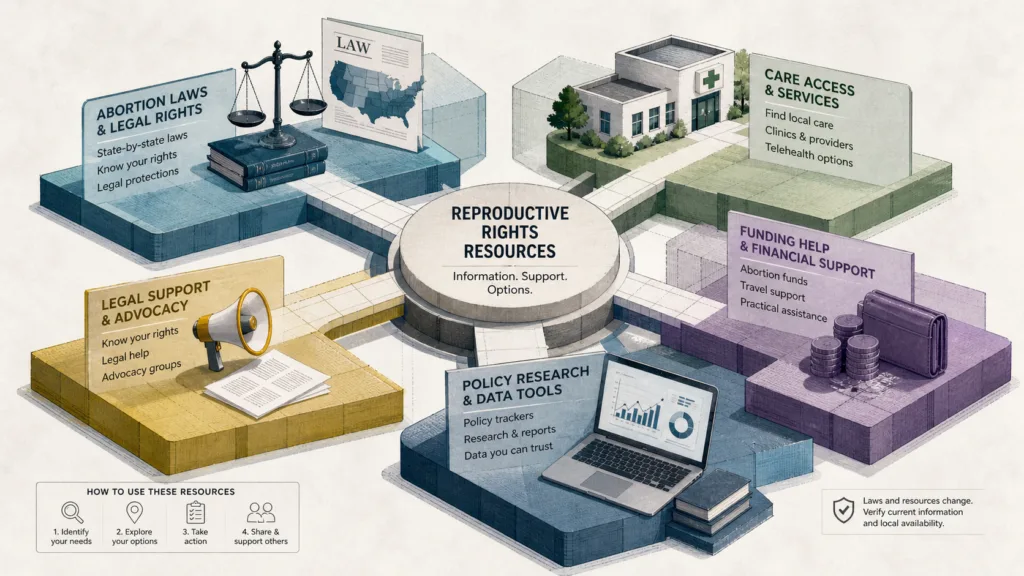
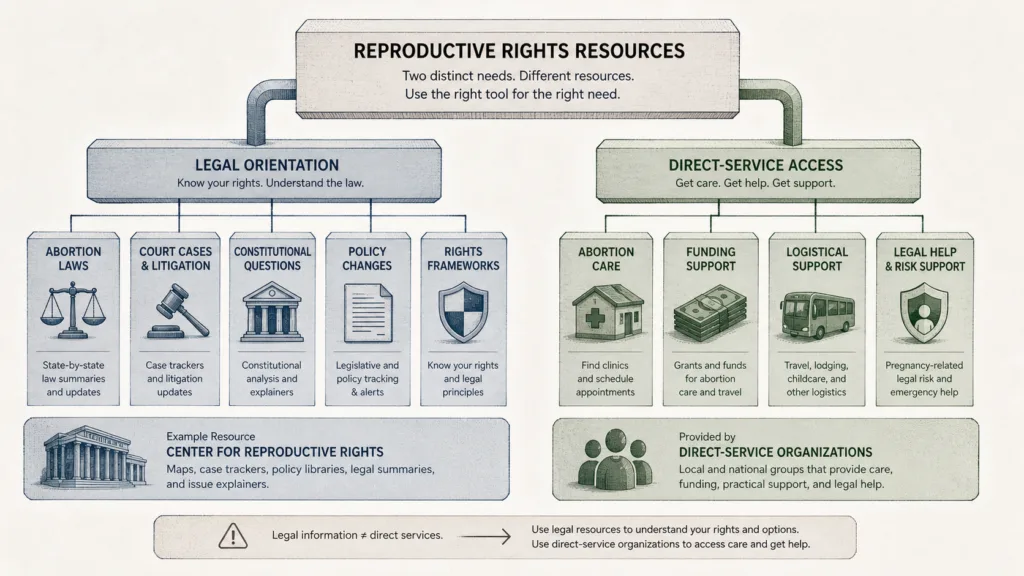
Reproductive rights resources support two distinct needs: legal orientation and direct-service access. Legal orientation clarifies abortion laws, court cases, constitutional questions, policy changes, and rights frameworks. Direct-service access supports provider search, abortion funding, logistical barriers, and pregnancy-related legal risk.
The Center for Reproductive Rights belongs in the legal-information category. Its strongest public value comes from maps, case trackers, policy libraries, legal summaries, and issue explainers. Abortion care, clinic appointments, funding support, routine individual legal advice, and emergency referrals require direct-service organizations.
In this article
- What the Center Provides
- How to Check Abortion Laws
- Where to Find Direct Help
- Which Resource to Use First
Effective resource selection begins with function. The Center explains legal systems, court activity, policy disputes, and human rights law. Provider directories, abortion funds, legal helplines, and defense funds address practical access and legal-risk needs.
This separation prevents resource confusion. Legal maps clarify jurisdictional conditions before practical care navigation. Direct-service resources then address appointments, funding, travel, logistical support, legal questions, or defense needs.
Reproductive Rights Resources by Need
Reproductive rights resources fit into clear categories. Legal resources explain abortion rights, state rules, global laws, constitutional interpretation, and litigation. Service resources support care access, funding, logistics, legal questions, and defense response.
The Center for Reproductive Rights provides legal and policy information. Abortion Finder, I Need An A, the National Network of Abortion Funds, the Repro Legal Helpline, and the Repro Legal Defense Fund provide direct support. Correct resource selection depends on the problem category.
What the Center Provides
The Center for Reproductive Rights functions as a legal advocacy and policy organization. Its work focuses on litigation, policy work, human rights law, court systems, and laws affecting reproductive healthcare. The organization uses law to advance reproductive rights as fundamental human rights worldwide.
The Center’s website supports legal research rather than direct healthcare access. Key resources include interactive maps, state and country law summaries, court case information, policy reports, fact sheets, legal analysis, and issue explainers. These tools clarify abortion law status, global abortion law differences, and court cases affecting access.
The Maps and Tools page provides the clearest starting point for legal orientation. The Policy and Resources library supports deeper research through reports, publications, fact sheets, and legal analysis. The Court Cases page tracks legal actions in national courts, United Nations committees, and regional human rights bodies.
The Center’s limitation matters. It does not operate as an abortion provider, clinic scheduler, abortion fund, or general individual legal-advice service in most circumstances. Care access, payment help, emergency legal support, and clinic referrals usually require direct-service organizations.
How to Check Abortion Laws
The Center’s abortion law maps provide legal orientation by jurisdiction. These tools clarify whether abortion access is expanded, protected, unprotected, hostile, illegal, restricted, or shaped by constitutional interpretation. Legal maps support research before practical access planning.
For United States law, After Roe Fell: U.S. Abortion Laws by State provides state-by-state and territory-level abortion law information. The map classifies each state and territory by access status. State-specific explanations support review of changing law, restrictions, protections, and access conditions.
The supplied source states that nineteen United States states have total bans or severe abortion restrictions. That variation makes state-specific legal review essential. Practical access may also depend on gestational limits, provider availability, travel distance, telehealth rules, and clinic capacity.
For global legal research, the World’s Abortion Laws Map shows abortion law status by country and territory. The supplied source states that more than sixty countries and territories liberalized abortion laws over the past thirty years, while four rolled back legality. This tool supports country-level comparison for policy research, advocacy, journalism, and academic use.
For United States constitutional analysis, the State Constitutions and Abortion Rights tool explains state court treatment of abortion rights under state constitutions. This tool matters because abortion access now depends heavily on state law and state court interpretation. Constitutional review can differ from statutory access categories.
These tools provide legal starting points, not medical advice or individualized legal advice. Laws change quickly, and practical access can differ from legal classification. Provider directories and legal helplines can help confirm current care options or risk questions.
Where to Find Direct Help
Direct help requires service-focused resources. The Center explains law and policy, while provider search, abortion funding, travel support, legal support, and defense help require specialized organizations. Each direct-service resource addresses a different barrier.
Abortion Finder offers a United States directory of verified abortion service providers and support resources. Its tools include provider search, funding information, travel and logistical support, legal-support links, medical guidance, and emotional-support links. This resource fits care access and provider-location needs.
I Need An A helps locate verified abortion providers, funding and support organizations, and state law information. Its location-based search supports abortion access navigation across different state conditions. This tool combines provider orientation, funding connections, support resources, and legal context.
The National Network of Abortion Funds connects abortion care needs with local and regional abortion funds. The supplied source states that the network includes nearly one hundred abortion funds. Funds may help with procedure costs, travel, lodging, childcare, and related barriers.
The Repro Legal Helpline provides free and confidential legal services related to abortion, pregnancy loss, and birth. It supports questions about abortion laws, legal options, emergency abortion denial, judicial bypass, and pregnancy-related criminalization risk. This resource fits individualized legal questions better than general legal maps.
The Repro Legal Defense Fund supports people facing investigation, arrest, or prosecution related to self-managed abortion or pregnancy loss. Support can include bail, legal fees, and related defense needs. This resource addresses legal defense, not general policy research.
Which Resource to Use First
The best first resource depends on the main need. Law research, provider search, funding, travel support, legal advice, and defense support require different entry points. Clear need classification prevents misrouting across legal-information and direct-service systems.
For current abortion law in a United States state, start with the Center’s After Roe Fell map. Then confirm practical care options through Abortion Finder or I Need An A. Legal status and actual care access can differ because restrictions, travel distance, clinic availability, gestational limits, and telehealth rules shape real access.
For international abortion law research, start with the Center’s World’s Abortion Laws Map and related fact sheets. This route fits journalists, students, advocates, policy researchers, and organizations needing country-level legal analysis. It does not replace localized provider referral systems.
For constitutional questions in the United States, start with the State Constitutions and Abortion Rights tool. State court interpretation can shape abortion access under state constitutions. This tool supports legal research where statutory categories alone give incomplete context.
For an appointment, start with Abortion Finder, I Need An A, or a trusted clinic network. For payment, travel, lodging, childcare, or related barriers, start with the National Network of Abortion Funds. For legal risk involving self-managed abortion, pregnancy loss, emergency-care denial, judicial bypass, or law-enforcement contact, start with the Repro Legal Helpline.
FAQs
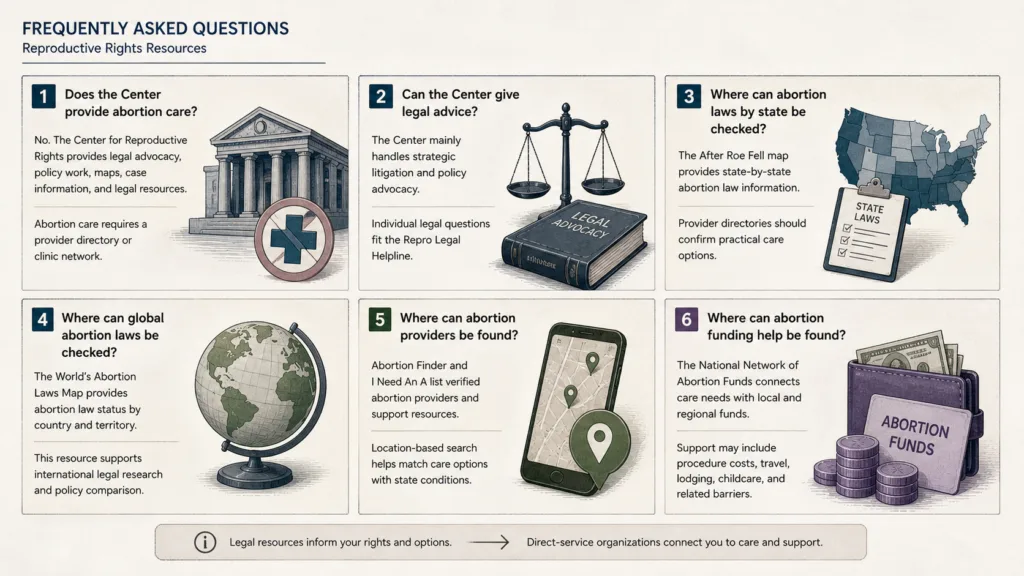
No. The Center for Reproductive Rights provides legal advocacy, policy work, maps, case information, and legal resources. Abortion care requires a provider directory or clinic network.
The Center mainly handles strategic litigation and policy advocacy. Individual legal questions fit the Repro Legal Helpline.
The After Roe Fell map provides state-by-state abortion law information. Provider directories should confirm practical care options.
The World’s Abortion Laws Map provides abortion law status by country and territory. This resource supports international legal research and policy comparison.
Abortion Finder and I Need An A list verified abortion providers and support resources. Location-based search helps match care options with state conditions.
The National Network of Abortion Funds connects care needs with local and regional funds. Support may include procedure costs, travel, lodging, childcare, and related barriers.
Reproductive Rights Resources Need Clear Routing
Start with legal maps for law research, then use provider directories, abortion funds, legal helplines, or defense resources for direct support.
More on Center for Reproductive Rights
Explore Center for Reproductive Rights from every angle: