

Autism Research Institute Resources for Families, Adults, and Care Teams
Many families had started their autism search with a question that felt personal. A parent may have noticed early signs, an adult may have wondered about a missed diagnosis, or a clinician may have needed clearer education for a care plan. In those moments, Autism Research Institute resources helped people gather facts, language, and shared understanding.
In this article
- How Autism Research Institute resources helped families and care teams.
- How ARI explained autism signs, screening, and diagnosis.
- How ARI webinars and research updates supported shared care.
- How ARI addressed adult autism, late diagnosis, and autistic women.
The Autism Research Institute, often called ARI, had served as a nonprofit organization focused on autism research funding and education. Its resources had supported autistic people, families, caregivers, clinicians, therapists, educators, and researchers. The organization had been useful for people who needed more than a basic definition of autism.
ARI did not diagnose autism. Its role had been to provide autism education, research updates, webinars, adult diagnosis information, and support materials. For many families, friends, and care teams, those resources helped turn worry into clearer questions for qualified professionals.

How Autism Research Institute Resources Supported Autism Learning
Autism had been described as a developmental disability related to differences in the brain. It could affect social communication, interaction, behavior, interests, routines, sensory processing, and support needs. Because autism was a spectrum, each person’s traits and needs could look different.
That difference had mattered in families, schools, clinics, and workplaces. One child may have needed speech and communication support, while another may have needed sensory help, educational planning, or care for co-occurring concerns. An adult may have needed language for long-standing social, sensory, or burnout-related patterns. ARI resources helped people organize those questions before a clinical, educational, or family conversation.
How Autism Research Institute resources helped families and care teams.
Autism Research Institute resources had helped people learn about autism through research, public education, family materials, and professional training. This mattered because autism support often involved more than one person. A parent, sibling, friend, teacher, therapist, clinician, and autistic adult could each hold part of the same story.
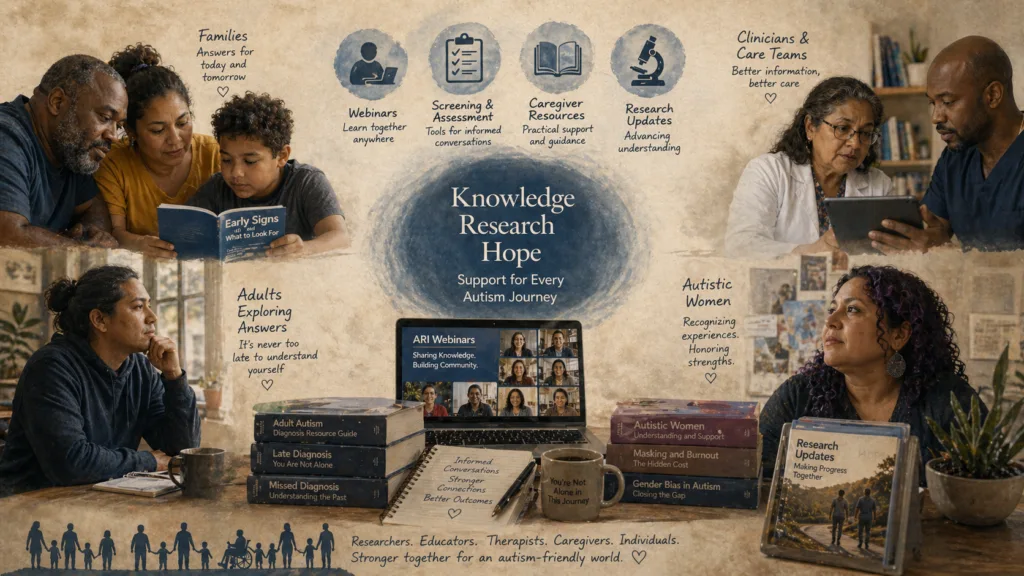
Autistic individuals could find information about diagnosis, support, and lived experience. Parents and caregivers could review early signs, screening, assessment, support needs, and educational resources. Clinicians, therapists, and educators could use ARI webinars and research updates to support more informed care.
ARI had also helped people prepare for formal evaluation conversations. A diagnosis required qualified professionals who could review developmental history, current traits, communication patterns, co-occurring conditions, and clinical criteria. ARI’s materials helped families and adults gather useful questions before those appointments.
For many people, the value had been practical. A family could begin with early signs. An adult could begin with late diagnosis. A clinician could begin with research updates or webinars. Each path helped people move from private concern into shared understanding.
How ARI explained autism signs, screening, and diagnosis.
ARI had provided information on early signs, autism screening, diagnosis, adult autism, support, and treatment-related education. These topics helped families and care teams understand what they had seen at home, school, work, or in social life. The resources also helped explain why autism traits could look different across ages and people.
Autism signs could appear in early childhood. They may have included delayed response to name, limited eye contact, differences in social communication, repetitive movements, strong reactions to sensory input, intense interests, or difficulty with changes in routine. Those signs did not confirm autism by themselves, but they could support a conversation with a pediatrician, psychologist, developmental specialist, or school evaluation team.
The supplied public health information noted that a diagnosis by an experienced professional could be considered reliable by age 2. That fact had mattered for families who were anxious about waiting or missing support. Early recognition could help families seek evaluation, early intervention, communication support, occupational therapy, educational planning, and caregiver guidance.
ARI also shared treatment-related education. Those materials were informational resources, not personal medical recommendations. Autism support may have included speech-language therapy, occupational therapy, educational accommodations, behavioral supports, mental health care, communication tools, family education, or support for co-occurring conditions.
How ARI webinars and research updates supported shared care.
ARI had offered free webinars for autistic individuals, parents, educators, physicians, clinicians, therapists, and other professionals. The webinar library included research updates and sessions on medical, behavioral, developmental, communication, and support-related topics. These resources helped families and professionals learn from the same source.
For families and caregivers, ARI webinars helped organize common next steps. A parent could review early signs before an appointment. A caregiver could learn more about sensory differences, communication, sleep, nutrition, behavior, or support planning. An older teen or adult could explore why autism may have been missed earlier.
For clinicians, therapists, and educators, ARI’s autism-focused education supported clearer care conversations. Autism-related needs often crossed medicine, psychology, education, occupational therapy, speech-language pathology, mental health care, and family support. Research updates helped professionals follow emerging evidence while recognizing where autism science was still developing.
The strongest starting point often depended on the question already present in the room. Developmental concerns often led families toward signs, screening, and assessment. Adult questions often led toward late-diagnosis resources. Professional learning often began with webinars and research updates.
How ARI addressed adult autism, late diagnosis, and autistic women.
ARI had included resources on adult autism, late diagnosis, gender differences, and autistic women. These topics mattered because many autistic adults had not been diagnosed in childhood. Some had been misdiagnosed, while others had masked autistic traits or had first been evaluated for anxiety, depression, ADHD, mood disorders, or personality-related concerns.
ARI’s adult diagnosis information explained why autism may be identified later in life. Adults may have sought evaluation after recognizing lifelong patterns in communication, sensory processing, social exhaustion, burnout, routines, intense interests, or daily demands. For many families, partners, friends, and clinicians, late diagnosis helped older experiences make more sense.
ARI’s resources on autistic women addressed delayed diagnosis, missed diagnosis, gender bias, masking, and the history of autism research. Older autism models had been shaped largely around male presentations. Because of that history, autism in girls and women may have been overlooked, especially when traits were internalized or socially camouflaged.
The supplied content also described a 2026 BMJ study that followed nearly 3 million children and found that autism diagnosis rates for males and females may be nearly equal by adulthood. That finding mattered for late-diagnosed women because it suggested that lower childhood diagnosis rates in girls may have reflected recognition problems. ARI’s materials helped people ask clearer questions about masking, burnout, sensory differences, mental health history, social expectations, and adult assessment.
FAQs
The Autism Research Institute is a nonprofit organization that had focused on autism research funding and education. Its resources supported autistic people, families, caregivers, clinicians, educators, therapists, and researchers.
ARI had provided early signs information, screening and assessment resources, webinars, caregiver materials, adult diagnosis content, and research updates. These resources helped families and care teams prepare for informed conversations.
ARI did not diagnose autism. A formal autism diagnosis required qualified professionals who reviewed developmental history, current traits, clinical criteria, assessment tools, and related concerns.
ARI had shared adult autism diagnosis resources, late-diagnosis information, and materials on missed diagnosis. These helped adults connect lifelong sensory, social, communication, or burnout patterns with possible assessment questions.
ARI had resources on autistic women, delayed diagnosis, missed diagnosis, gender bias, and masking. These materials explained why autism may have been overlooked in girls and women.
ARI webinars and research updates had supported autistic individuals, families, caregivers, educators, physicians, clinicians, therapists, and researchers. The shared learning helped people discuss autism support with more context.
Autism Research Institute Resources Helped People Share the Autism Story More Clearly
Families, adults, friends, caregivers, and clinicians often began with the ARI resource that matched the question they had already been carrying together.
More on Autism Research Institute
Explore autism research institute from every angle: