

Asian Americans Advancing Justice Resource Analysis
Asian Americans Advancing Justice, commonly identified through AAJC, functions as a national civil rights resource structure for Asian American, Native Hawaiian, Pacific Islander, and immigrant populations. AAJC public materials concentrate civil rights information, voting assistance, anti-hate reporting, language access guidance, legal referral pathways, and public policy research into a navigable resource system. Source material establishes AAJC as a practical information hub rather than an emergency response agency or direct-service substitute.
Search intent around Asian Americans Advancing Justice centers on actionable civil rights navigation. Common resource needs include anti-Asian hate reporting, Asian-language voting assistance, local organization discovery, polling-place language rights, and reliable Asian American data. Such needs indicate an information architecture oriented toward documentation, referral, rights clarification, and civic participation.
AAJC resources organize civil rights concerns through issue explainers, public resource pages, reports, partner tools, and action-oriented navigation. The resource structure supports movement from general concern to concrete pathway: incident documentation, voting hotline use, language-rights review, local organization identification, or research consultation. Analysis below examines AAJC public resources through access, voter protection, language support, and data infrastructure.
In this article
- Asian Americans Advancing Justice institutional function.
- Asian Americans Advancing Justice help pathway architecture.
- Asian Americans Advancing Justice voter access mechanisms.
- Asian Americans Advancing Justice data and policy research.
Asian Americans Advancing Justice operates across advocacy, public education, legal analysis, policy research, and resource navigation. National positioning creates a bridge between broad civil rights frameworks and specific access mechanisms. Strong public value appears in resource translation: abstract rights become hotline numbers, reporting portals, multilingual fact sheets, directories, and research pages.
The AAJC resource environment addresses recurring access barriers. Language access affects voting, legal systems, public benefits, healthcare, emergency communication, workplace rights, education, and harm reporting. Public-facing tools such as Stand Against Hatred, APIAVote hotline materials, language-rights voting resources, and the Asian Resource Hub convert access barriers into structured entry points.

Asian Americans Advancing Justice access infrastructure.
AAJC public resources combine national civil rights framing with issue-specific navigation. The organization’s stated mission centers civil and human rights advancement for Asian Americans and equitable social conditions. Affiliation with broader Advancing Justice organizations places national advocacy within a wider civil rights network.
Issue areas include voting rights, language access, immigration and immigrant rights, anti-Asian hate, census participation, education equity, legal advocacy, media diversity, telecommunications, technology policy, and racial justice. These areas appear across reports, explainers, press releases, public education pages, and action resources. Breadth across policy, research, and public education indicates a multidisciplinary approach to structural access concerns.
AAJC’s role differs from emergency response, direct legal representation, or localized social-service delivery. The organization supplies public education, legal analysis, policy advocacy, research, and referral navigation. Immediate protection, urgent legal advice, election administration, and direct local assistance require emergency services, qualified attorneys, election offices, or community-based organizations.
Asian Americans Advancing Justice institutional function.
Asian Americans Advancing Justice serves as a national civil rights information and advocacy structure with significant public resource functions. Washington, D.C. positioning supports national policy engagement, legal advocacy, and public education. Institutional scope supports issue analysis beyond localized direct-service activity.
The organization’s public-facing identity combines civil rights advocacy with public education and research dissemination. Reports and explainers translate policy domains into accessible resource formats. Press materials and action pages connect current civil rights concerns with public participation and informed navigation.
AAJC institutional function depends on distinction between resource navigation and direct intervention. The organization guides access to reporting tools, voting assistance, language-rights materials, legal referral information, and research. Emergency response, official election administration, and individualized attorney-client legal advice require separate institutional channels.
Clear boundaries strengthen resource accuracy and expectation management. Civil rights information gains value when referral pathways remain visible and service limits remain explicit. AAJC public pages support orientation, documentation, and rights awareness while directing urgent or specialized needs toward appropriate systems.
Asian Americans Advancing Justice help pathway architecture.
AAJC help pathways concentrate around reporting, referral, voting assistance, local organization discovery, and rights education. Strong starting points include Stand Against Hatred, the Asian Resource Hub, the Know Your Rights page, and anti-Asian hate resource materials. Each pathway addresses a distinct public need within a larger access framework.
Stand Against Hatred documents hate incidents affecting Asian American communities and supports public awareness regarding racism and xenophobia. The reporting tool accepts submissions in English, Chinese, Vietnamese, and Korean. Primary function centers documentation and education, while immediate danger requires emergency services before resource reporting.
The Asian Resource Hub functions as a searchable directory for AANHPI-serving organizations and services. Resource categories may include social services, legal help, language support, victim services, mental health support, civic engagement programs, and local assistance. Directory structure supports localized navigation when national information lacks geographic specificity.
The Know Your Rights page consolidates action-oriented links for voter assistance, citizenship clinics in the Washington, D.C., Maryland, and Virginia region, voting language rights, and legal referral information. Anti-Asian hate materials connect to bystander intervention training and mental health resources. The combined help architecture supports incident documentation, support navigation, and rights clarification without overstating direct-service capacity.
Asian Americans Advancing Justice voter access mechanisms.
AAJC voting resources focus on voter protection, language assistance, civic participation, and election information. The organization works with APIAVote on a voter hotline for voting questions and Asian-language assistance. The hotline appears as one-eight-eight-eight-API-VOTE and one-eight-eight-eight-two-seven-four-eight-six-eight-three.
Voting language-rights materials explain two central protections. Certain voters can bring a chosen assistance provider into the voting process, subject to limited federal exceptions. Certain jurisdictions must provide translated election materials and oral assistance under Section Two Hundred Three of the Voting Rights Act.
AAJC provides multilingual fact sheets covering the right to receive help in the voting booth. These materials direct voters toward hotline support for in-language assistance. The resource structure links legal protections, practical assistance, and multilingual public education.
Voting access gains importance alongside Asian American population growth. Census Bureau Asian alone-or-in-combination population data shows almost forty percent growth between twenty-ten and twenty-twenty. Population increase does not produce representation without registration, turnout, outreach, language access, accurate district data, and usable election information.
Section Two Hundred Three coverage depends on Census Bureau determinations and legal thresholds for limited-English-proficient voting-age citizens in covered language minority groups. Covered categories include Asian language groups, American Indian and Alaska Native languages, and Spanish. Because determinations remain location-specific, official county or state election offices remain necessary sources for local materials, deadlines, polling locations, mail ballot rules, identification requirements, and ballot tracking.
Asian Americans Advancing Justice data and policy research.
AAJC publishes and connects to research on Asian American voters, census participation, language access, hate incidents, immigration, education, and technology policy. These materials support journalism, education, nonprofit administration, public administration, academic work, and community resource planning. Research pages extend AAJC’s value beyond immediate resource navigation.
The twenty-twenty-four Asian American Voter Survey stands as a major research resource connected to AAJC. The survey comes through AAJC, APIAVote, AAPI Data, and AARP. Coverage includes voter preferences, issue priorities, language access, discrimination concerns, outreach gaps, and news sources among Asian American registered voters.
AAJC describes the Asian American Voter Survey as the longest-running survey of Asian American voters. AAPI Data’s summary reports that seventy-two percent of Asian American voters speak a language other than English at home. This figure clarifies the significance of hotline support, translated materials, voting language-rights fact sheets, and Section Two Hundred Three resources.
AAJC census resources also support the case for disaggregated data. Broad Asian American categories can obscure differences by language, income, immigration history, geography, education, and service access. More specific data improves policy design, funding allocation, community planning, and visibility for needs hidden inside aggregate labels.
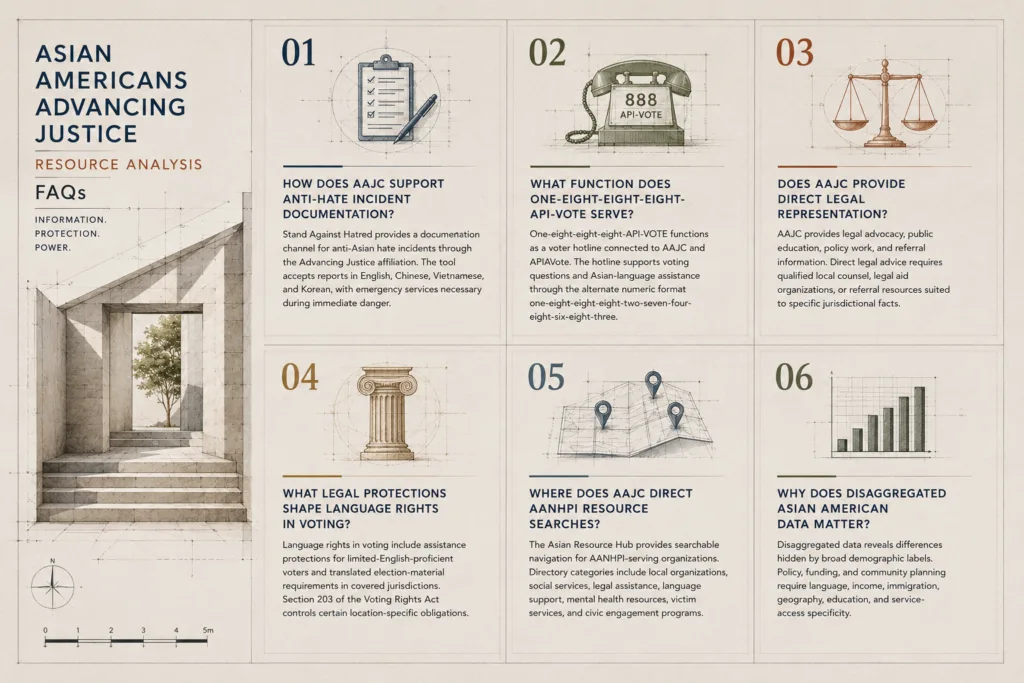
FAQs
Stand Against Hatred provides a documentation channel for anti-Asian hate incidents through the Advancing Justice affiliation. The tool accepts reports in English, Chinese, Vietnamese, and Korean, with emergency services necessary during immediate danger.
One-eight-eight-eight-API-VOTE functions as a voter hotline connected to AAJC and APIAVote. The hotline supports voting questions and Asian-language assistance through the alternate numeric format one-eight-eight-eight-two-seven-four-eight-six-eight-three.
AAJC provides legal advocacy, public education, policy work, and referral information. Direct legal advice requires qualified local counsel, legal aid organizations, or referral resources suited to specific jurisdictional facts.
Language rights in voting include assistance protections for limited-English-proficient voters and translated election-material requirements in covered jurisdictions. Section Two Hundred Three of the Voting Rights Act controls certain location-specific obligations.
The Asian Resource Hub provides searchable navigation for AANHPI-serving organizations. Directory categories include local organizations, social services, legal assistance, language support, mental health resources, victim services, and civic engagement programs.
Disaggregated data reveals differences hidden by broad demographic labels. Policy, funding, and community planning require language, income, immigration, geography, education, and service-access specificity.
Asian Americans Advancing Justice access infrastructure and civic information value.
Consult AAJC’s Know Your Rights page, Stand Against Hatred, Asian Resource Hub, voter hotline materials, and research pages for structured civil rights resource navigation.
More on Asian Americans Advancing Justice
Explore Asian Americans Advancing Justice from every angle: