

Asian Americans Advancing Justice Resources That Help You Fight Back
You do not need another civil rights page that sounds calm while people get blocked. Asian Americans Advancing Justice gives you resources for voting help, hate reporting, language access, legal referrals, and AANHPI community data. That matters because confusion is not harmless. It keeps people from using rights they already have.
In this article
- What AAJC Does
- Where to Get Help
- Asian Americans Advancing Justice Voting Help
- AAJC Data and Research
You usually look for AAJC when something already feels wrong. Maybe someone needs to report anti-Asian hate. Maybe a voter needs help in an Asian language. Maybe a person needs a local organization, a legal referral, or real data about AANHPI communities.
AAJC puts civil rights information, voter help, anti-hate reporting tools, language access guidance, referrals, and research in one public place. That is useful because people do not need a maze when harm is already happening. They need a clear starting point that names the problem and shows the next step.
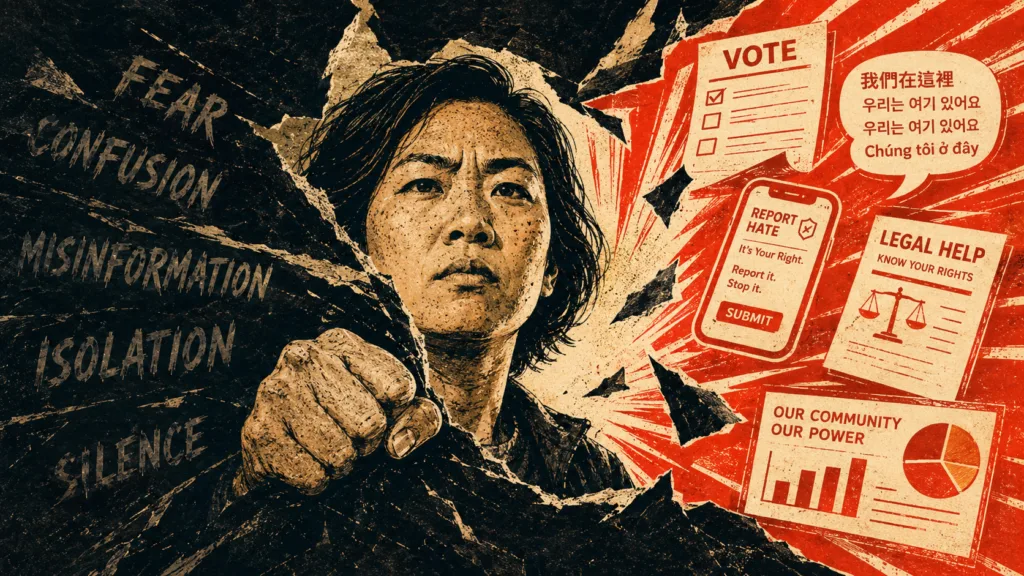
Asian Americans Advancing Justice Resources Give You Clear Next Steps
AAJC is not an emergency agency, and pretending otherwise gets people hurt. It gives people public education, advocacy, legal analysis, research, and resource navigation when systems start closing doors. That distinction matters because people need the right tool before confusion turns into danger.
Use emergency services when immediate danger exists. Use a qualified attorney when legal advice matters. Use official election offices for final voting rules. Use AAJC when the system dumps civil rights questions on you and expects you to stay lost.
What AAJC Does
Asian Americans Advancing Justice | AAJC is a Washington, D.C.-based nonprofit focused on civil rights advocacy, policy analysis, litigation support, community education, and public information. Its mission centers Asian Americans and pushes toward a fair and equitable society. That mission is not decoration. It exists because public systems still fail people who need language access, legal clarity, and civic protection.
AAJC is part of a broader Advancing Justice affiliation with regional civil rights organizations across the United States. That structure matters because harm does not land in one neat national category. People face local barriers, local agencies, local elections, and local discrimination. They need national advocacy and local pathways that do not leave them stranded.
The organization covers voting rights, language access, immigration and immigrant rights, anti-Asian hate, census participation, education equity, legal advocacy, media diversity, telecommunications, technology policy, and racial justice. Those issue areas show where people keep getting blocked, miscounted, under-informed, and pushed aside. AAJC does not treat those problems like side issues. It puts them where people can find them.
AAJC organizes those topics through reports, explainers, press releases, public education pages, and action resources. That structure turns broad civil rights anxiety into something more concrete. A hate incident can move toward documentation through Stand Against Hatred. A voting question can move toward the APIAVote hotline. A local support need can move toward the Asian Resource Hub.
AAJC also has limits, and those limits should stay clear. It does not replace emergency services, local legal counsel, election offices, or community-based direct service. Pretending otherwise would be dangerous bullshit. The power of the site is navigation, not fantasy rescue.
Where to Get Help
AAJC connects people to practical tools for reporting, referrals, voting assistance, and community support. The strongest starting points are Stand Against Hatred, the Asian Resource Hub, the Know Your Rights page, and anti-Asian hate resources. That matters because people in distress do not need polished language. They need a next step that does not waste their time.
Stand Against Hatred documents hate incidents and educates the public about racism and xenophobia affecting Asian American communities. People can report incidents in English, Chinese, Vietnamese, and Korean. That language access is not a bonus feature. It is the difference between being counted and being erased.
The tool supports documentation and awareness, not emergency intervention. If someone faces immediate danger, emergency services come first. That line is blunt because confusion can cost people safety. Reporting systems matter, but they do not replace urgent protection.
The Asian Resource Hub helps people search for community organizations and services. It connects Asian American, Native Hawaiian, and Pacific Islander communities with organizations that may provide social services, legal help, language support, victim services, mental health support, civic engagement programs, and local assistance. That kind of directory matters when people need humans nearby, not another dead-end webpage.
AAJC’s anti-Asian hate page also links to bystander intervention training and mental health resources. Those resources matter after harassment, discrimination, or witnessing harm. People need support that understands AANHPI community realities. They do not need strangers minimizing what happened.
The Know Your Rights page gathers action-oriented links in one place. It includes the voter hotline, citizenship clinics in the Washington, D.C., Maryland, and Virginia region, language rights in voting, and legal referral information. This is where scattered needs become visible. That visibility matters because systems love when people stay lost.
Asian Americans Advancing Justice Voting Help
AAJC’s voting resources focus on voter protection, language assistance, civic participation, and election information. The organization works with APIAVote on a voter hotline that answers voting questions and provides assistance in Asian languages. The number is 1-888-API-VOTE, also written as 1-888-274-8683. Use it when voting confusion starts turning into exclusion.
The language rights in voting page names two protections people need to know. First, some voters can bring a person of their choice to help them vote, with limited exceptions under federal law. Second, some jurisdictions must provide translated election materials and oral assistance under Section 203 of the Voting Rights Act. Those protections matter because a right you cannot use is a trap.
AAJC provides multilingual fact sheets about receiving help in the voting booth. It also directs voters to the hotline for in-language assistance. That matters because people should not have to decode election rules alone while officials, forms, deadlines, and polling places create pressure. They need language support before confusion turns into silence.
Asian Americans grew by almost 40% between 2010 and 2020, based on the Census Bureau’s Asian alone-or-in-combination population count. Growth does not automatically create representation. They can still ignore people when registration, turnout, outreach, district data, and translated information fail. Numbers alone do not protect anyone.
Representation depends on practical access. People need registration help, turnout information, accurate district data, language assistance, and election materials they can actually use. AAJC’s voting materials push into those access points. They do not pretend civic participation happens just because a system says people have rights.
Section 203 coverage depends on Census Bureau determinations. Coverage applies when legal thresholds are met for limited-English-proficient voting-age citizens in certain language minority groups, including Asian language groups, American Indian and Alaska Native languages, and Spanish. Those determinations are location-specific. Voters still need official county or state election offices for final local materials and rules.
AAJC and APIAVote help with language support, rights information, and process questions. Official election websites confirm registration deadlines, polling locations, mail ballot rules, identification requirements, and ballot tracking. Use both. Do not let one missing link become the excuse that blocks a vote.
AAJC Data and Research
AAJC publishes and links to research on Asian American voters, census participation, language access, hate incidents, immigration, education, and technology policy. That research serves journalists, educators, nonprofit staff, public officials, students, and community members. It also exposes a hard truth. People disappear from policy when nobody measures their needs correctly.
The 2024 Asian American Voter Survey is one of the strongest AAJC-connected research resources. AAJC, APIAVote, AAPI Data, and AARP produced it. The survey covers voter preferences, issue priorities, language access, discrimination concerns, outreach gaps, and news sources among Asian American registered voters. AAJC describes it as the longest-running survey of Asian American voters.
AAPI Data’s summary reports that 72% of Asian American voters speak a language other than English at home. That number makes the stakes obvious. Language access is not a niche concern. It shapes voting, public benefits, legal systems, emergency information, healthcare, education, workplace rights, and the ability to report harm.
That is why the voter hotline, translated materials, language rights fact sheets, and Section 203 resources matter. They are not ornamental outreach. They are infrastructure for people who will otherwise hit English-only walls and get blamed for not climbing them. That blame is ugly, lazy, and predictable.
AAJC’s census resources also show why disaggregated data matters. Broad labels can hide major differences among Asian American communities by language, income, immigration history, geography, education, and access to services. One giant category can look clean on a chart and still fail real people. That is how policy turns vague and harmful.
More specific data can show needs that disappear under broad labels. It can shape funding, services, representation, and community planning. Without it, they can claim communities are “doing fine” while actual people face language barriers, poverty, discrimination, and service gaps. Data is not neutral when bad data protects neglect.
FAQs
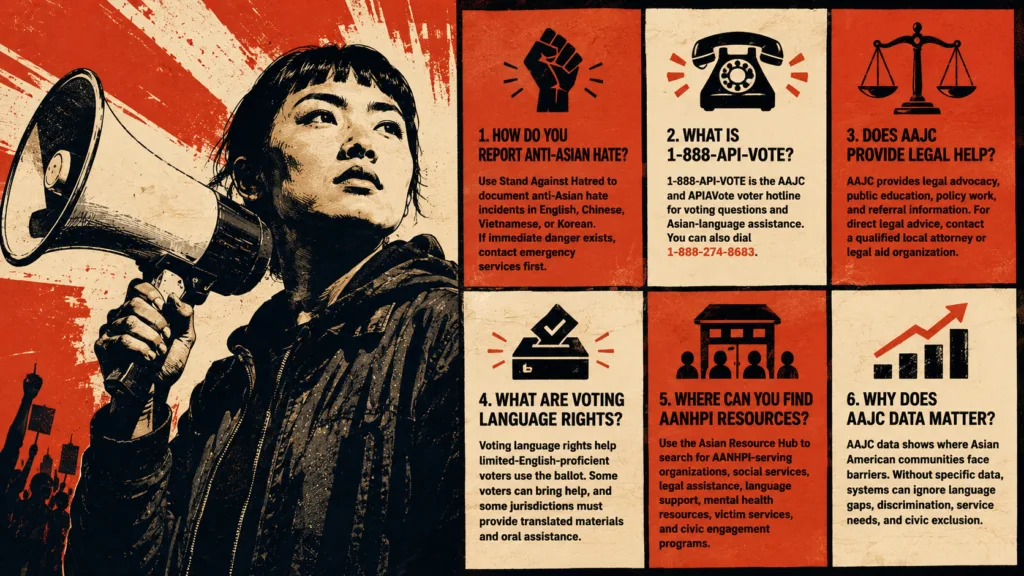
Use Stand Against Hatred to document anti-Asian hate incidents in English, Chinese, Vietnamese, or Korean. If immediate danger exists, contact emergency services first.
1-888-API-VOTE is the AAJC and APIAVote voter hotline for voting questions and Asian-language assistance. You can also dial 1-888-274-8683.
AAJC provides legal advocacy, public education, policy work, and referral information. For direct legal advice, contact a qualified local attorney or legal aid organization.
Voting language rights help limited-English-proficient voters use the ballot. Some voters can bring help, and some jurisdictions must provide translated materials and oral assistance.
Use the Asian Resource Hub to search for AANHPI-serving organizations, social services, legal assistance, language support, mental health resources, victim services, and civic engagement programs.
AAJC data shows where Asian American communities face barriers. Without specific data, systems can ignore language gaps, discrimination, service needs, and civic exclusion.
AAJC Helps You Stop Guessing and Start Acting
Use AAJC’s Know Your Rights page, Stand Against Hatred, voter hotline, and Asian Resource Hub when the system tries to make your next step unclear.
Authoritative sources that make the system harder to hide behind:
More on Asian Americans Advancing Justice
Explore Asian Americans Advancing Justice from every angle: