
Asian Americans Advancing Justice Resources and Community Help
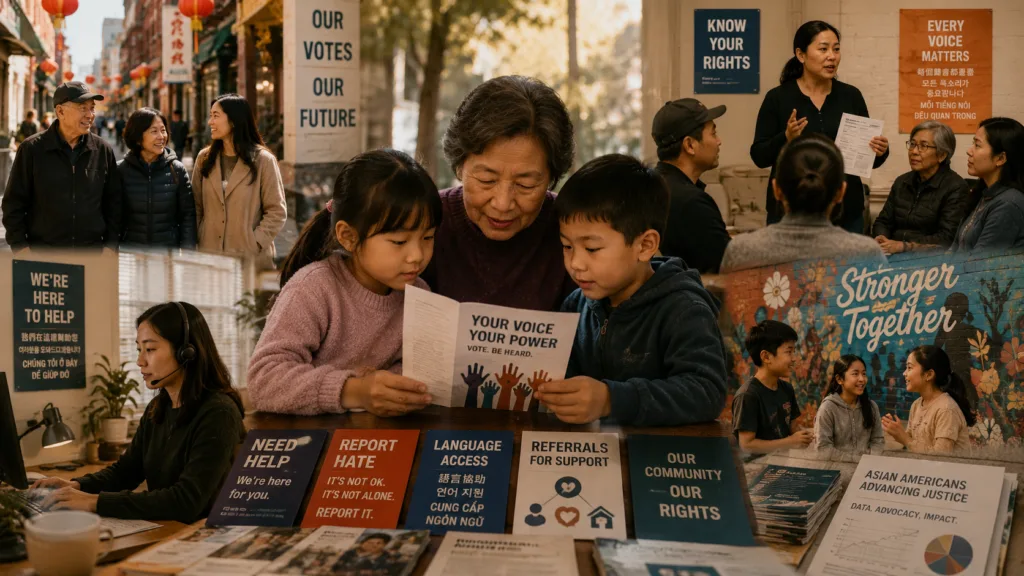
Asian Americans Advancing Justice Resources had often appeared when a family, friend, elder, student, or neighbor needed help understanding civil rights, voting, language access, or hate reporting. We had seen those searches begin with worry. She may have needed to report an anti-Asian hate incident, he may have needed voting help in an Asian language, and a family may have needed a trusted local organization. AAJC’s public resources had connected those community questions with rights information, voter support, reporting tools, legal referral resources, and public policy research for Asian American, Native Hawaiian, Pacific Islander, and immigrant communities.
In this article
- AAJC Connected Rights to Daily Life
- Families Found Reporting and Local Help
- AAJC Helped Voters Access Language Support
- AAJC Research Preserved Community Stories
The searches around AAJC had carried practical needs and personal stakes. A friend may have looked for a way to document hate, a parent may have searched for voting help, and a service provider may have needed reliable data about Asian American communities. We had seen those needs become easier to handle when public information led to a clear next step.
AAJC’s resources had also reflected a larger civic story. Asian American communities had grown, language needs had remained central, and public data had shown that one broad label could hide many different family histories. In that setting, AAJC had helped connect private concern with shared community understanding.
AAJC Resources Had Helped Communities Find Their Next Step
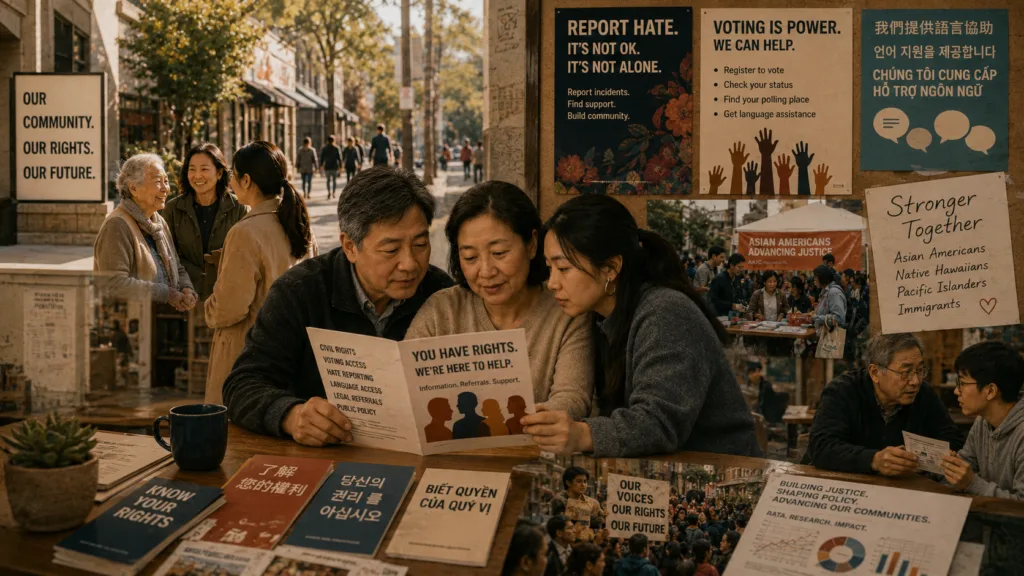
AAJC had served as a national civil rights organization for Asian American, Native Hawaiian, Pacific Islander, and immigrant communities. Its work had included advocacy, public education, legal analysis, policy research, and resource navigation. We had seen its website become useful when someone needed to move from concern to action through a report, hotline, rights page, referral, or research source.
AAJC Connected Rights to Daily Life
Asian Americans Advancing Justice | AAJC had been based in Washington, D.C., and had worked to advance civil and human rights for Asian Americans. It had also belonged to the broader Advancing Justice affiliation, where regional organizations had served communities across the United States. That connection had helped national civil rights work stay tied to local stories, family needs, and community memory.
AAJC’s issue areas had touched many parts of daily life. Voting rights, language access, immigration, anti-Asian hate, census participation, education equity, legal advocacy, media diversity, technology policy, telecommunications, and racial justice had all shaped how people moved through schools, workplaces, public systems, and neighborhoods. Through reports, explainers, press releases, public education pages, and action resources, AAJC had turned broad policy issues into information that communities could use.
Its role had not been the same as an emergency service or a direct legal clinic. AAJC had offered public education, legal analysis, advocacy, research, and referrals, while urgent protection, local services, and direct legal advice still belonged with emergency responders, attorneys, election offices, or community organizations. That difference had mattered when a worried sister, father, friend, or neighbor needed to know where one kind of help ended and another began.
AAJC’s website had been strongest when a concern needed a concrete path. A hate incident could be documented through Stand Against Hatred, voting questions could move toward the APIAVote hotline, local support could begin through the Asian Resource Hub, and language access questions could be checked through voting rights materials. We had seen that pattern turn information into a bridge between private experience and community response.
Families Found Reporting and Local Help
When harm, confusion, or fear had touched a family, AAJC’s resource pages had offered several starting points. Stand Against Hatred, the Asian Resource Hub, the Know Your Rights page, and anti-Asian hate resources had gathered reporting, referrals, voting support, and community help. Each tool had reflected a simple social truth: civil rights questions rarely stayed abstract after a parent, coworker, friend, or child had been affected.
Stand Against Hatred had been created by the Asian Americans Advancing Justice affiliation to document hate incidents and educate the public about racism and xenophobia affecting Asian American communities. Reports had been accepted in English, Chinese, Vietnamese, and Korean. That language access had mattered because she may have needed to describe harm in the language she trusted, and he may have needed a record that helped a painful event become part of a wider public account.
The Asian Resource Hub had helped people search for community organizations and services. It had been designed for Asian American, Native Hawaiian, and Pacific Islander communities seeking groups that may have offered social services, legal help, language support, victim services, mental health support, civic engagement programs, and local assistance. For a friend supporting another friend after discrimination, or a family trying to find nearby help, the hub had offered a clearer beginning.
AAJC’s anti-Asian hate page had also linked to bystander intervention training and mental health resources. Those resources had been useful for witnesses, survivors, relatives, and friends who were trying to understand what happened and how care could continue afterward. The Know Your Rights page had gathered links for the voter hotline, citizenship clinics in the Washington, D.C., Maryland, and Virginia region, language rights in voting, and legal referral information, so a scattered search could become a connected route.
AAJC Helped Voters Access Language Support
AAJC’s voting resources had focused on voter protection, language assistance, civic participation, and election information. The organization had worked with APIAVote on a voter hotline that answered voting questions and offered help in Asian languages. The hotline had been listed as 1-888-API-VOTE, also written as 1-888-274-8683, which gave families, friends, and community groups a number they could share before election concerns grew.
The language rights in voting page had explained two important protections. Some voters had the right to bring a person of their choice to help them vote, with limited exceptions under federal law. Some jurisdictions had also been required to provide translated election materials and oral assistance under Section 203 of the Voting Rights Act.
Those protections had mattered in everyday family terms. She may have trusted a relative to help her understand the voting process, or he may have needed oral assistance before his ballot felt accessible. We had seen how language support helped turn voting from a confusing public system into a process that more people could approach with support.
Asian Americans had grown by almost 40% between 2010 and 2020, based on the Census Bureau’s Asian alone-or-in-combination population count. That growth had carried civic meaning because population growth alone had not guaranteed full representation. Registration, turnout, outreach, language access, accurate district data, and clear election information had all shaped whether a growing community could be heard.
Section 203 coverage had depended on Census Bureau determinations. Coverage had applied when legal thresholds were met for limited-English-proficient voting-age citizens in certain language minority groups, including Asian language groups, American Indian and Alaska Native languages, and Spanish. Because coverage had been location-specific, AAJC and APIAVote resources had worked best alongside official state and county election websites for registration deadlines, polling places, mail ballot rules, identification requirements, and ballot tracking.
AAJC Research Preserved Community Stories
AAJC had published and linked to research on Asian American voters, census participation, language access, hate incidents, immigration, education, and technology policy. Those materials had helped journalists, educators, nonprofit staff, public officials, students, and community members understand issues with reliable background. We had seen research help show that one family’s barrier, one friend’s fear, or one neighbor’s silence could reflect a larger pattern.
The 2024 Asian American Voter Survey had been one of the strongest research resources connected to AAJC. It had been produced by AAJC, APIAVote, AAPI Data, and AARP. The survey had covered voter preferences, issue priorities, language access, discrimination concerns, outreach gaps, and news sources among Asian American registered voters.
AAJC had described the survey as the longest-running survey of Asian American voters. That history had mattered because civic life had unfolded over time, across families, neighborhoods, and generations. A survey like this had helped place individual voter stories inside a broader public record.
AAPI Data’s summary of the survey had reported that 72% of Asian American voters spoke a language other than English at home. That figure had explained why AAJC’s voter hotline, translated materials, language rights fact sheets, and Section 203 resources had carried such practical value. Language access had not stopped at election day; it had shaped public benefits, legal systems, emergency information, healthcare, education, workplace rights, and the ability to report harm.
AAJC’s census resources had also shown why disaggregated data mattered. Broad labels had hidden major differences by language, income, immigration history, geography, education, and access to services. More specific data had helped policy, funding, and community planning reflect needs that may have disappeared when every Asian American community had been treated as one group.
FAQs
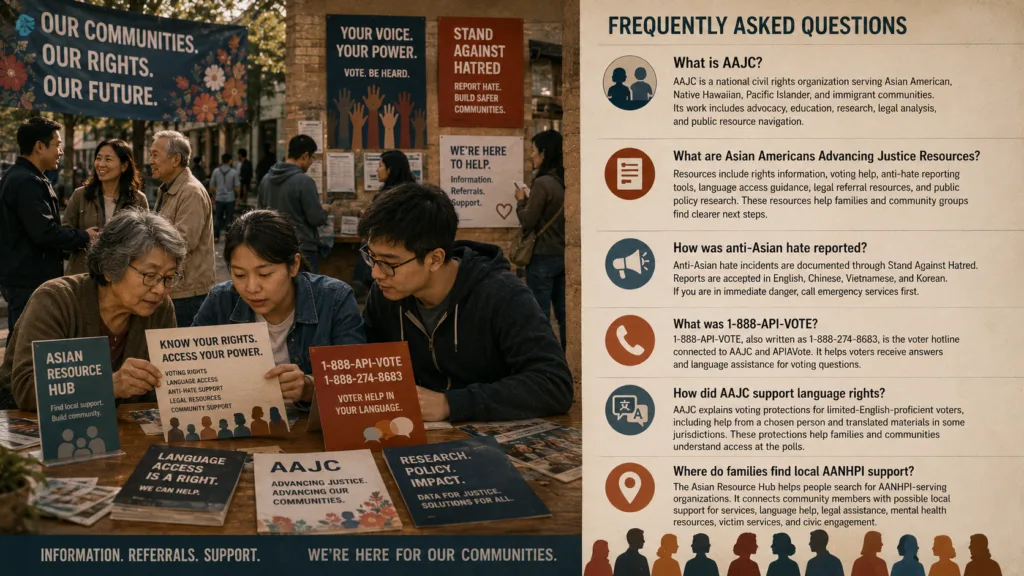
AAJC had been a national civil rights organization serving Asian American, Native Hawaiian, Pacific Islander, and immigrant communities. Its work had included advocacy, education, research, legal analysis, and public resource navigation.
Asian Americans Advancing Justice Resources had included rights information, voting help, anti-hate reporting tools, language access guidance, legal referral resources, and public policy research. We had seen these resources help families and community groups find clearer next steps.
Anti-Asian hate incidents had been documented through Stand Against Hatred. Reports had been accepted in English, Chinese, Vietnamese, and Korean, while immediate danger still belonged first with emergency services.
1-888-API-VOTE, also written as 1-888-274-8683, had been the voter hotline connected to AAJC and APIAVote. It had helped voters receive answers and language assistance for voting questions.
AAJC had explained voting protections for limited-English-proficient voters, including help from a chosen person and translated materials in some jurisdictions. Those protections had helped families and communities understand access at the polls.
The Asian Resource Hub had helped people search for AANHPI-serving organizations. It had connected community members with possible local support for services, language help, legal assistance, mental health resources, victim services, and civic engagement.
AAJC Resources Showed How Access Became Community Care
AAJC’s rights pages, reporting tools, voter hotline, and community directories had given families, friends, and neighbors a shared path toward support.
More on AAJC
Explore AAJC from every angle: