
World Resources Institute: Systems Governance, Open Data Architecture, Environmental Decision Utility
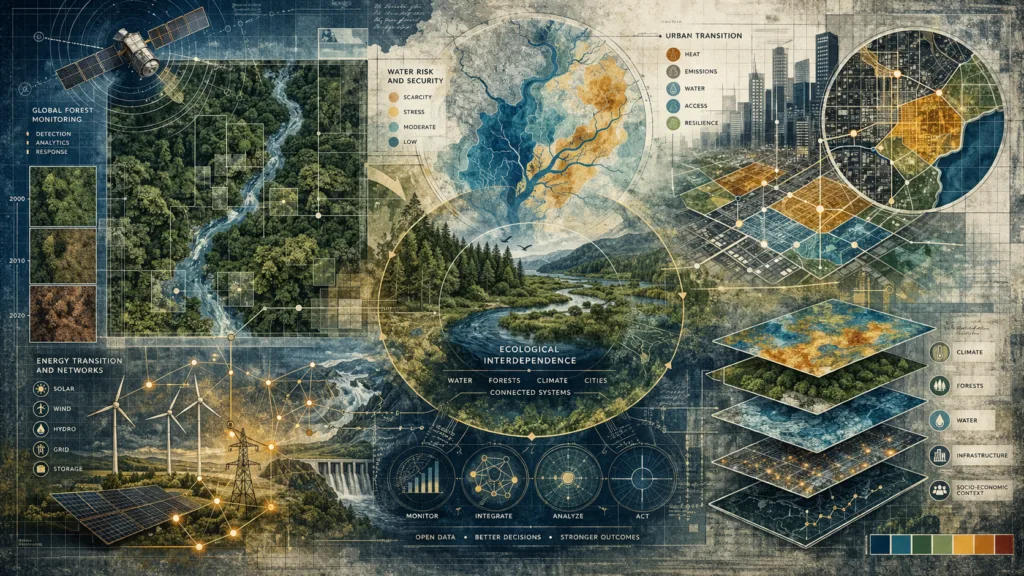
The World Resources Institute functions as a systems-focused environmental institution operating across climate stabilization, ecological restoration, water security, food systems, energy transition, and urban infrastructure. Institutional mission architecture centers on three linked priorities: essential-needs provision, nature protection and restoration, and climate resilience through durable community systems. Analytical significance emerges from interdependence across domains rather than isolation within policy silos. Water scarcity shapes agricultural output, health conditions, and energy reliability; forest degradation alters biodiversity, carbon storage, and land-use stability; urban design influences transport emissions, heat exposure, air quality, and economic access.
In this article
- World Resources Institute Strategic Distinction
- World Resources Institute Systems Impact Across Water, Forests, Energy, and Cities
- World Resources Institute Public Data Platforms and Analytical Utility
- World Resources Institute Practical Significance in Institutional Decision Contexts
Environmental pressure operates through linked resource systems, overlapping infrastructures, and cumulative governance constraints. A narrow single-issue framework obscures causal structure because drought risk, forest loss, urban heat, land degradation, energy transition, and climate instability share material dependencies. The World Resources Institute addresses that condition through a systems model organized around food, land and water, energy, and cities as primary transition fields. Institutional value therefore derives from conversion of environmental complexity into public evidence, structured datasets, analytical platforms, and practical decision frameworks rather than report publication alone.

Analytical Structure
Institutional assessment requires examination of strategic distinction, measurable systems impact, platform utility, and decision relevance. The following sections apply a concept-to-evidence-to-implication sequence in order to maintain analytical clarity and preserve Segment 4 density across every element.
World Resources Institute Strategic Distinction
World Resources Institute strategic distinction rests on institutional integration across research production, open-data publication, public-tool design, and transition support. Strategic planning identifies food, land and water, energy, and cities as high-leverage systems because resource security, ecological condition, and climate outcomes converge within those domains. Such framing produces coherence across topics that often appear fragmented within public discussion, including drought exposure, deforestation, urban mobility, clean energy, and climate governance. Analytical range therefore emerges from structural design rather than thematic accumulation.
A second differentiator involves accessibility architecture. The organization states that datasets, applications, and data infrastructure remain freely available under an Open Data Commitment, creating broad evidence access across multiple institutional settings. Public availability alters the distribution of analytical capability because high-cost private datasets and specialized technical repositories often restrict environmental interpretation to a narrow expert tier. Open infrastructure lowers informational barriers for policy analysis, classroom instruction, public-interest reporting, nonprofit planning, and comparative risk assessment. Strategic distinction therefore includes both knowledge generation and knowledge circulation.
A third differentiator involves practical orientation. Institutional strategy emphasizes research-based approaches linked with global and country-level transition activity, indicating an operational model designed for implementation contexts rather than detached commentary. Applied orientation matters because environmental evidence gains higher value when diagnostic output aligns with governance design, infrastructure planning, and resource management. The World Resources Institute therefore occupies an intermediate position between abstract analysis and operational transition architecture. Institutional relevance follows from that intermediate position, since complex environmental problems require both conceptual synthesis and practical instrumentation.
World Resources Institute Systems Impact Across Water, Forests, Energy, and Cities
World Resources Institute impact appears most clearly where diffuse environmental pressure acquires measurable and interpretable form. Water analysis offers a strong example through Aqueduct findings indicating that 25 countries, containing one-quarter of the global population, face extremely high annual water stress. The significance of that finding lies in structural translation rather than scale alone. Hydrological stress becomes legible as a cross-sector risk condition with implications for agricultural productivity, energy generation, industrial stability, and social resilience. A technical water metric therefore acquires direct policy and planning relevance.
Forest analysis extends the same logic. Through Global Forest Watch and related assessment, tropical primary forest loss in 2024 reaches 6.7 million hectares, described as equivalent to 18 football pitches per minute. The figure communicates velocity, cumulative scale, and ecological urgency without dependence on specialized forestry vocabulary. Satellite-informed monitoring transforms land-cover change into visible evidence of biodiversity decline, carbon-storage reduction, and governance weakness across forest landscapes. Systems impact therefore includes visibility production, since invisible degradation sustains policy delay and public underestimation.
Energy and urban work add another dimension of institutional significance. Strategic framing rejects treatment of climate as a narrow emissions ledger detached from land use, transport systems, buildings, public services, and infrastructure resilience. Within that model, energy transition intersects with housing form, mobility design, heat exposure, and economic functionality inside the same analytical field. Climate policy consequently appears as systems reconfiguration rather than atmospheric accounting alone. Impact thus resides not merely in topic coverage, but in analytical recomposition of environmental change into interconnected operational systems.
Institutional influence expands because that systems framing increases explanatory coherence across multiple sectors. Food security, water availability, forest integrity, energy reliability, and urban resilience function as mutually conditioning variables rather than discrete categories. A hotter city requires transport redesign and heat-resilient infrastructure; a water-stressed basin can trigger agricultural instability and energy disruption; forest loss can intensify carbon exposure and watershed degradation. The World Resources Institute contributes by making those dependencies visible through common evidence structures. Such visibility strengthens cross-sector understanding and improves comparative evaluation of environmental pressure.
World Resources Institute Public Data Platforms and Analytical Utility
Public utility reaches highest visibility through flagship platforms that convert complex datasets into searchable, mappable, and layered interfaces. Aqueduct provides open-source, peer-reviewed analysis of water stress, drought, and flood risk, with higher-resolution indicators in later iterations. Geographic specificity matters because broad concern about water insecurity rarely supports serious planning without local exposure data, comparative severity metrics, and interpretive context. Aqueduct functions as an analytical bridge between hydrological complexity and place-based decision structure. Utility therefore depends on translation capacity as much as on data volume.
Global Forest Watch performs an analogous role for forest monitoring. Satellite data and related technologies support observation of forest loss and pressure across near-current temporal conditions, reducing dependence on delayed retrospective reporting. Analytical value grows from temporal compression because rapid land-cover change gains higher relevance when monitoring cadence approaches operational timelines. Platform design allows conservation analysis, land-governance review, supply-chain scrutiny, and environmental reporting to draw from a shared evidence base. Public visibility and analytical standardization emerge as core institutional outputs.
Resource Watch fills the cross-sector requirement. Organized by the World Resources Institute with more than 30 partners, the platform provides access to more than 200 datasets spanning climate change, migration, air quality, agriculture, energy, and associated environmental conditions. Breadth enables layered interpretation of overlapping pressures rather than isolated examination of single issues. Air quality can be assessed alongside urban growth patterns; climate exposure can be interpreted with land use, agriculture, or migration variables. Platform utility therefore lies in intersectional analytical design, not only in dataset abundance.
A common institutional thread runs across all three platforms. Barrier reduction defines the architecture: technical data becomes publicly navigable, spatially interpretable, and operationally useful without dependence on scattered repositories or highly specialized data-processing workflows. The World Resources Institute packages evidence into public-facing systems that support exploration, comparison, and explanation. Such packaging matters because usability often determines whether high-quality environmental data shapes discourse and policy or remains inert within technical archives. Analytical utility therefore includes interface design, interpretive accessibility, and structured public availability.
World Resources Institute Practical Significance in Institutional Decision Contexts
Practical significance depends on conversion of large-scale environmental complexity into usable decision structure. World Resources Institute platforms and datasets support that conversion by clarifying where pressure concentrates, how severity varies across space, and which systems interact under stress. Water insecurity becomes actionable when basin-level exposure gains map-based visibility. Forest loss gains policy salience when monitoring reveals pace, location, and cumulative pattern. Climate and urban conditions become materially intelligible when linked with transport design, building form, land configuration, and infrastructure resilience.
Open-data infrastructure amplifies decision significance. The organization states that good data forms the foundation of good decision-making and makes data infrastructure freely available through public access commitments. Such availability broadens evidence use across educational settings, public-interest reporting, planning units, research institutions, and policy design contexts. Shared access improves baseline analytical consistency because multiple sectors can work from common evidence rather than incompatible private sources or anecdotal interpretation. Practical significance therefore extends beyond information possession into evidence alignment across institutions.
Cross-sector integration provides an additional source of relevance. Institutional strategy avoids isolated success metrics and instead emphasizes systems transition that aligns climate stabilization, ecological restoration, and resilience. That framing preserves applicability across policy, business, education, and civil-society environments because each domain confronts resource constraints, infrastructure dependencies, and environmental exposure. Sectoral separation weakens environmental interpretation; integrated systems framing strengthens causal understanding and response design. The World Resources Institute remains useful because institutional outputs support integrated reasoning rather than fragmented issue treatment.
A final implication concerns durability of use. Information products with narrow topical scope often lose relevance outside specialist audiences, yet systems-focused public platforms retain value across multiple analytical contexts. Water maps inform infrastructure planning, forest monitoring supports land-governance scrutiny, and cross-sector datasets support broader environmental synthesis. The World Resources Institute therefore offers more than informational content. Institutional contribution consists of a structured method for observing how climate, water, forests, land, energy, and cities operate within a common pressure landscape. Practical significance follows from that durable observational framework.
FAQs
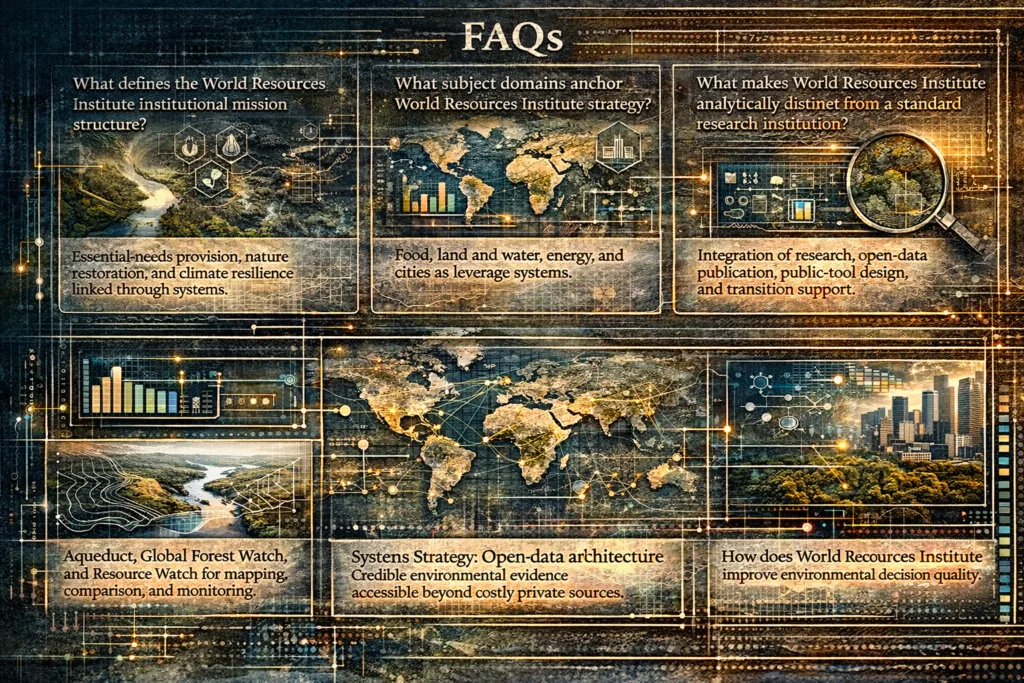
The mission structure centers on essential-needs provision, nature protection and restoration, and climate stabilization through resilient community systems. Institutional design links those priorities through a systems framework rather than separate issue silos.
Core strategic domains include food, land and water, energy, and cities. Those domains function as high-leverage systems shaping environmental stability, ecological condition, and development outcomes.
Analytical distinction derives from integration of research, open-data publication, public-tool design, and transition support. Institutional output therefore combines evidence generation with operational usability.
Aqueduct, Global Forest Watch, and Resource Watch provide the strongest public-facing analytical utility. Platform design supports mapping, comparison, monitoring, and layered environmental interpretation.
Open-data architecture widens access to credible environmental evidence and reduces dependence on costly private sources. Broad availability improves analytical consistency across planning, reporting, education, and policy settings.
Decision quality improves through clearer visibility of risk location, severity, system interaction, and temporal change. Public platforms transform diffuse environmental pressure into measurable and interpretable evidence.
Synthesis of World Resources Institute Utility
Aqueduct, Global Forest Watch, and Resource Watch provide a direct evidence base for structured analysis of water risk, forest change, climate exposure, and urban systems pressure.
More on World Resources Institute
Explore World Resources Institute from every angle: