
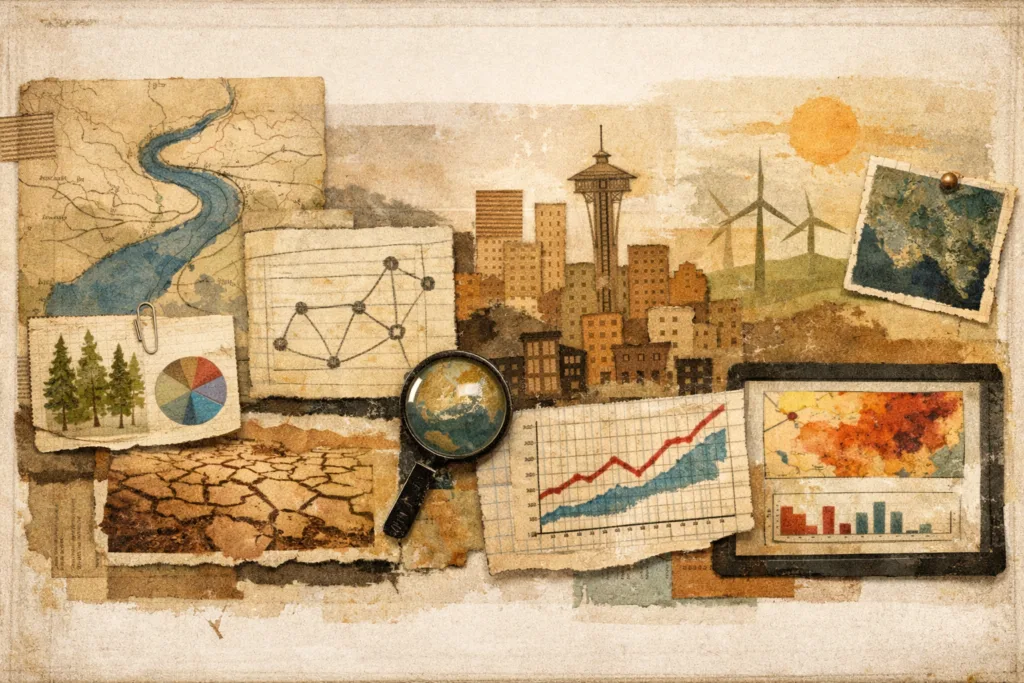
World Resources Institute: How Shared Data and Public Tools Helped Communities Understand a Changing World
The World Resources Institute entered public life through problems that had already been linked in families, neighborhoods, and institutions. In one place, water stress had touched crops, health, and power. In another, forest loss had unsettled livelihoods, biodiversity, and carbon storage. Across cities, transport, heat, housing, and air quality had moved together, and those pressures rarely stayed in separate boxes for long.
That was why the organization’s scope mattered. WRI described its mission through three connected goals: meeting people’s essential needs, protecting and restoring nature, and stabilizing the climate while building resilient communities. Those aims were not arranged as isolated ambitions. They were part of one shared social story, where environmental pressure had already shaped daily life and where practical understanding had become necessary.
For many readers, WRI became useful because it did more than study those patterns. It translated research into public tools, accessible data, and practical resources that teachers, journalists, planners, nonprofit teams, students, and civic groups could all approach together. In that quieter way, the organization helped evidence move from distant analysis into common use.
In this article:
- Why the World Resources Institute stood apart through shared systems and public trust
- Where the World Resources Institute made environmental change feel human and visible
- How the World Resources Institute built tools that helped communities read risk together
- Why the World Resources Institute mattered when decisions reached homes, cities, and institutions
When environmental institutions were discussed only through technical language, a kind of distance often settled over the subject. Numbers could seem remote. Policy terms could feel formal. The lived meaning could slip away from view. WRI mattered because it reduced that distance and kept the human setting in sight.
Its work moved across climate change, water risk, food systems, forests, energy, and cities, yet the deeper pattern remained relational. Water shortages affected crops, health, and energy systems. Forest loss affected biodiversity, family income, and long-term carbon storage. City design shaped mobility, air quality, heat exposure, and economic opportunity. WRI’s work was built around those connections, and that structure helped public readers understand that these were not separate stories after all.
That was also why the organization became more than a publisher of reports. It became part of a wider civic effort to make evidence visible, searchable, and usable. Through open data, public platforms, and system-level analysis, it helped people and institutions read change together and place local strain inside a larger shared pattern.
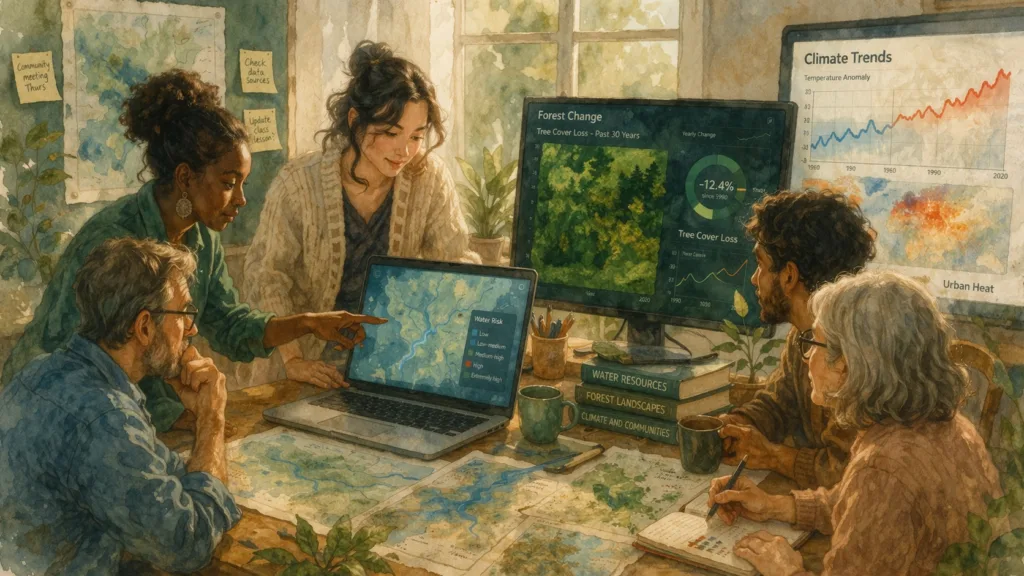
The World Resources Institute and the Shared Story of Environmental Change
The story of WRI was not only about scale. It was about relationships between systems, people, and decisions that had already been shaping one another. Across food, land, water, energy, forests, and cities, the organization helped public readers see how one strain often traveled beside another.
That approach gave its work unusual durability. Rather than treating environmental issues as separate topics, WRI kept returning to the ways communities had already experienced them together. In that sense, its research, tools, and data platforms became part of a broader public language for understanding risk.
Why the World Resources Institute stood apart through shared systems and public trust
WRI stood apart because it did more than publish research and leave the interpretation to specialists. It produced data, built public tools, supported decision-makers, and worked across the systems that most directly affected people, nature, and climate. Its strategic plan made that idea explicit by arguing that lasting progress depended on changing the systems tied most closely to daily life, especially food, land and water, energy, and cities.
That systems view gave the organization unusual range without making its work feel fragmented. A discussion could begin with drought risk and move toward forest monitoring, urban planning, clean energy, or climate governance, yet the thread still held. The reason was simple and social: these problems had already been connected in the world long before they were connected in public policy language.
Another reason WRI gained trust was access. The organization stated that it made datasets, applications, and data infrastructure freely available under its Open Data Commitment. That mattered because credible information had often been unevenly distributed, while teachers, journalists, students, nonprofit teams, and planners still needed dependable evidence. WRI lowered that barrier, and in doing so it widened the circle of people who could join the same factual conversation.
Its identity as a practical change partner also gave the work a steadier presence. The strategy emphasized research-based approaches, global and country-level work, and a focus on helping deliver real transitions for people, nature, and climate. That combination of scale, public access, and institutional usefulness helped the organization build lasting credibility across many social settings.
Where the World Resources Institute made environmental change feel human and visible
One of WRI’s clearest strengths was making large environmental risks easier to understand in human terms. Water offered a strong example. According to WRI’s Aqueduct work, 25 countries, home to one-quarter of the world’s population, faced extremely high water stress each year. That figure did more than describe scarcity. It placed pressure on homes, crops, health, and public stability inside one shared frame.
Its forest work carried a similar force. Through Global Forest Watch and related analysis, WRI helped users see where forest change was happening and why that change mattered. In 2024, the tropics lost 6.7 million hectares of primary forest, equal to 18 football pitches a minute. That comparison gave public readers a scale they could hold, and it turned raw acreage into a more immediate social and environmental story.
The organization’s work on cities added another layer of meaning. WRI’s strategy argued that real progress depended on getting transitions right in food and land, energy, and cities, so climate was not treated as a narrow emissions issue. It was tied to housing, mobility, resilience, jobs, public services, and the broader design of daily life. In that framing, climate change was not an abstract future concern. It was part of the built and social world people had already been moving through.
This was part of what made WRI broadly useful. It helped readers understand environmental change not as a distant collection of topics, but as a set of linked pressures touching water access, food security, urban heat, forest stability, and long-term resilience. The organization’s value came from making those links visible enough for communities and institutions to read together.
How the World Resources Institute built tools that helped communities read risk together
Aqueduct became one of WRI’s most practical resources because it moved the conversation from general concern toward place-based evidence. It used open-source, peer-reviewed data to map risks including water stress, drought, and flooding, and the latest version offered higher-resolution indicators. For planners, researchers, journalists, companies, and civic groups, the platform provided a way to ask not only whether water risk existed, but where it had gathered and how severe it had become.
Global Forest Watch served a similar public role for forests and land-use change. WRI presented it as a way to monitor forest change through satellite data and related technologies, giving users access to current information about loss and pressure in forested areas. That mattered not only for conservation groups, but also for governments, communities, supply-chain actors, and reporters trying to follow what had been happening across land and livelihoods.
Resource Watch filled another need because environmental pressures had rarely stayed confined to one field. Organized by WRI and more than 30 partners, it allowed users to explore more than 200 datasets covering climate change, migration, air quality, agriculture, energy, and more. That broader view helped readers understand how one system could press against another, and how the social meaning of environmental change often emerged through overlap rather than isolation.
The common thread across these platforms was lowered friction. Instead of requiring people to sort through scattered databases or dense technical papers, WRI packaged information into tools that could be searched, mapped, layered, and applied. That design choice made the evidence easier to approach, and it helped communities, institutions, and public readers participate in the same interpretive work.
Why the World Resources Institute mattered when decisions reached homes, cities, and institutions
WRI mattered because difficult global problems became easier to address when they were made legible. Water risk could be mapped more clearly. Forest loss became harder to dismiss when it could be monitored in near real time. Climate and urban pressures felt more concrete when they were connected to transport, buildings, heat, land, and public infrastructure rather than left in abstract debate.
Its open-data model also mattered in practical terms. WRI stated that good data formed the foundation of good decision-making, and it made its data infrastructure freely available. That widened access to credible evidence and allowed more people to work from the same base of knowledge. A teacher could bring the maps into class. A journalist could anchor a story in a public dataset. A city team could compare risks before shaping policy. In each case, shared evidence helped shared discussion become more grounded.
The organization’s influence also came from how it connected sectors rather than chasing isolated wins. Its strategy was built around shifting systems and helping institutions navigate transitions in ways that worked for people as well as the planet. That systems framing helped explain why WRI remained relevant across policy, business, education, and civil society, where the same pressures often appeared under different names but belonged to the same story.
For readers, the practical takeaway remained steady. WRI offered more than information. It offered a way to see how climate, water, forests, food, and cities fit together, along with tools that made those relationships easier to explore and explain. That was what made its work durable and widely useful across different communities and moments.
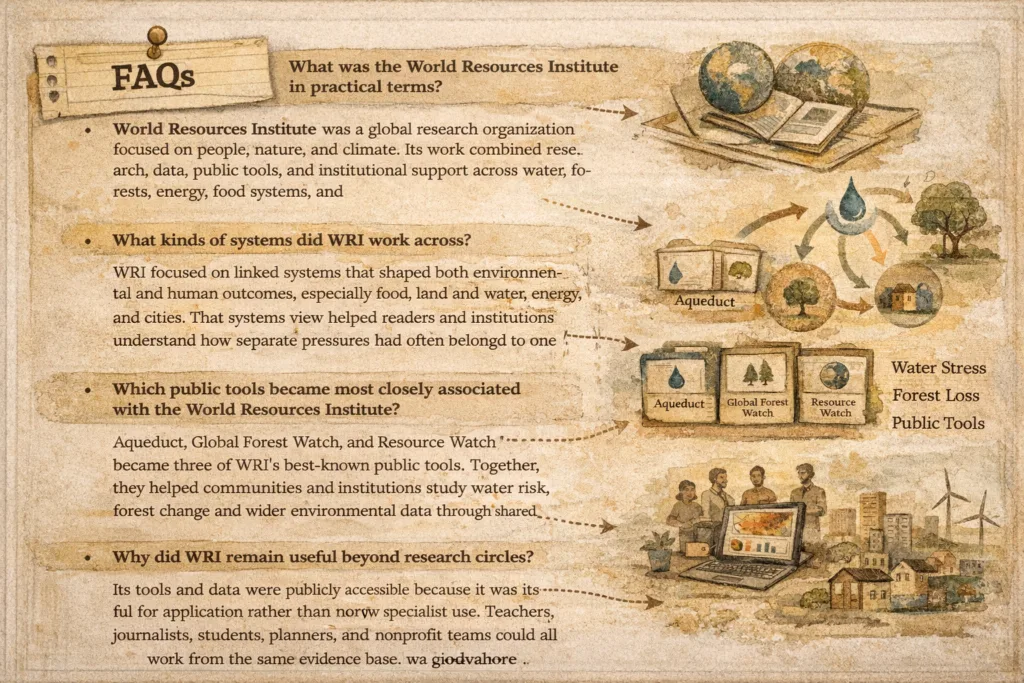
FAQs
The World Resources Institute was a global research organization focused on people, nature, and climate. Its work combined research, data, public tools, and institutional support across water, forests, energy, food systems, and cities.
WRI focused on linked systems that shaped both environmental and human outcomes, especially food, land and water, energy, and cities. That systems view helped readers and institutions understand how separate pressures had often belonged to one connected pattern.
Aqueduct, Global Forest Watch, and Resource Watch became three of WRI’s best-known public tools. Together, they helped communities and institutions study water risk, forest change, and wider environmental data through shared platforms.
Its tools and data were publicly accessible and designed for application rather than narrow specialist use. Teachers, journalists, students, planners, and nonprofit teams could all work from the same evidence base.
They mattered because they helped broad concern move toward specific evidence. Water stress, forest loss, and environmental pressure could be examined by place, severity, and change over time.
Its work linked climate and environmental change to housing, mobility, food supply, public services, heat, land use, and resilience. That wider framing helped communities see those issues as part of the shared conditions they had already been navigating.
World Resources Institute: A Shared Map of Risk, Evidence, and Community Meaning
A quiet starting point often came through Aqueduct, Global Forest Watch, or Resource Watch, where one map or dataset opened a wider story about water, forests, cities, and climate.
More on World Resources Institute
Explore World Resources Institute from every angle: