

Institute for Justice: Why It Exists, Who It Fights, and What Government Power Keeps Breaking
You do not search for the Institute for Justice because the system feels fine. You search because government power keeps crushing people under rules, seizures, licensing blocks, retaliation, and polished legal excuses. The Institute for Justice says it exists to stop those abuses and defend the constitutional rights that let people keep property, speak freely, earn a living, educate their children, and push back when officials cross the line. That claim is not small, and it does not deserve soft handling.
This topic matters because the legal ground IJ works on is where ordinary people get cornered hardest. Property rights, speech, occupational licensing, educational choice, civil forfeiture, and government accountability are not abstract debates for people with time to waste. They shape whether somebody keeps a home, keeps a business, keeps seized money, or keeps any real protection from officials who act like power answers to nobody. IJ says it has argued 13 times at the U.S. Supreme Court, won 11 of those cases, returned $21 million in wrongfully seized assets, supported more than 300 legislative reforms, and helped save 20,000 homes and businesses from eminent domain abuse. When an organization makes claims that large, you do not nod politely. You test them.
This article tears through the core questions people actually ask. What is the Institute for Justice. What fights does it pick. How does it choose cases. How large is it, and what does its money say about its real power. Those are the right questions because institutions hide behind noble language all the time, and people pay the price when nobody bothers to look harder.
In this article
- Institute for Justice is not a soft nonprofit brand. It is a targeted legal weapon.
- Institute for Justice keeps hitting the places where government abuse hurts people most
- Institute for Justice does not take every case. It picks fights that can break bad rules wider open
- Institute for Justice has real money, real scale, and the kind of structure that lets pressure last
The Institute for Justice describes itself as a nonprofit public interest law firm fighting government overreach through litigation, research, legislation, and activism. That description matters, but the sharper point matters more. IJ is not presenting itself as a general legal aid office that tries to patch every injury one by one. It is presenting itself as a constitutional litigation shop that chooses cases with wider implications, then uses those cases to pressure law, policy, and public understanding at the same time.
That distinction changes how you judge it. A general service organization gets measured by how broadly it responds. A mission-driven litigation organization gets measured by whether its targets are clear, whether its case selection makes sense, whether its reported wins match its public posture, and whether its money and staffing support the scale it claims. IJ’s own materials push readers toward mission, issue areas, staff, case intake, annual reporting, and nonprofit records because those are the places where the image either holds or starts to crack. That is exactly where serious readers should look.
Institute for Justice exists because government abuse does not stop itself
The cleanest way to understand the Institute for Justice is this: it says it steps in when government power violates constitutional rights and ordinary people get trapped underneath the damage. Its public materials do not frame that as a side project. They frame it as the reason the organization exists. That gives IJ a sharper profile than the average nonprofit, and it also gives readers a harder standard to apply.
IJ says it was founded in 1991 and grew from a five-person startup into a nationally recognized law firm with offices in six states and headquarters in Arlington, Virginia. Growth alone proves nothing, but sustained growth inside constitutional litigation does show institutional durability. That matters because legal pressure against government abuse means very little if the organization behind it cannot keep showing up, keep funding cases, and keep holding the line when the fight gets expensive.
Institute for Justice is not a soft nonprofit brand. It is a targeted legal weapon.
The Institute for Justice, often shortened to IJ, says it is a nonprofit public interest law firm and a national civil liberties law firm. That language sounds polished, but the substance is harder than the label. IJ says it represents everyday people free of charge when government violates core constitutional rights. That is not generic charity language. That is conflict language, and it should be read that way.
Its public materials show an organization built for selected fights, not universal intake. IJ says it files cases in state and federal courts, conducts research, supports legislation, and trains people to advocate in their communities. That mix tells you they are not betting everything on a single courtroom win and pretending the rest will sort itself out. Broken systems rarely stop after one legal loss. They repackage the same damage in different words, and people get hit again.
That is why IJ makes more sense as a strategic litigation operation than as a general nonprofit story. Readers looking up the Institute for Justice usually want to know what it really is, not what the polished homepage says it is. On the public record, it looks like a mission-driven organization selecting constitutional cases with broader consequences, then trying to turn those cases into pressure far beyond a single client file. That is the right frame, and anything softer misses the point.
Institute for Justice keeps hitting the places where government abuse hurts people most
IJ organizes its public-facing work around a defined group of issue areas. On its site, the main categories are private property, First Amendment, educational choice, and economic liberty. It also names projects like the End Forfeiture Initiative, the Project on Immunity and Accountability, the Project on the Fourth Amendment, the Food Freedom Initiative, and the Zoning Justice Project. That structure matters because it shows discipline. IJ is not pretending to cover every civil-liberties fight in existence. It is concentrating on repeat locations of government harm.
Those categories map directly onto the ways power corners people in daily life. Private property work includes eminent domain and seizures, where homes, businesses, land, or assets can get taken while officials hide behind procedure. Economic liberty work often attacks occupational licensing and entry barriers that block people from earning a living or opening a business. First Amendment work covers speech and retaliation claims, where power punishes people for saying what officials do not want to hear. Educational choice work pushes into school-choice programs and related constitutional disputes, where state control can trap children and families inside systems that are not serving them.
IJ also ties litigation to research and legislative advocacy, and that changes the stakes. A lawsuit can win and still leave the wider machinery intact if nobody follows through. IJ says it has supported more than 300 legislative reforms, which suggests it is trying to force change through more than one lane. That does not make every claim automatically correct, but it does make the organization more legible. It is a specialized constitutional litigation shop with recurring themes, recurring pressure points, and a public identity built around the claim that government abuse is not isolated. It is patterned, repeated, and worth fighting on purpose.
Institute for Justice does not take every case. It picks fights that can break bad rules wider open
The organization says it reviews case submissions through an online form and represents clients free of charge. Its About page says someone from the legal team reviews all submissions and that the usual response window is six to eight weeks if a case may fit. It also says the organization receives far more requests than it can respond to. That is not a gap in the model. That is the model. IJ is selective because it is choosing cases for wider constitutional pressure, not simply processing every problem that arrives.
That selectivity lines up with how IJ describes its litigation strategy. On the home page, it says it files “cutting-edge constitutional cases” aimed not only at defending one client’s rights but also at setting precedent that protects other people. That is the hard center of impact litigation. You identify a fact pattern that can expose a larger abuse, you build the case, and you try to force a rule that reaches past one courtroom. That approach can feel ruthless because it has to be. Systems do not yield because harm exists. They yield when somebody corners the harm inside a case the law cannot easily ignore.
IJ says it wins nearly three out of every four cases it files. In its fiscal year 2024 annual report, it said that period captured only part of what it called its biggest and busiest year yet, with a docket on track to exceed 110 active lawsuits in state and federal courts. The same report noted two U.S. Supreme Court victories during that broader period. Those numbers do not tell you everything about legal significance, but they do tell you this organization is operating at national scale, carrying a heavy docket, and chasing outcomes that can shift rules, not just headlines.
Institute for Justice has real money, real scale, and the kind of structure that lets pressure last
Publicly available data show that IJ does not operate like a tiny boutique office with a loud mission statement and fragile internals. The organization says it has more than 70 full-time attorneys across offices in six states. Charity Navigator lists it as a 501(c)(3) headquartered in Arlington, Virginia and gives it a 100% score with a Four-Star rating. ProPublica’s Nonprofit Explorer and IJ’s own audited statements point to a large national advocacy nonprofit with the administrative backbone to keep litigating, communicating, publishing, and pushing policy over time.
According to IJ’s 2025 audited financial statements, total support and revenue for the year ended June 30, 2025 was about $47.6 million, and total expenses were about $47.7 million. Program services accounted for about $38.8 million of spending. The same filing reported about $143.5 million in total investments and about $178.0 million in total liabilities and net assets. Those are not decorative numbers for a polished annual report. They suggest reserves, operating depth, and a major investment base relative to yearly expenses.
Financial scale does not settle every argument about effectiveness, but pretending it does not matter is nonsense. A national litigation operation handling active lawsuits, appellate work, legislative campaigns, communications, publications, and multistate offices cannot run on moral language alone. It needs durable funding, infrastructure, and staff who can keep pressure on when the fight drags. On the public record, IJ appears to have that capacity. Readers trying to evaluate the Institute for Justice should compare three things at once: what it says on its website, what it reports about lawsuits and reforms, and what independent nonprofit records show about size, transparency, and staying power.
FAQs
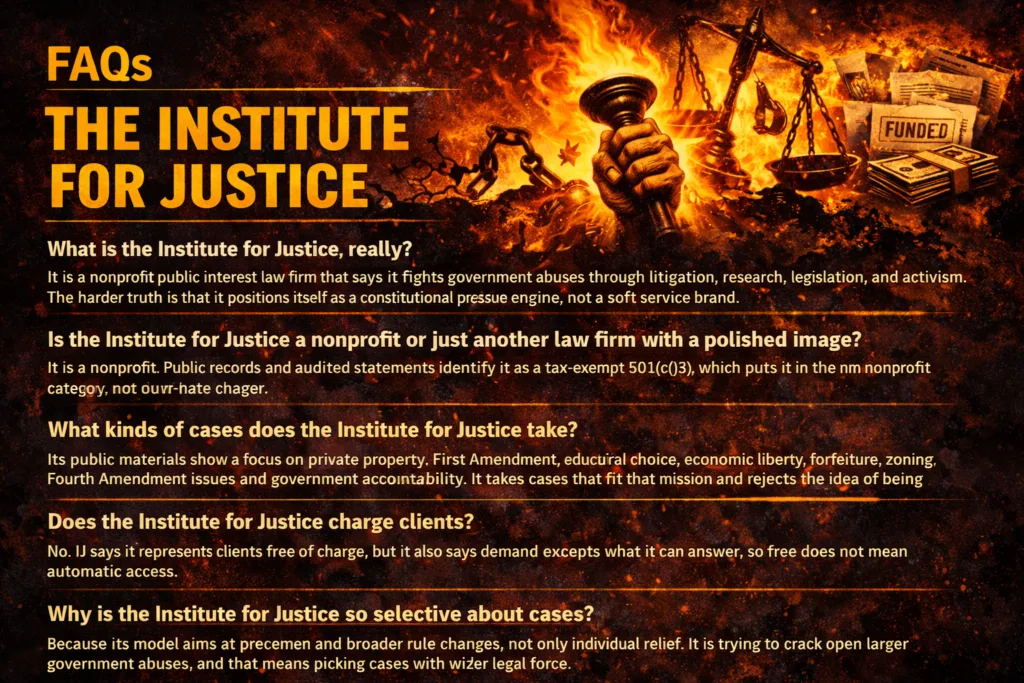
It is a nonprofit public interest law firm that says it fights government abuses through litigation, research, legislation, and activism. The harder truth is that it positions itself as a constitutional pressure engine, not a soft service brand.
It is a nonprofit. Public records and audited statements identify it as a tax-exempt 501(c)(3), which puts it in the nonprofit category, not the private-firm category.
Its public materials show a focus on private property, First Amendment, educational choice, economic liberty, forfeiture, zoning, Fourth Amendment issues, and government accountability. It takes cases that fit that mission and rejects the idea of being a catchall legal fixer.
No. IJ says it represents clients free of charge, but it also says demand exceeds what it can answer, so free does not mean automatic access.
Because its model aims at precedent and broader rule changes, not only individual relief. It is trying to crack open larger government abuses, and that means picking cases with wider legal force.
It says it has more than 70 full-time attorneys, offices in six states, and roughly $47.6 million in fiscal 2025 revenue. That size matters because national constitutional litigation does not survive on outrage alone.
Institute for Justice matters because rights mean nothing when power can ignore them cheaply
Read IJ’s About page, case list, annual report, Charity Navigator profile, and ProPublica nonprofit records yourself, then decide whether its mission, docket, and money prove real pressure or leave government abuse too much room to keep hurting people.