World Resources Institute: I Finally See How It Works and Why It Matters
I come to the World Resources Institute with a quiet sense of relief because its work helps me understand how large environmental issues actually move through real life. I do not only see climate, water, forests, food, energy, and cities as separate subjects when I read this organization. I see how they work together, how pressure in one area touches another, and how that fuller picture can become easier to hold. That is why this topic stays meaningful to me: the World Resources Institute turns difficult systems into something clearer, more practical, and more human.
In this article
- I begin to understand how the World Resources Institute really works
- I notice how the World Resources Institute turns complex problems into something I can grasp
- I keep coming back to the tools that show me how the World Resources Institute works
- I feel why the World Resources Institute matters in real life
I read the World Resources Institute as a place where environmental change becomes easier to understand because the organization does not treat major issues as isolated problems. Its mission is described through three connected aims: meeting people’s essential needs, protecting and restoring nature, and stabilizing the climate while building resilient communities. I find that framing deeply grounding because it keeps practical human needs, ecological care, and long-term stability in the same field of view. That combination gives the work a feeling of steadiness rather than distance.
I also notice that the value of WRI becomes stronger when I read it through the search intent of how it works. I am not only asking what the organization believes or what topics it covers. I am asking how it takes research, data, public tools, and system-level thinking and turns them into something people can use. That question changes the reading in a helpful way, because the answer lives in method, access, and application as much as in mission. When I look at WRI that way, the organization feels much easier to understand.
I feel most grounded when I see how the World Resources Institute actually works
I do not experience the World Resources Institute as a static source of information. I experience it as a working model that gathers evidence, organizes connected systems, builds public tools, and supports better decisions. That movement matters to me because environmental knowledge can feel heavy when it stays abstract. WRI feels more useful when I can see the path from research to tools to real-world understanding.
I begin to understand how the World Resources Institute really works
The World Resources Institute works by connecting research to systems that shape daily life instead of treating environmental problems as separate topics. I see that clearly in its strategic focus on food, land and water, energy, and cities, because those are the places where people, nature, and climate keep meeting each other. That structure helps me understand the organization’s method: it studies linked pressures, then frames them through the systems where change can actually happen. I find that approach reassuring because it gives the work a visible logic.
I also understand WRI better when I notice that it does more than publish reports. The organization produces data, builds applications, supports decision-makers, and works at global and country levels, and that layered model is central to how it works. I do not read that as institutional expansion for its own sake. I read it as a way of making sure evidence can travel from analysis into planning, public understanding, and practical use. That movement from knowledge to application is one of the clearest parts of its working method.
Another part of how WRI works is openness. The organization states that its datasets, applications, and data infrastructure are freely available through its Open Data Commitment, and I feel the importance of that immediately. Open access means the work does not stay inside a small expert circle, because teachers, journalists, students, planners, and nonprofit teams can use the same foundations that support wider research and policy discussions. That openness gives the organization a generous public character, and it also explains why its influence can travel so widely.
I keep returning to this point because it makes the whole model easier to understand. WRI works by joining system-level thinking, research-based analysis, open public resources, and practical decision support into one connected process. I find that process deeply useful because it does not leave knowledge sitting still. It keeps knowledge moving toward places where it can clarify choices and deepen understanding.
I notice how the World Resources Institute turns complex problems into something I can grasp
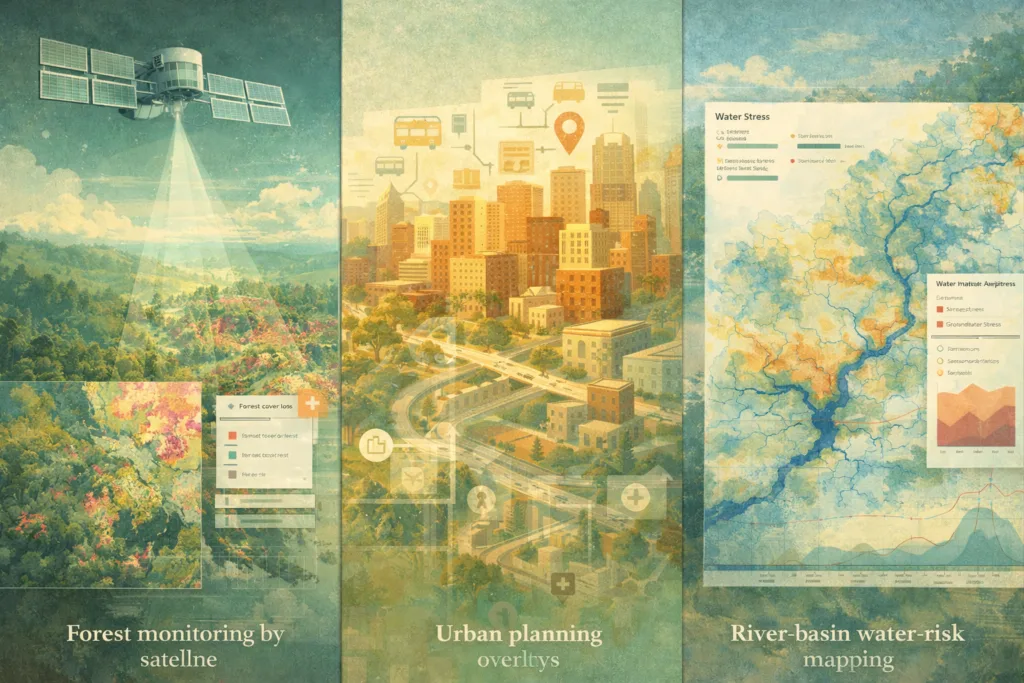
I begin to see the practical side of WRI’s work most clearly when I follow how it handles connected environmental pressure. Water is a strong example because Aqueduct analysis from WRI says 25 countries, home to one-quarter of the world’s population, face extremely high water stress each year. I feel the force of that number because it takes a technical subject and gives it immediate human scale. That is part of how the organization works so well for me: it translates complex risk into something legible without losing seriousness.
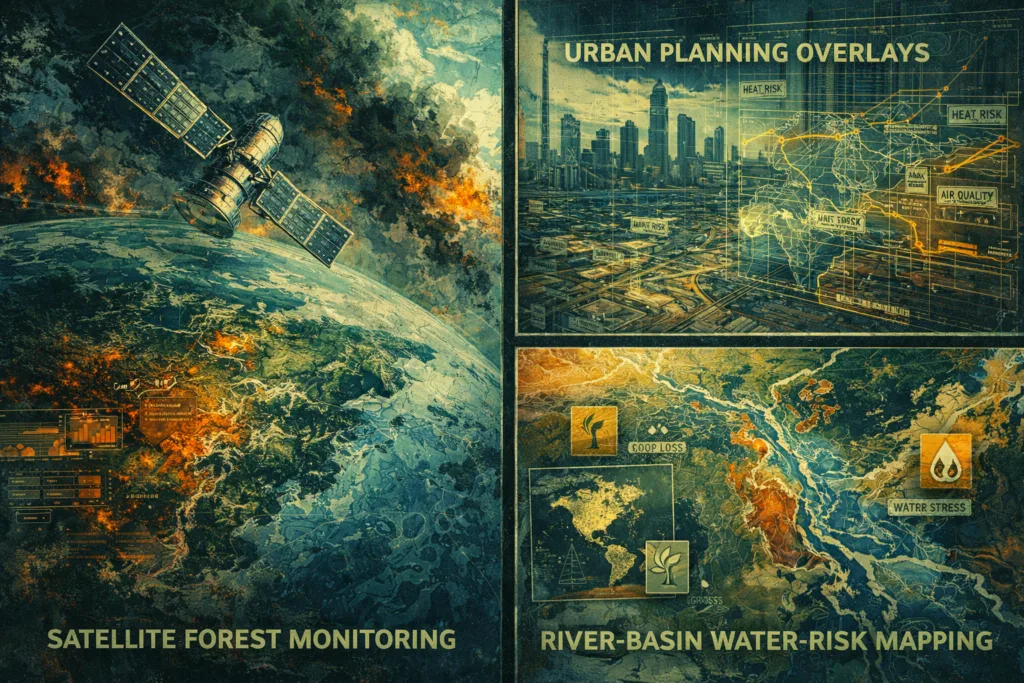
The same pattern appears in the organization’s forest work. Through Global Forest Watch and related analysis, WRI helps users see where forest change is happening and why it matters. The finding that the tropics lost 6.7 million hectares of primary forest in 2024, equal to 18 football pitches a minute, stays with me because it turns scale into something visual and memorable. I notice here that WRI is not simplifying the issue into something shallow. It is making the issue easier to grasp so that attention can become steadier and more informed.
I also see how the organization works through framing. Its strategy argues that progress depends on major transitions in food and land, energy, and cities, and that means climate is not treated as a narrow emissions topic. I appreciate that broader method because it ties environmental change to transport, housing, jobs, public services, resilience, and the design of ordinary life. That fuller frame helps me understand that WRI works by connecting issue analysis to lived systems rather than isolating one metric at a time.
This is where the search intent of how it works feels fully answered for me. The World Resources Institute works by making linked pressures visible, giving them practical form, and showing how they move through real systems that affect people every day. I do not only learn what the issues are. I learn how the organization helps those issues become understandable, actionable, and harder to ignore. That is the point where explanation turns into real usefulness.
I keep coming back to the tools that show me how the World Resources Institute works
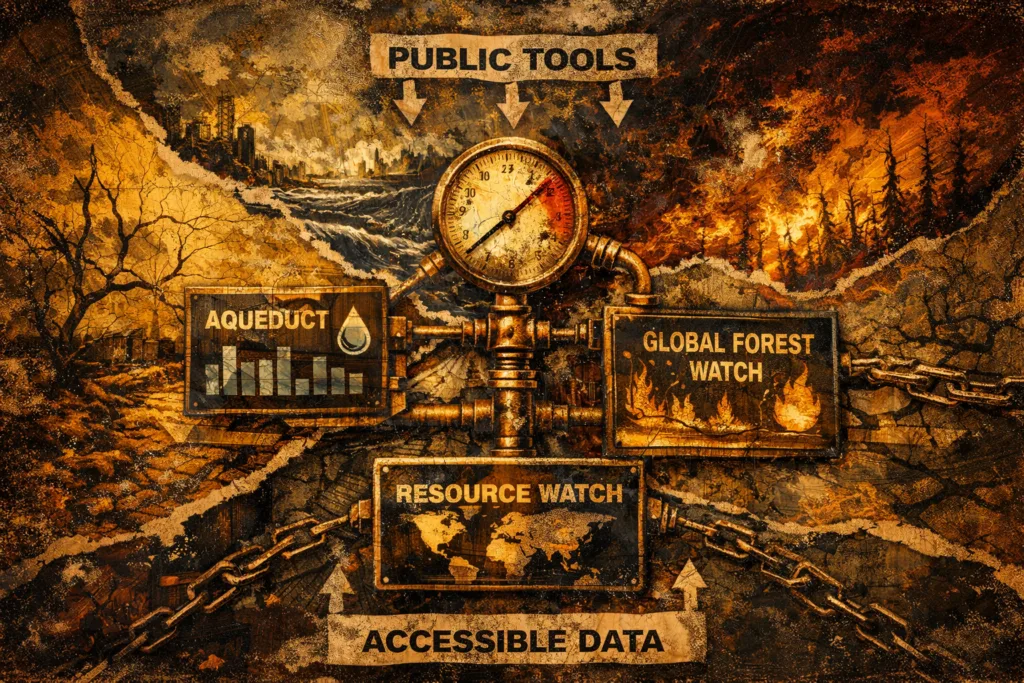
Aqueduct is one of the clearest examples of how the World Resources Institute works in practice because it turns concern about water into place-based evidence. The tool uses open-source, peer-reviewed data to map risks such as water stress, drought, and flooding, and the latest version offers higher-resolution indicators. I find that especially meaningful because it shows the organization’s method in action: gather credible data, structure it clearly, and give users a way to apply it. The tool feels like a calm bridge between awareness and practical understanding.
Global Forest Watch gives me the same sense of method, even though the subject changes from water to forests. WRI presents it as a platform for monitoring forest change through satellite data and related technologies, giving users current information about forest loss and pressure. I appreciate that this does not stay inside conservation language alone, because governments, communities, supply-chain actors, and reporters can all use it. That wide usability helps me see that WRI works by building tools that move across many real settings rather than serving only one audience.
Resource Watch reveals another important part of the model. Organized by WRI and more than 30 partners, it lets users explore more than 200 datasets across climate change, migration, air quality, agriculture, energy, and more. I like what that says about the organization’s working style, because it supports intersection rather than fragmentation. The tool invites users to see how issues overlap, and that makes the larger environmental picture feel more coherent and more honest.
The common thread across these platforms is what I keep trusting most. WRI works by lowering the barrier to understanding without lowering the seriousness of the material. I do not need to sort through scattered databases or move through stacks of technical papers before I begin seeing patterns. The organization packages information into tools that can be searched, mapped, layered, and applied, and that design choice makes the knowledge feel more welcoming and more alive.
I feel why the World Resources Institute matters in real life
The World Resources Institute matters to me because its way of working helps large problems become clearer decisions. Water risk becomes easier to address when it can be mapped. Forest loss becomes harder to overlook when it can be monitored in near real time. Climate and city challenges become more concrete when they are connected to transport, buildings, heat, land, and infrastructure. I feel the practical value there because the work keeps moving toward places where understanding can shape action.
Its open-data model matters in a deeply public way. WRI says good data is the foundation of good decision-making, and that belief becomes meaningful because the organization makes its data infrastructure freely available. I think of a teacher bringing a map into class, a journalist grounding a story in a public dataset, or a city team comparing risks before shaping policy. Those examples help me feel that the organization’s value is not distant or elite. It lives in wider access to shared evidence.
I also understand the organization’s real-world importance through its systems view. WRI is not built around isolated wins or narrow topic framing. It is built around shifting systems and helping institutions navigate transition in ways that work for people as well as the planet. I trust that approach because it feels patient, practical, and broad enough for reality, where pressures rarely stay inside neat boundaries. That is part of why the organization remains relevant across policy, education, civil society, and business.
My lasting takeaway is warm and simple. The World Resources Institute matters because it helps me see how climate, water, forests, food, energy, and cities fit together, and it shows how evidence can move into useful form. I come away not only with more information, but with a clearer sense of how the organization actually works and why that method has real value. That clarity is what makes the work feel durable to me.
FAQs
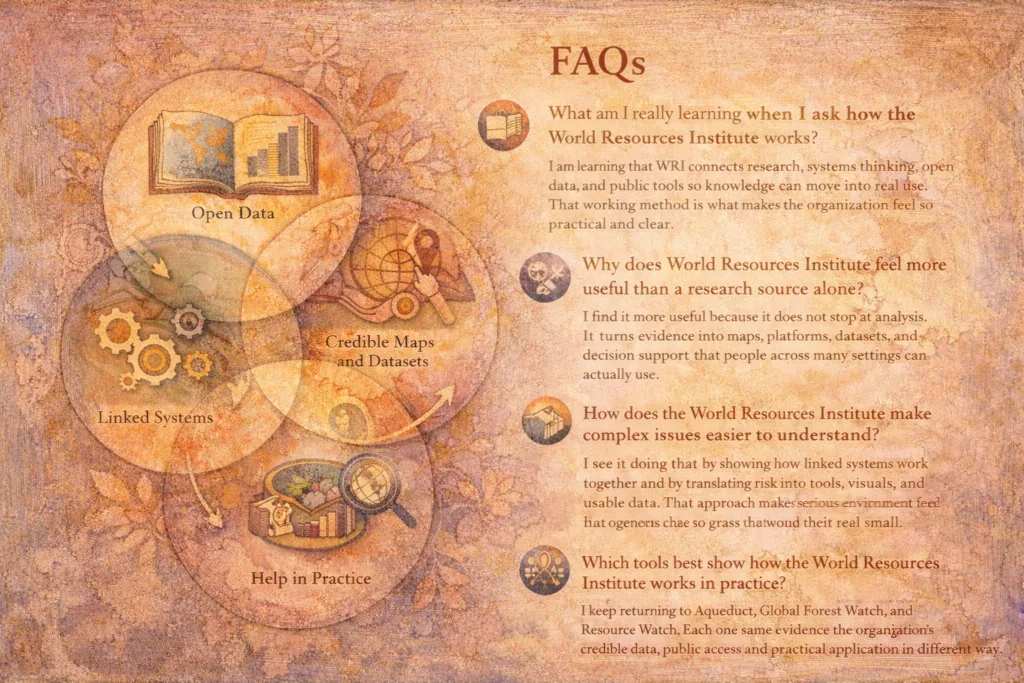
I am learning that WRI connects research, systems thinking, open data, and public tools so knowledge can move into real use. That working method is what makes the organization feel so practical and clear.
I find it more useful because it does not stop at analysis. It turns evidence into maps, platforms, datasets, and decision support that people across many settings can actually use.
I see it doing that by showing how linked systems work together and by translating risk into tools, visuals, and usable data. That approach makes serious environmental change easier to grasp without making it feel small.
I keep returning to Aqueduct, Global Forest Watch, and Resource Watch. Each one shows the same pattern of credible data, public access, and practical application in a different way.
It matters because open access widens who can learn, teach, report, and plan from the same evidence base. That makes the organization’s work feel more generous, more public, and more alive in real settings.
I feel its relevance in the way it connects environmental change to water access, forests, urban heat, infrastructure, and food systems. The work keeps major issues close to lived reality instead of leaving them far away.
I come away from the World Resources Institute with a calmer understanding of how it works and why it matters
I would begin with Aqueduct, Global Forest Watch, or Resource Watch and let one map or dataset gently open a clearer understanding of how this work touches real life.