Understanding the National Women’s Law Center as a Living Framework for Gender Justice
The National Women’s Law Center can be understood as more than an organization, because its work reveals how gender justice is formed through institutions, law, public reasoning, and social responsibility over time. This matters because inequality rarely appears as a single event with a single cause. It usually emerges through patterns that shape work, education, health care, caregiving, and economic stability in connected ways. To understand the National Women’s Law Center, therefore, is to recognize that meaningful support depends on more than intention. It depends on structures that can identify unfairness, interpret its causes, and create conditions that lead to greater protection and alignment in practice.
In this guide, the discussion unfolds through four connected principles:
- The National Women’s Law Center reveals that personal hardship often reflects institutional design
- Legal advocacy and policy change show how protection becomes durable over time
- Workplace rights, care, education, and economic security form one interconnected pattern
- Resources and public engagement transform awareness into participation and public meaning
This guide explores the National Women’s Law Center through a reflective and systems-level lens, which means it does not only describe what the organization does. It also clarifies why that work matters, what larger patterns it reveals, and how those patterns shape lived experience over time. The National Women’s Law Center advances gender justice through legal advocacy, policy change, and public education, and each of these functions helps us understand a deeper principle: fairness becomes real when institutions are capable of recognizing inequality and responding to it with continuity, accountability, and practical support.
That principle deserves careful attention because many barriers in daily life do not appear to be systemic at first. They may feel private, isolated, or difficult to name. Yet when people begin to examine wage inequality, workplace discrimination, unequal educational opportunity, barriers to care, or economic instability, they often discover recurring structures beneath those experiences. The National Women’s Law Center helps bring those structures into view. As a result, its work offers not only advocacy, but also clarity. It gives readers a way to interpret how gender justice support is built, why it must address more than one area of life, and how legal and social alignment leads to more stable conditions in practice.
How the National Women’s Law Center Creates Gender Justice Through Structure, Clarity, and Durable Protection
The National Women’s Law Center creates support by connecting individual experience to institutional reality. This connection matters because people often encounter inequality through immediate circumstances, while the causes of that inequality remain partially hidden inside systems of law, policy, and public priority. The organization helps clarify those causes, which means its work is both practical and interpretive. It provides resources and pathways for support, while also revealing the patterns that explain why certain harms persist and what kinds of structural change can reduce them over time. In this sense, the National Women’s Law Center can be understood as both a source of assistance and a framework for understanding how gender justice becomes possible.
The National Women’s Law Center Reveals That Personal Hardship Often Reflects Institutional Design
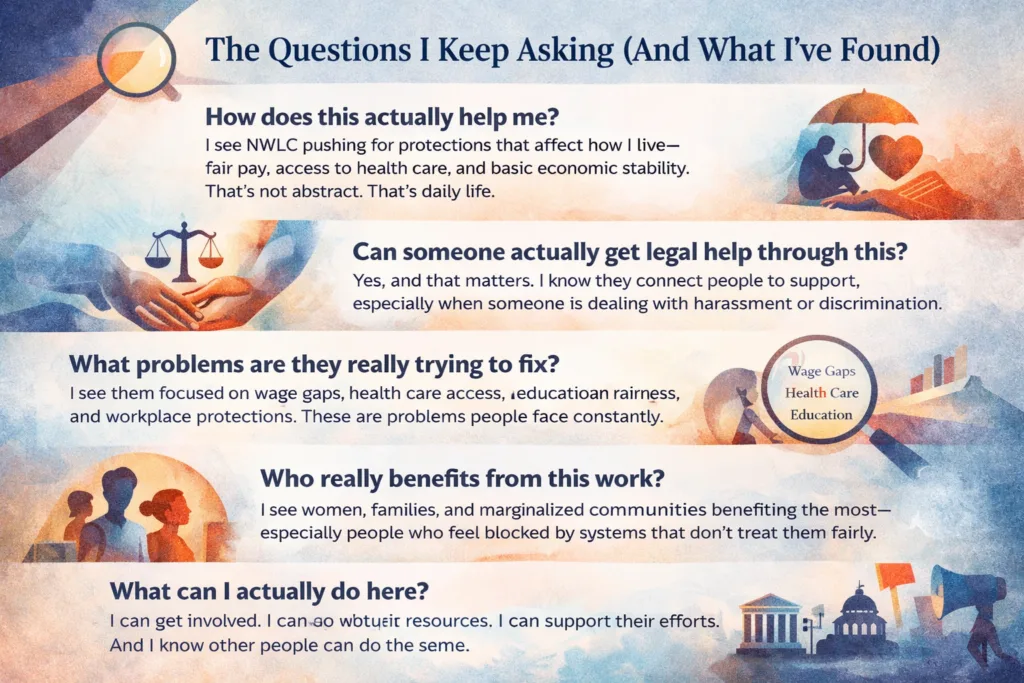
The National Women’s Law Center works to address barriers related to fair pay, health care, education, employment, and family well-being. What this reveals is an important principle: many experiences that feel deeply personal are also shaped by larger institutional conditions. A person may experience exclusion, instability, or unfair treatment as an individual burden, yet that burden often reflects the design of workplaces, legal systems, educational structures, or care arrangements that distribute support unevenly. When this pattern becomes visible, the meaning of support changes. It becomes less about isolated relief and more about understanding the systems that produce recurring forms of hardship.
This matters because interpretation influences response. When inequality is experienced without context, people may struggle to understand whether what they are facing is accidental, personal, or structural. The National Women’s Law Center helps clarify that context by focusing on rights, protections, and barriers that affect everyday life. As a result, people are better able to recognize that unequal outcomes may reflect systemic arrangements rather than private inadequacy. That recognition has practical importance because it restores legitimacy to concerns that might otherwise remain minimized or misunderstood.
There is also a deeper implication here. Rights are not only formal ideas written into legal language. They are lived conditions that influence whether people can work with dignity, care for family members, pursue education, and access necessary support. Because these conditions are shaped by institutions, meaningful gender justice support must engage those institutions directly. The National Women’s Law Center reveals this clearly. Its role is significant not only because it responds to need, but because it helps society understand where that need comes from and what structural responsibility requires.
Legal Advocacy and Policy Change Show How Protection Becomes Durable Over Time
NWLC uses litigation, public policy advocacy, and research to influence the legal and institutional structures that shape daily life. This approach is significant because unfairness does not disappear simply because it has been recognized. It often continues until the rules, priorities, and enforcement mechanisms that sustain it begin to change. Legal advocacy matters, therefore, because it helps move concern into structure. It translates social recognition into standards, protections, and accountability that can endure beyond a single moment.
Policy change carries a similar meaning. It may appear distant from ordinary experience, yet it often determines which forms of support become available, whose needs are treated as legitimate, and how institutions define responsibility. This is why policy work should not be understood as abstract or secondary. In practice, policy shapes the material conditions under which people live, work, learn, and seek care. It influences what is possible, what is protected, and what remains vulnerable. As a result, policy advocacy is one of the ways justice takes institutional form.
The National Women’s Law Center helps clarify this relationship between structure and experience. It reveals that courts, lawmakers, and research are not separate from ordinary life, because their decisions and frameworks produce consequences that enter daily reality in quiet but lasting ways. A stronger workplace protection, a clearer public standard, or a more equitable policy does not remain theoretical for long. It leads to changed conditions, changed expectations, and changed possibilities over time. Therefore, legal advocacy and policy change can be understood as forms of durable care. They do not only respond to harm after it appears. They help produce a context in which harm is less likely to be normalized in the future.
Workplace Rights, Care, Education, and Economic Security Form One Interconnected Pattern
One of the clearest insights revealed by NWLC’s work is that gender justice cannot be understood through a single issue alone. Workplace rights, child care, health care, education, and economic security are deeply interconnected because lived experience is interconnected. A challenge in one area often leads to instability in another. This means inequality rarely stays contained within neat categories. It moves across systems, shaping opportunity, stress, autonomy, and long-term well-being through overlapping pressures rather than isolated events.
This interconnectedness helps explain why a narrow response is often incomplete. Equal pay is not only about compensation. It also shapes housing stability, access to care, family resilience, and future possibility. Child care is not only a family concern. It influences whether work is sustainable, whether opportunity remains accessible, and whether caregiving is recognized as part of social reality rather than treated as a private obstacle. Education is not only about schooling. It helps structure future participation, economic mobility, and access to civic life. Health care is not only about treatment. It affects dignity, bodily autonomy, and the practical ability to engage fully in public and private life.
The National Women’s Law Center reflects an understanding that fairness must be approached with this fuller pattern in mind. That breadth is not a sign of vagueness. It is a sign of accuracy. When an organization addresses connected systems together, it reveals the underlying structure that links them. As a result, readers are able to move from fragmented interpretation to systems-level understanding. That shift matters because people are more likely to recognize meaningful change when they understand that justice must account for the full texture of life, not only one visible part of it.
There is a philosophical implication here as well. Gender justice is not merely the correction of separate wrongs. It is the gradual creation of alignment between institutions and lived human reality. That alignment requires seeing how work, care, education, health, and economic security influence one another. NWLC’s focus helps make that relationship visible, which means its work supports not only reform, but also deeper understanding.
Resources and Public Engagement Transform Awareness Into Participation and Public Meaning
Individuals can access NWLC resources through its website, where information, advocacy tools, and connections to legal support help turn concern into orientation. This matters because awareness by itself is often incomplete. A person may realize that something feels wrong and still lack the language, context, or pathway needed to respond effectively. Resources become meaningful when they do more than inform. They help people recognize what they are experiencing, understand how it relates to larger structures, and identify what forms of support are available in practice.
Programs such as the TIME’S UP Legal Defense Fund help make this process easier to understand. They show how support can move from principle into application by connecting people facing workplace harassment or sex discrimination with avenues for assistance. What is important here is not only the existence of help, but the way help is made intelligible. People are more likely to act with clarity when they can see the relationship between an immediate problem and the larger legal or institutional framework surrounding it. In that sense, resources do not simply deliver answers. They help create coherence.
Public engagement adds another layer of meaning. When individuals use advocacy tools, seek legal help, or participate in campaigns, they are not only responding to private difficulty. They are also contributing to a broader public process through which rights become more visible and accountability becomes more thinkable. This is significant because justice depends partly on what a society can collectively recognize, name, and defend. Over time, participation helps shape public understanding, and public understanding helps shape institutions. As a result, engagement is not only a practical option. It is one of the ways social meaning changes.
The National Women’s Law Center helps sustain this movement from awareness to participation. It does so by offering resources that ground people in context while also inviting them into a wider framework of responsibility and possibility. Therefore, its resources are not only supportive in an immediate sense. They help produce a culture in which fairness is easier to articulate, easier to defend, and more difficult to ignore.
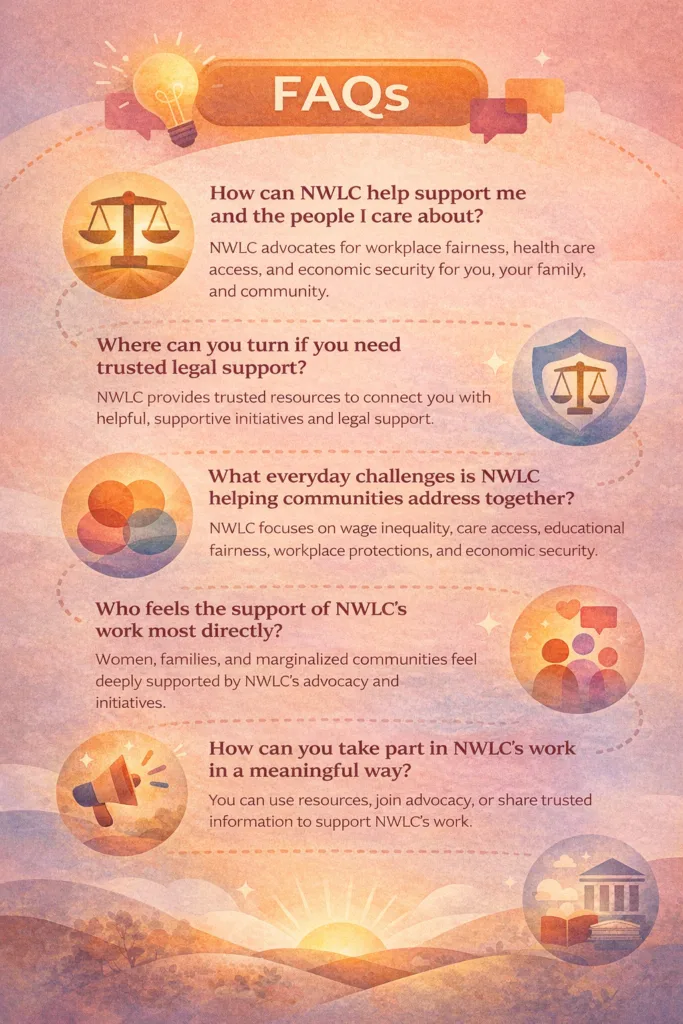
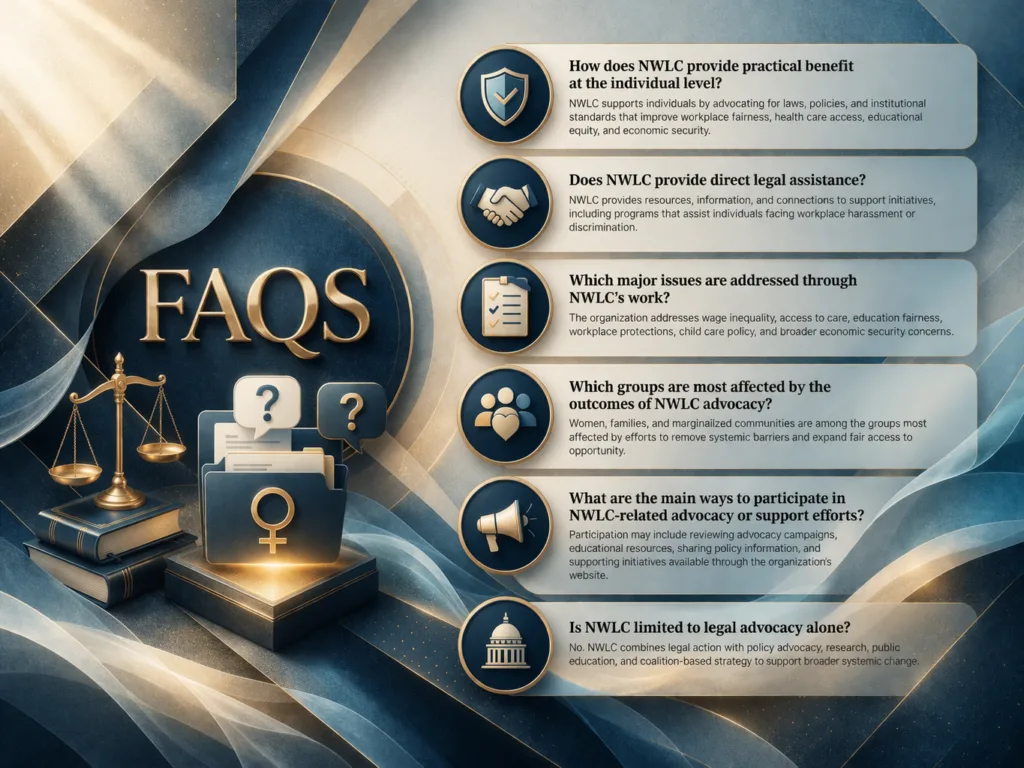
FAQs
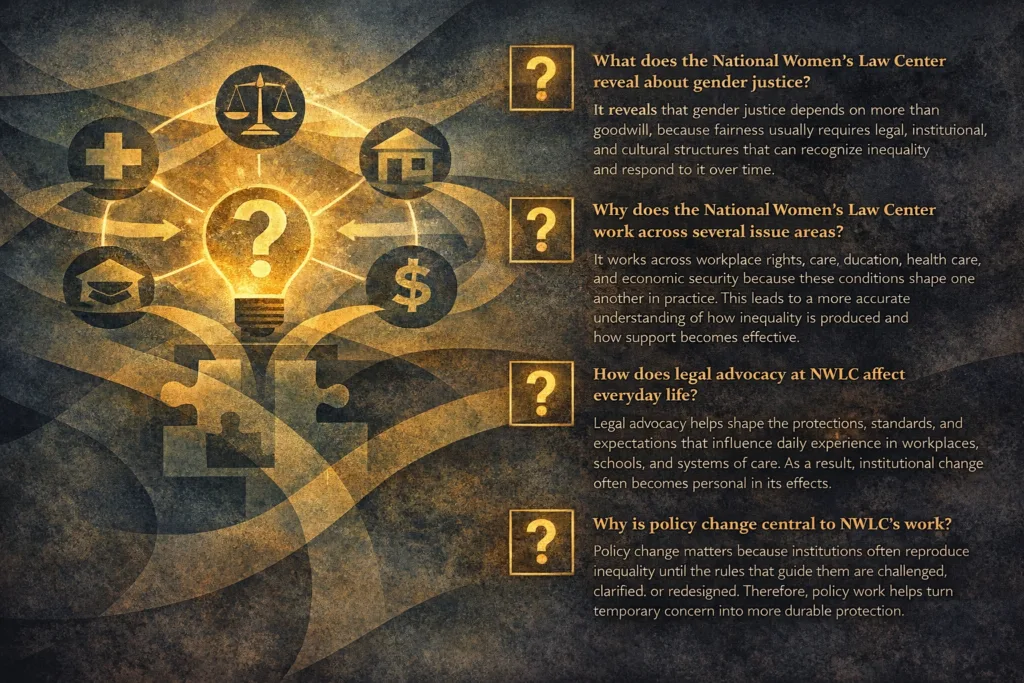
It reveals that gender justice depends on more than goodwill, because fairness usually requires legal, institutional, and cultural structures that can recognize inequality and respond to it over time.
It works across workplace rights, care, education, health care, and economic security because these conditions shape one another in practice. This leads to a more accurate understanding of how inequality is produced and how support becomes effective.
Legal advocacy helps shape the protections, standards, and expectations that influence daily experience in workplaces, schools, and systems of care. As a result, institutional change often becomes personal in its effects.
Yes. NWLC provides resources, legal help connections, and support pathways, including the TIME’S UP Legal Defense Fund for workplace harassment and sex discrimination concerns.
Policy change matters because institutions often reproduce inequality until the rules that guide them are challenged, clarified, or redesigned. Therefore, policy work helps turn temporary concern into more durable protection.
Women, families, and marginalized communities benefit from efforts that reduce systemic barriers and expand access to fair treatment. More broadly, the public benefits when institutions become more coherent, accountable, and responsive to lived reality.
The National Women’s Law Center and the Deeper Meaning of Gender Justice
The National Women’s Law Center helps us understand a principle that is easy to overlook when public life is discussed only in fragments: justice becomes meaningful when institutions are able to recognize lived inequality and respond with structure, continuity, and care. Its work matters because it joins legal advocacy, policy change, and public education into a framework that does more than answer immediate need. It clarifies why harm persists, reveals the patterns that lead to exclusion, and supports the conditions under which fairer outcomes can emerge over time.
In this sense, the National Women’s Law Center is not only a source of support. It is also a way of understanding how gender justice takes shape in practice. It reminds us that fairness is rarely created through intention alone. It is produced through alignment between rights, institutions, resources, and public understanding. When that alignment is weak, inequality becomes easier to normalize. When that alignment is strengthened, dignity, protection, and participation become more possible.
To engage with the work of the National Women’s Law Center, therefore, is to recognize that gender justice support is both practical and interpretive. It offers help in immediate contexts, yet it also reveals how larger systems shape what people experience, what they can expect, and what forms of change remain possible. That broader understanding is part of what makes the organization significant. It does not only respond to the world as it is. It helps clarify the principles through which a more just world can be built over time.