Institute for Justice: How I Hold Its Mission, Cases, and Impact in Mind
I come to the Institute for Justice with a gentle kind of attention because its work seems to sit where constitutional principle meets ordinary life. I read it as a nonprofit public interest law firm that places itself against government overreach, and I feel the center of its mission most clearly when it speaks about securing the rights that allow Americans to pursue their dreams. That language stays with me because it makes law feel close to lived experience rather than far away from it.
In this article
- I feel the Institute for Justice present itself as a focused constitutional law firm
- I sense the Institute for Justice reveal itself through a careful cluster of rights
- I notice the Institute for Justice choose cases that seem meant to protect lives beyond the first one
- I read the Institute for Justice as a large nonprofit with steady strength behind its work
I find that interest in the Institute for Justice often begins in a sincere and simple place. I see readers trying to understand what it is, what it does, what legal themes shape its work, whether it is a nonprofit, and how its litigation record and financial profile fit together. That curiosity feels natural to me because the organization presents itself as both values-driven and highly active. It invites a closer reading by speaking in moral, legal, and organizational language at the same time.
Its own public materials seem arranged to meet that curiosity with unusual clarity. I notice mission language, issue pages, case intake information, staff pages, financial reports, and organizational history placed where a careful reader would hope to find them. That structure gives me a feeling of openness rather than distance. I leave the introductory material with the sense that the Institute for Justice wants its ideals, its methods, and its scale to be understood together.

My personal reading of the Institute for Justice through mission, rights, case choice, and scale
I come away from the available material with a steady feeling that the Institute for Justice is not trying to become everything at once. I read it as a specialized constitutional litigation nonprofit with a defined sense of purpose and a selective way of living out that purpose through cases. That concentration gives the organization a shape that feels contained, recognizable, and emotionally coherent in my mind. I do not experience it as broad and diffuse. I experience it as focused and deliberate.
As I move through its mission language, issue categories, litigation approach, and public financial data, that impression deepens rather than softens. Each layer adds another form of clarity to the one before it. I feel a repeated return to the same core constitutional commitments, and that repetition makes the organization easier to understand. The more closely I read it, the more the Institute for Justice feels like a nonprofit built around recurring principles rather than scattered causes.
I feel the Institute for Justice present itself as a focused constitutional law firm
The Institute for Justice, often shortened to IJ, describes itself as a nonprofit public interest law firm and a national civil liberties law firm. I read that description as the calm center of its identity because its About page says it represents everyday people when government violates what it calls their most important constitutional rights. The organization says it was founded in 1991 and grew from a five-person startup into a nationally recognized law firm, while public nonprofit profiles place its headquarters in Arlington, Virginia. That history gives me the feeling of a small beginning that has been carried forward with persistence and purpose.
I do not read IJ as a general legal aid provider, and that distinction matters in the way I understand its role. Its home page and About page suggest a mission-driven litigation organization that selects cases with broader constitutional implications rather than responding to every legal problem in front of it. The organization says it files cases in state and federal courts, conducts research, supports legislation, and trains members of the public to advocate in their communities. That combination leaves me with the sense of a law firm that wants each case to do more than resolve one dispute. It seems to want a case to express a principle that can reach further.
I also notice that the Institute for Justice speaks about rights in a way that feels personally grounded rather than emotionally flat. Its mission language centers on securing the constitutional rights that allow Americans to pursue their dreams. I stay with that phrasing because it gives legal doctrine an affective purpose without leaving constitutional language behind. In my reading, the organization presents law as something that helps preserve the shape of a life, not only the terms of a legal argument. That is part of what makes its public voice feel distinct to me.
I sense the Institute for Justice reveal itself through a careful cluster of rights
When I look at the Institute for Justice’s public-facing work, I do not see a broad claim over every civil-liberties question. I see a defined cluster of issue areas that gives the organization a clear and recognizable outline: private property, First Amendment, educational choice, and economic liberty. Its named projects include the End Forfeiture Initiative, the Project on Immunity and Accountability, the Project on the Fourth Amendment, the Food Freedom Initiative, and the Zoning Justice Project. That structure helps me feel the organization’s priorities instead of merely listing them.
Each issue area points toward a place where individual freedom and government power seem to meet in direct and recurring ways. Private property work includes eminent domain and seizure disputes, while economic liberty work often addresses occupational licensing and barriers that make it harder for small businesses to begin or continue their work. First Amendment matters cover speech and retaliation claims, and educational choice work addresses school-choice programs and related constitutional questions. I find that pattern quietly persuasive because the same underlying concern seems to return again and again. The Institute for Justice appears to keep coming back to legal spaces where a person’s ability to act, speak, keep property, or pursue work may depend on constitutional protection.
This concentration also changes how I hold the organization in mind as an institution. A narrower issue mix makes it easier for courts, donors, journalists, and policymakers to recognize what the Institute for Justice stands for, and that gives its public identity a stronger internal coherence. IJ says it has supported more than 300 legislative reforms, and I read that detail as a sign that litigation is only one expression of its work. In my view, the organization appears less like a general advocacy nonprofit and more like a specialized constitutional litigation shop returning, with unusual consistency, to a careful set of freedoms.
I notice the Institute for Justice choose cases that seem meant to protect lives beyond the first one
The Institute for Justice describes a free representation model, and I feel that detail carries both warmth and seriousness. Its public materials say that clients are represented free of charge and that case submissions are reviewed through an online form. The About page states that someone from the legal team reviews all submissions, with a typical response window of six to eight weeks if the case may be a fit. At the same time, the organization says it receives more requests than it can respond to. That leaves me with a clear sense of selectivity, but it also leaves me with the impression that selectivity is part of a larger legal purpose rather than a retreat from one.
That selectivity seems deeply connected to the litigation strategy the organization describes for itself. On its home page, IJ says it files cutting-edge constitutional cases intended not only to defend clients’ rights, but also to set precedent that protects others. I experience that as the emotional and strategic center of its case model. A lawsuit is not presented as an ending in itself, but as a way of reaching a broader legal rule that may offer protection beyond the original dispute. That makes the screening process feel grounded and coherent to me, because the first story is being chosen with later stories already in mind.
Its reporting reinforces that sense of a national, precedent-oriented docket. IJ says it wins nearly three out of every four cases it files, and its fiscal year 2024 annual report describes that period as part of its biggest and busiest year yet. The same report says the docket was on track to exceed 110 active lawsuits in state and federal courts and notes two U.S. Supreme Court victories during that broader period. Those figures do not answer every question for me, yet they do create a picture of an organization working at scale with a clear desire for one case to carry meaning far beyond one file, one courtroom, or one moment.
I read the Institute for Justice as a large nonprofit with steady strength behind its work
Public financial and organizational data leave me with the feeling that the Institute for Justice is not a small boutique litigation office. The organization says it has more than 70 full-time attorneys across offices in six states, and that alone suggests a national footprint with meaningful institutional depth. Charity Navigator lists it as a 501(c)(3) headquartered in Arlington, Virginia and gives it a 100% score with a Four-Star rating. ProPublica’s Nonprofit Explorer and IJ’s own audited statements deepen that impression by showing revenue, assets, and operational scale that support a substantial multistate legal effort. I read all of that with a sense of steadiness rather than spectacle.
According to IJ’s 2025 audited financial statements, total support and revenue for the year ended June 30, 2025 was about $47.6 million, while total expenses were about $47.7 million. Program services accounted for about $38.8 million of spending, and the same filing reported total investments of about $143.5 million and total liabilities and net assets of about $178.0 million. I read those figures with a feeling of continuity because they suggest reserves, infrastructure, and long-term capacity. The financial picture feels durable rather than fragile. It gives the organization the appearance of something built to continue its work with patience.
I do not think financial scale answers every question about value, and I do not feel drawn to treat size as a complete measure of meaning. Still, it matters because sustained constitutional litigation asks for more than conviction alone. A national docket, appellate work, legislative campaigns, publications, communications, and multistate offices all depend on durable funding and administrative support. In the case of the Institute for Justice, the public record leaves me with the impression of an organization whose material capacity matches the seriousness of the mission it describes. That alignment between mission and means feels central to how I understand its reach.

FAQs
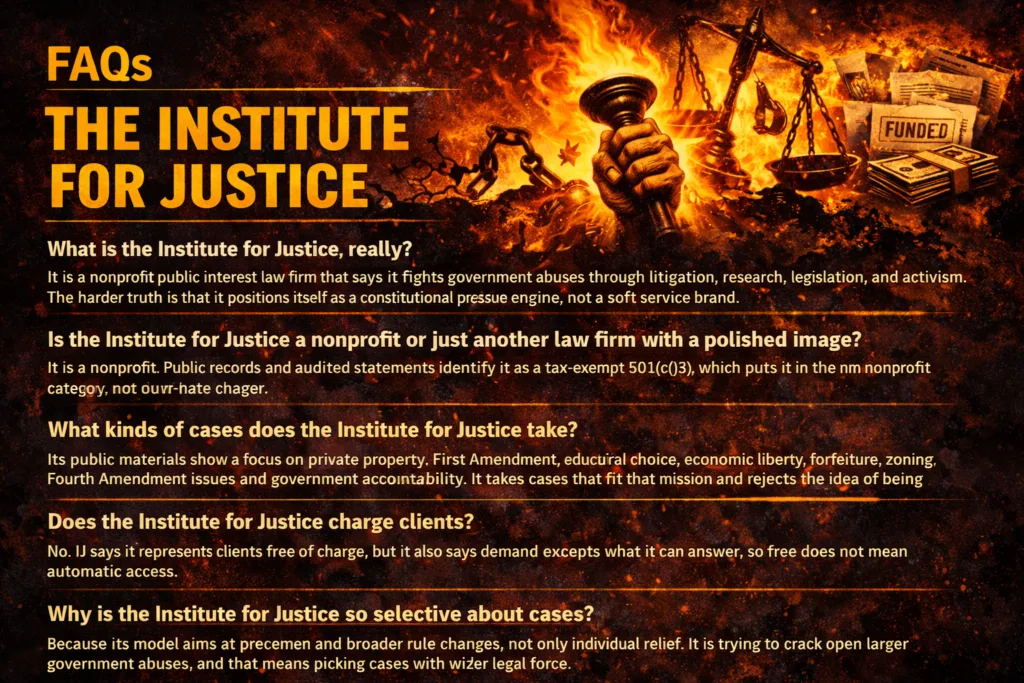
I understand the Institute for Justice as a nonprofit public interest law firm in the United States. Its public description centers on constitutional litigation, research, legislation, and activism aimed at limiting abuses of government power.
Yes, that is how the public record presents it. Charity Navigator lists IJ as a 501(c)(3), and its audited statements also identify it as tax-exempt under section 501(c)(3) of the Internal Revenue Code.
I see a recurring focus on private property, First Amendment, educational choice, economic liberty, forfeiture, government accountability, zoning, and Fourth Amendment issues. Its public materials also say that submissions are reviewed for fit with its mission.
No, its public materials say it represents clients free of charge. I also notice that it says it receives more requests than it can respond to, so the free model still works through a careful and selective intake process.
It reads to me as a large national litigation nonprofit rather than a small advocacy project. The organization says it has more than 70 full-time attorneys, offices in six states, and about $47.6 million in annual revenue for fiscal 2025.
I think that comes from the way it describes its lawsuits as precedent-setting efforts meant to protect others too. Its issue focus and reported legislative reforms make it feel present not only in case filings, but in broader public conversations about constitutional rights.
How the Institute for Justice settles in my mind with steadiness
I find the clearest understanding by sitting quietly with IJ’s About page, case materials, annual report, and nonprofit filings side by side.