The Marine Mammal Center: Ocean Health Interpretation Through Rescue, Research, and Conservation
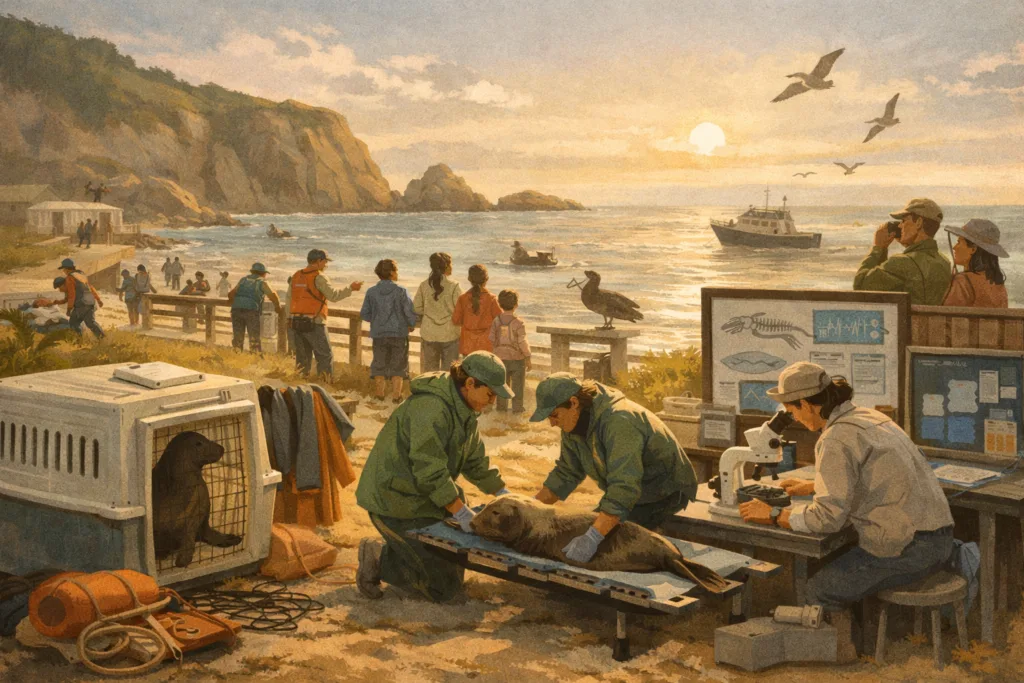
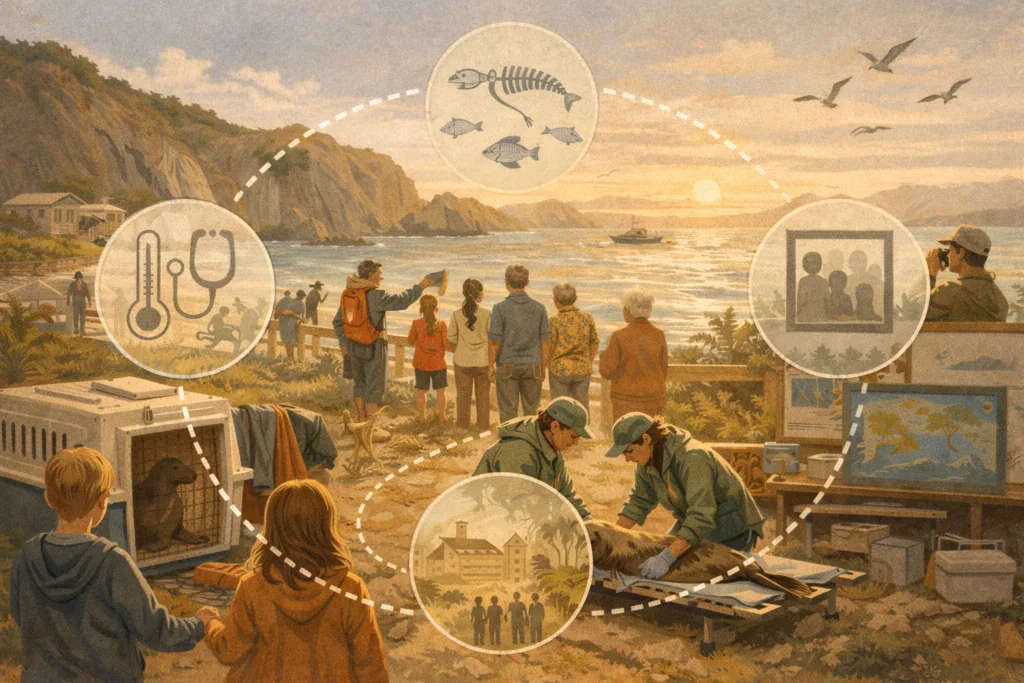
The Marine Mammal Center represents an institutional model in which marine mammal care functions as ocean health interpretation. Rescue and rehabilitation supply clinical intervention, while research and education convert individual animal distress into ecological evidence and public guidance. Within that structure, stranded marine mammals carry significance beyond immediate pathology because each admission may disclose toxin exposure, infectious disease, trauma patterns, food stress, or broader ecosystem disruption. Ocean health therefore becomes legible through systematic observation of marine mammal condition rather than through abstraction alone.
In this article
- The Marine Mammal Center mission structure and ocean health interpretation
- Marine mammal rescue and rehabilitation as diagnostic infrastructure
- Research translation and educational diffusion in ocean health governance
- The Marine Mammal Center Hawaii program and endangered species recovery
A wildlife hospital description captures only one layer of institutional meaning. The deeper structure concerns signal detection across marine systems shaped by climate pressure, pollution exposure, harmful algal bloom activity, vessel interaction, entanglement, prey instability, and public health risk. NOAA treatment of strandings within a national response and monitoring framework reinforces that interpretation by positioning marine mammals as indicators of broader ocean conditions. The central analytic conclusion follows directly from that framework: marine mammal rescue addresses immediate biological crisis, while associated evidence supports stronger interpretation of ecosystem condition.
Analytical Framework
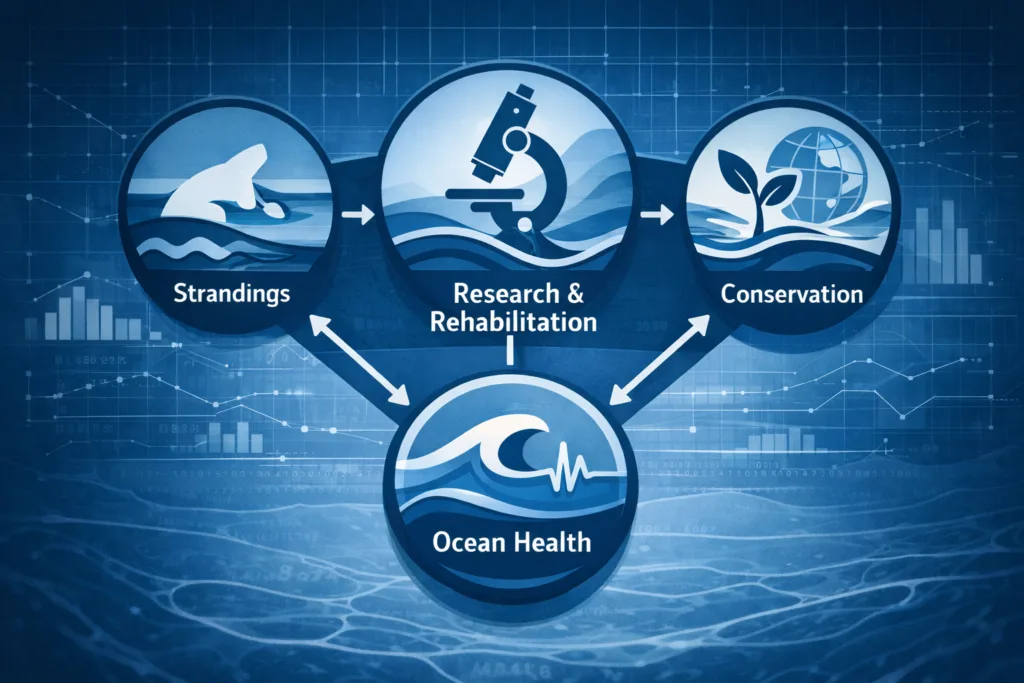
The Marine Mammal Center presents an integrated model rather than a collection of unrelated services. Rescue and rehabilitation create access to patient-level evidence, research transforms case detail into pattern recognition, and education distributes applied meaning through public guidance and climate communication. California operations and Hawaiʻi conservation work reveal the same institutional logic across different operational contexts, from recurrent stranding response to endangered species recovery. Measured as structure rather than sentiment, the organization functions as a clinical, scientific, and interpretive platform for ocean health analysis.
The Marine Mammal Center mission structure and ocean health interpretation
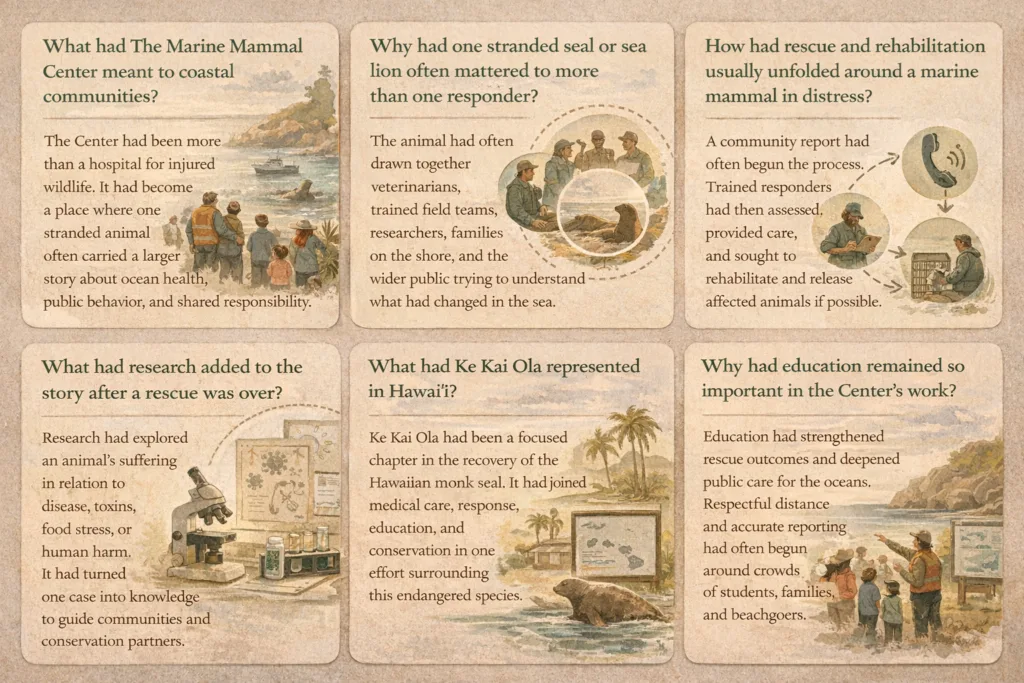
The Marine Mammal Center defines institutional purpose through marine mammal rescue and rehabilitation, research, and education, with ocean health advancement as the unifying concept. That phrasing matters because clinical care gains analytical status within a larger conservation system. A rescued sea lion or seal does not represent only a patient under treatment; the same animal may also reveal domoic acid exposure, disease circulation, plastic interaction, entanglement history, vessel trauma, or nutritional stress linked to ecosystem instability. Mission language therefore establishes the Center as both treatment facility and interpretive institution.
Historical duration strengthens that role. Work traced to 1975 provides longitudinal perspective through case records, stranding observations, laboratory analysis, and field response experience accumulated across decades. Single incidents often appear isolated, while recurring case patterns disclose structural pressures within a region. One stranded animal may suggest emergency; repeated admissions over time may indicate environmental strain, changing prey conditions, or expanding exposure to human-caused hazards. Institutional memory thus increases explanatory capacity.
The Center also describes institutional scale through characterization as the world’s largest marine mammal hospital. That claim matters less as branding than as an indicator of evidence volume. Large admission totals generate richer comparative material for symptom clustering, diagnostic trend recognition, and conservation inference. Marine mammal care becomes especially valuable when clinical information remains connected to broader ecological interpretation.
The strongest conceptual insight concerns integration. Rescue creates the entry point, rehabilitation produces biological stabilization, research identifies larger patterns, and education extends operational meaning into public understanding. No element stands alone. The Center’s structure depends on the proposition that individual animal distress contains ecosystem information and that systematic analysis can convert that information into broader ocean health knowledge.
Marine mammal rescue and rehabilitation as diagnostic infrastructure
Marine mammal rescue and rehabilitation follow a sequence built around rescue, rehabilitation, release, and research. Surface simplicity conceals substantial institutional complexity because effective intervention depends on trained responders, veterinary judgment, federal coordination, case documentation, and disciplined public distance. NOAA authorization of trained organizations within the stranding network establishes that complexity clearly. Public reporting initiates the process, while professional assessment determines whether intervention is necessary and whether rescue offers a realistic path toward release and data collection value.
Operational scale illustrates continuity. During 2024, the Center rescued 941 marine mammals, a figure equivalent to roughly two or three animals each day across the year. That total conveys more than workload volume. Continuous admissions create repeated opportunities for comparison across symptom patterns, age classes, species distributions, and environmental conditions. Repetition allows diagnostic signals to emerge from cases that might otherwise appear isolated or anecdotal.
Rehabilitation itself serves a dual function. Clinical treatment seeks stabilization, recovery of strength and function, and eventual return to the wild when feasible. At the same time, rehabilitation generates evidence regarding trauma source, toxin burden, infectious disease expression, malnutrition, orphaning, or exposure to fishing gear and vessel interaction. A cluster of neurologic signs may suggest harmful algal bloom activity; recurring injury profiles may point toward repeated human-caused threat pathways; rising malnourishment among young animals may indicate prey scarcity within surrounding waters.
For that reason, rehabilitation functions as diagnostic infrastructure rather than simple recovery space. The hospital setting collects and organizes biological evidence under conditions rigorous enough for interpretation. Individual survival remains important, yet the larger conservation value often lies in aggregation. Case accumulation transforms emergency response into a real-time observational system for ocean change.
Research translation and educational diffusion in ocean health governance
Rescue alone treats consequence without fully clarifying mechanism. Research extends clinical response into explanation by identifying disease pathways, toxin exposure patterns, mortality drivers, and recurring ecological stress signatures. The Marine Mammal Center repeatedly emphasizes that broader logic by linking direct animal care with scientific publication, training, and public interpretation. Ocean health governance depends on that transition from isolated case response to structured causal understanding.
NOAA support for the concept of marine mammals as indicators of ocean health reinforces the same reasoning. Marine mammals occupy food webs shaped by environmental change and human activity, and visible illness or stranding may provide an early signal of wider disruption. Indicator value, however, requires institutions capable of converting visible distress into usable knowledge. The Center’s research role occupies that translation boundary between raw biological evidence and organized ecological interpretation.
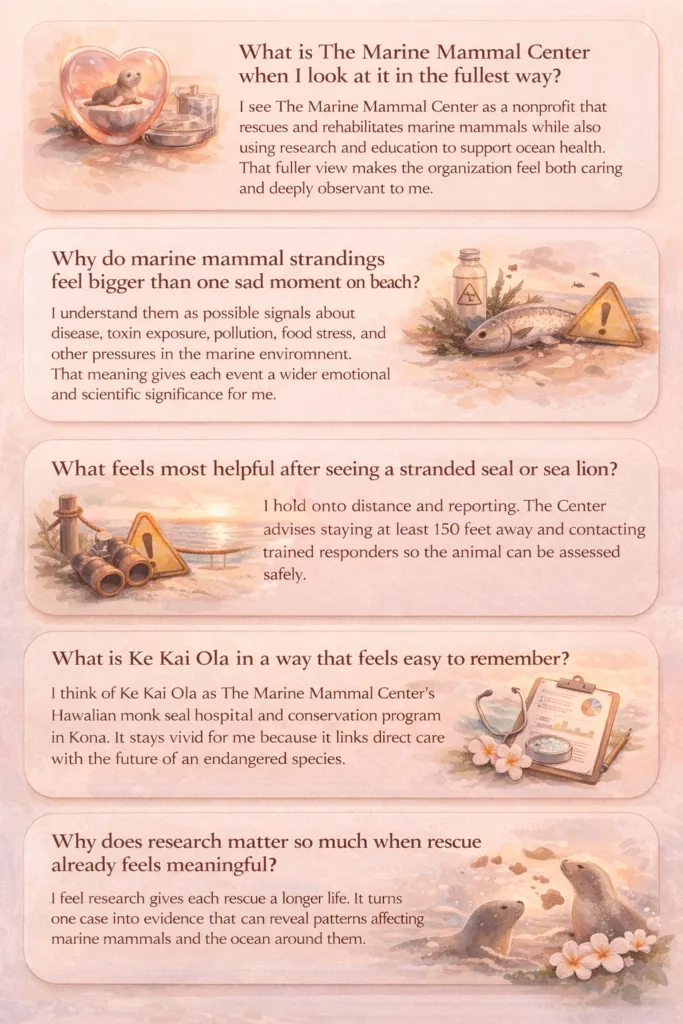
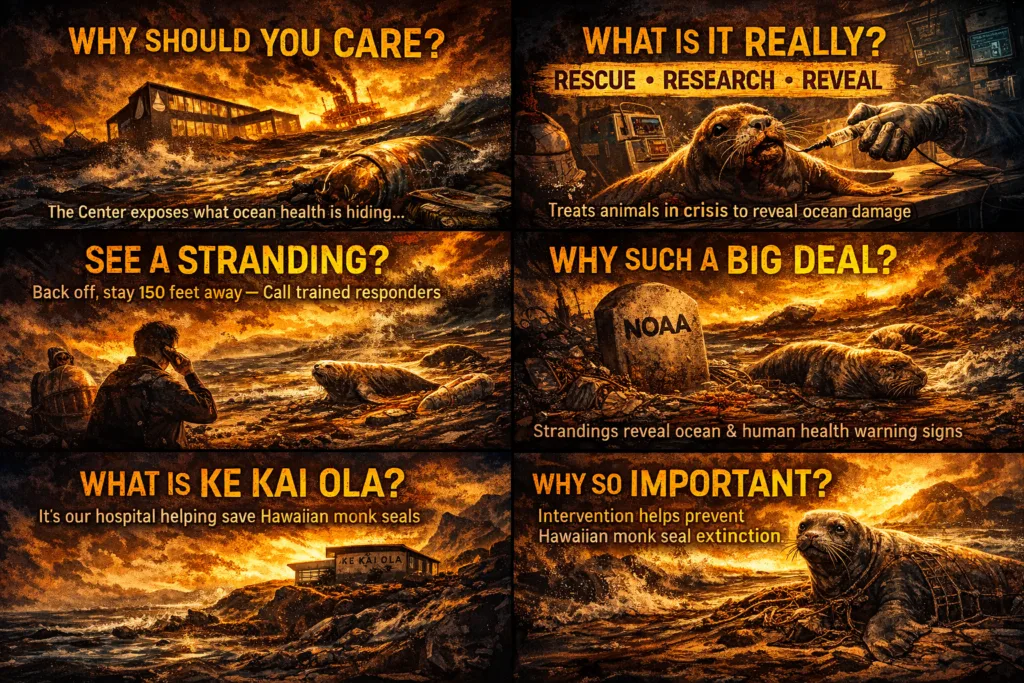
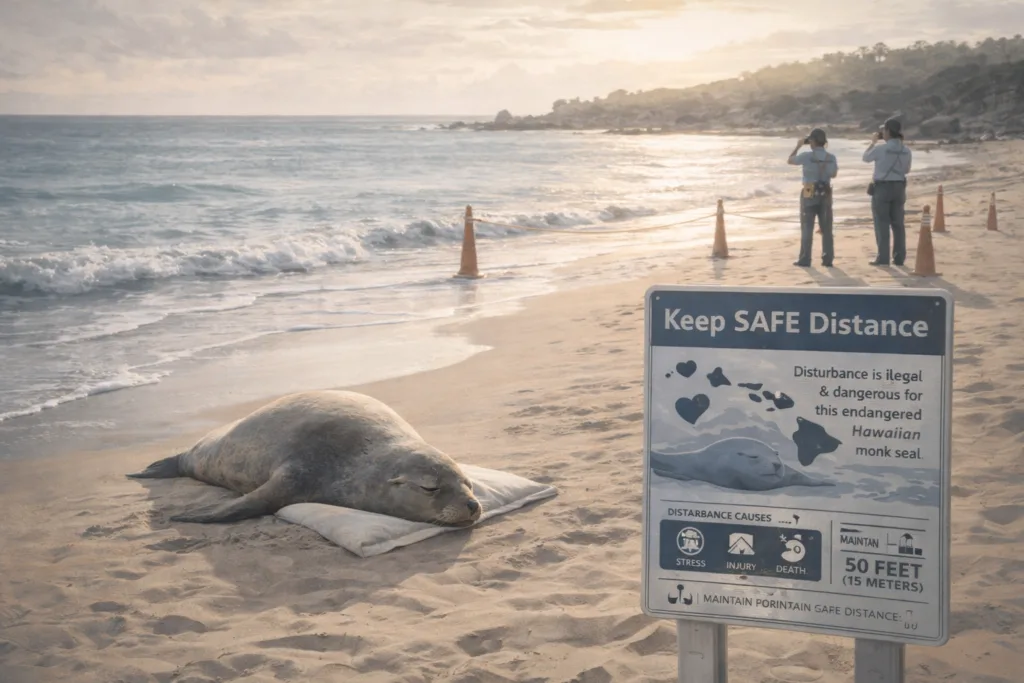
Education extends that translation process into public conduct. Wildlife-distance guidance offers a clear example. Beachgoers receive advice to maintain at least 150 feet of distance from marine mammals, approximately half a football field, because resting animals may already face exhaustion, sickness, or severe energy depletion. Distance therefore operates as a practical conservation measure grounded in biological reasoning rather than as general courtesy language.
Educational reach also appears in institutional reporting. During 2024, formal programs inspired more than 5,800 students and teachers, while climate communication efforts trained more than 1,000 participants. Those figures indicate expansion of interpretive capacity beyond hospital walls. Better-informed communities improve reporting accuracy, reduce disturbance pressure, and recognize that a single stranding event may reflect a larger environmental story involving pollution, toxin exposure, prey disruption, or climate-related ocean instability.
The Marine Mammal Center Hawaii program and endangered species recovery
The Hawaii program clarifies the Center’s conservation role through a more concentrated recovery framework. On Hawaii Island, the Center serves as lead responder for Hawaiian monk seals and operates Ke Kai Ola, a hospital and conservation program dedicated to this endangered species. Program design shifts the institutional frame from broad marine mammal response toward targeted population recovery, sustained monitoring, community guidance, and direct reduction of avoidable harm. Hawaii therefore supplies a sharper view of the same integrated model visible in California.
A single statistic communicates the magnitude of conservation relevance with unusual precision. Nearly 30 percent of the roughly 1,600 Hawaiian monk seals alive today remain alive because of NOAA and partner conservation efforts that include the Center. Population survival in this context depends on active intervention, veterinary treatment, response infrastructure, and organized collaboration rather than passive habitat appreciation alone. Conservation action thus becomes a constitutive factor in current species persistence.
Population increase does not remove fragility. NOAA still describes the Hawaiian monk seal as one of the most endangered seal species in the world, and the current population remains only about one-third of historic size. Recovery and vulnerability therefore coexist within the same species narrative. That coexistence justifies continued emphasis on emergency response, medical treatment, safe wildlife viewing guidance, fishing gear awareness, and public education across monk seal habitat.
Ke Kai Ola demonstrates the practical structure of that recovery work. Emergency response addresses acute cases, veterinary care supports survival, outreach shapes beach behavior, and education reduces repeated human-caused risk. The program does more than treat seals already in distress. The broader aim concerns prevention, population resilience, and conservation continuity grounded in science, coordination, and sustained community understanding.
FAQs
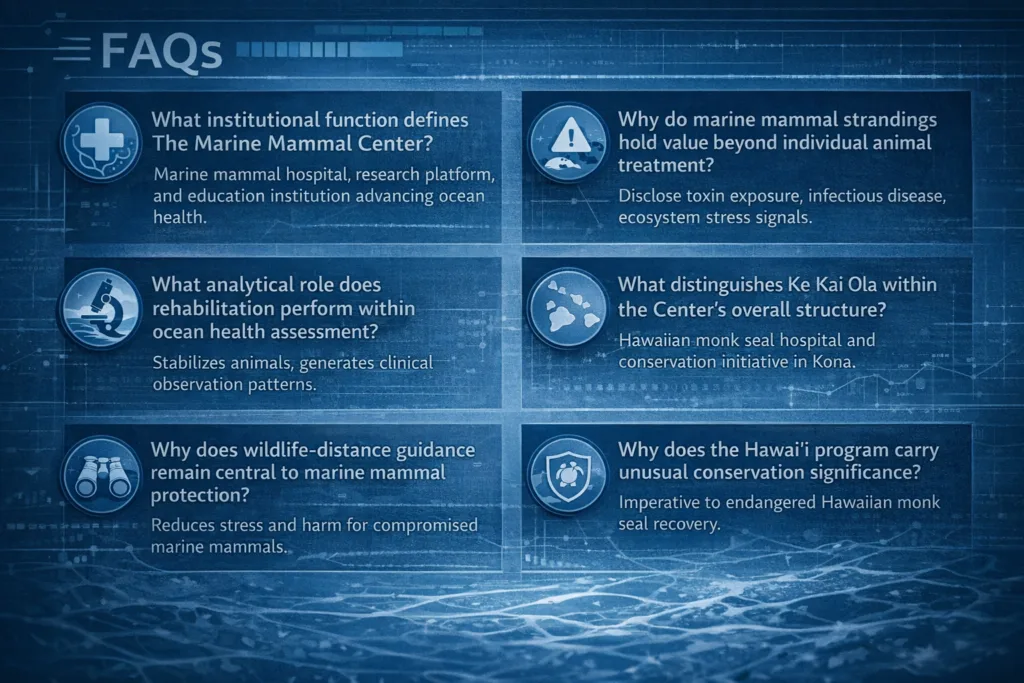
The Marine Mammal Center functions as a marine mammal hospital, research platform, and education institution organized around ocean health advancement. Rescue activity supplies both clinical intervention and ecological evidence.
Strandings can disclose toxin exposure, infectious disease, trauma patterns, prey instability, and broader marine ecosystem stress. Each case may therefore operate as both emergency event and indicator of ocean condition.
Rehabilitation stabilizes animals while generating structured clinical observations. Aggregated observations support pattern recognition across disease, injury, malnutrition, and environmental exposure.
Ke Kai Ola serves as the Hawaiian monk seal hospital and conservation program in Kona. The program combines veterinary care, emergency response, outreach, and endangered species recovery activity.
Close approach can intensify physiological stress, interrupt rest, and reduce recovery prospects for already compromised animals. Distance guidance therefore functions as direct harm reduction.
A substantial share of the current Hawaiian monk seal population reflects organized conservation intervention. Continued recovery depends on sustained response capacity, treatment infrastructure, monitoring, and public cooperation.
Conclusion: The Marine Mammal Center as an Ocean Health Interpretation System
Review The Marine Mammal Center reporting, stranding guidance, and Hawaii conservation materials for direct access to institutional evidence and operational context.