

ACLU in the news often means that a public controversy has become a civil liberties question. The headline may involve voting, immigration, protest, detention, privacy, schools, criminal justice, LGBTQ rights, or technology. The deeper issue is usually the same: what rights do people have when a government rule, official action, or public institution affects daily life?
Recent ACLU coverage shows how broad those questions can be. Current stories and issue filters include voting rights, free speech, immigrants’ rights, juvenile justice, disability rights, LGBTQ rights, prisoners’ rights, privacy and technology, racial justice, reproductive freedom, religious liberty, and human rights. The news topics range from mail-in voting and redistricting to immigration detention, federal agent accountability, facial recognition, and digital search warrants.
This post explains how to understand ACLU in the news without getting lost in separate headlines. It covers why the ACLU appears in major rights disputes, what civil liberties issues are currently being tracked, how individual stories connect to larger legal questions, and where readers can go next for rights guides, case updates, local affiliates, and ongoing alerts.
In this article
- Why does the ACLU appear in major rights disputes?
- What current civil liberties issues is the ACLU tracking?
- How do ACLU news stories connect personal impact to legal change?
- Where should readers go after reading ACLU news?

Why does the ACLU appear in major rights disputes?
The ACLU appears in major rights disputes because civil liberties questions often arise when government power meets individual experience. A rule about voting by mail may affect whether a disabled voter can cast a ballot. A policy on detention may affect medical care, food, family contact, and access to counsel. A police technology tool may affect whether a person is identified correctly. A restriction on recording federal agents may affect whether the public can document official conduct.
That range can make ACLU coverage look scattered, but the issues share a common structure. Each story asks whether a law, policy, court decision, enforcement practice, or public institution is consistent with constitutional rights or civil rights protections. The ACLU’s news categories reflect that structure by organizing stories around rights areas rather than ordinary political beats. Current filters include free speech, voting rights, immigrants’ rights, privacy and technology, disability rights, criminal law reform, juvenile justice, LGBTQ rights, racial justice, and more.
For readers, the useful starting point is to identify the right at stake. A voting story may be about equal access. An immigration story may be about due process. A surveillance story may be about privacy. A protest story may be about speech, assembly, and government accountability. Once the rights issue is clear, the headline becomes easier to understand.
What current civil liberties issues is the ACLU tracking?
Current ACLU coverage points to several major civil liberties themes. One is democratic participation: voting by mail, disability access, redistricting, and the design of election systems. Another is federal power: executive orders, federal agents, immigration enforcement, and challenges involving citizenship. A third is institutional confinement: immigration detention, juvenile detention, prisoners’ rights, and conditions inside facilities. A fourth is modern privacy: facial recognition, digital warrants, device searches, and government access to personal data.
These themes are useful because many stories belong to more than one category. A story about recording ICE or other federal agents is not only a free speech issue. It may also involve immigration enforcement, public accountability, retaliation, and the use of phone footage as evidence. A story about mail-in voting is not only about election procedure. It may also involve disability rights, accessibility, and whether voting systems work for people who cannot easily appear at a polling place.
More than a dozen wrongful arrests have been linked to police reliance on facial recognition technology.
The practical value of ACLU news is that it shows how rights disputes develop in real time. It identifies where litigation, public pressure, legislation, court rulings, and personal experience intersect. For someone searching for context, the key is not to memorize every article. The key is to recognize the pattern: a current event becomes a rights issue when access, liberty, equality, privacy, speech, or accountability is at stake.
How do ACLU news stories connect personal impact to legal change?
ACLU news stories often begin with a specific person, family, or community because civil liberties disputes usually become visible through concrete harm. A voter with cerebral palsy explaining why mail-in voting matters is not only describing a personal preference. That story helps show how voting rules can determine whether a legal right is usable. A detained person protesting unsafe conditions is not only describing a facility. That story raises questions about government custody, medical neglect, and standards of treatment.
This connection between personal impact and legal change is important because rights can sound abstract until a rule is applied. Redistricting is a technical process, but it can affect whether communities have meaningful representation. Birthright citizenship is a constitutional issue, but recent ACLU coverage describes families facing uncertainty around childbirth, citizenship, travel, and long-term stability. Digital warrants may sound procedural, but a broad device search can expose years of messages, photos, locations, contacts, and private records.
The same pattern appears in stories about free speech and public accountability. Recording law enforcement may seem like a narrow question about phones, but it affects whether people can document arrests, raids, protests, and public encounters with officials. The ACLU’s Know Your Rights materials state that everyone has basic rights under the U.S. Constitution and civil rights laws, and that the section is designed to explain how to exercise those rights and what to do when they are violated.
This is why ACLU coverage can be useful even for readers who are not following a specific lawsuit. The stories show how legal principles operate in practical settings.
Where should readers go after reading ACLU news?
The best next step depends on what the reader needs. Someone trying to understand a headline should start with the relevant ACLU issue category or related news article. Someone trying to understand personal rights should go to Know Your Rights. Someone tracking litigation should search Court Cases. Someone dealing with a state or local issue should look for the appropriate state affiliate. Someone who wants ongoing updates should use Stay Informed.
The ACLU News & Commentary archive runs 1,157 pages.
That depth is helpful, but it also means readers need a clear path. A news article may explain what happened and why the ACLU is involved. A case page can show whether there is active litigation, what claims were filed, and what has happened in court. A Know Your Rights guide is more practical when someone needs guidance during a police encounter, immigration enforcement situation, protest, voting issue, or school-related conflict. A state affiliate may be the most relevant source when the issue depends on local law, local enforcement, election offices, schools, jails, or state courts.
ACLU in the news is therefore best used as an entry point, not the final stop. The strongest research approach is to move from the article to the underlying right, then to supporting materials such as court filings, rights guides, public records, government statements, local reporting, and affiliate updates.
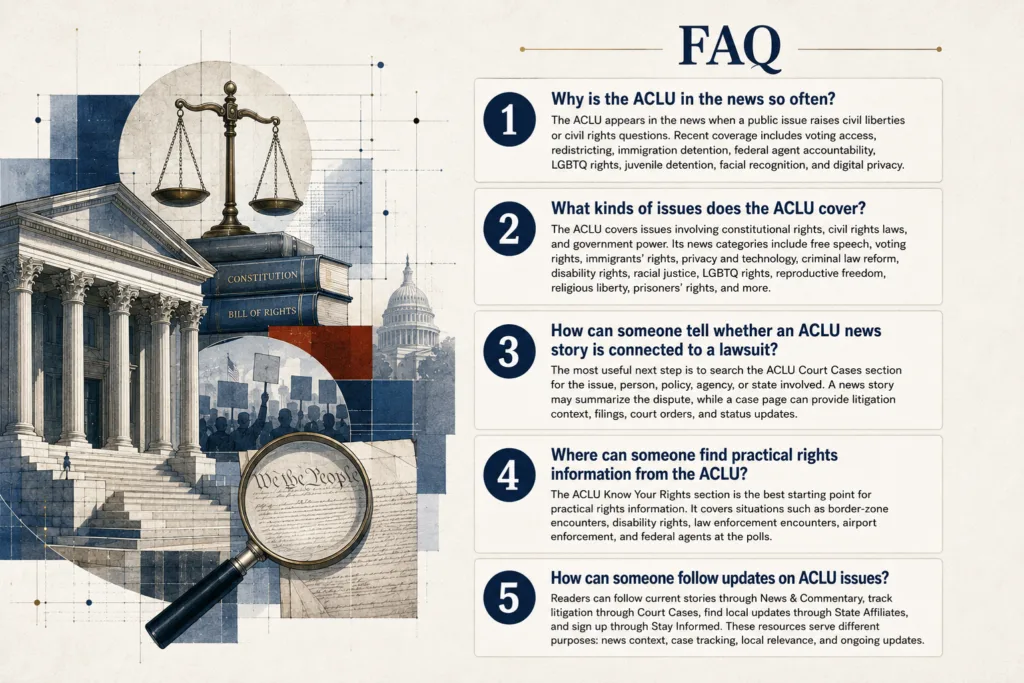
FAQs
The ACLU appears in the news when a public issue raises civil liberties or civil rights questions. Recent coverage includes voting access, redistricting, immigration detention, federal agent accountability, LGBTQ rights, juvenile detention, facial recognition, and digital privacy.
The ACLU covers issues involving constitutional rights, civil rights laws, and government power. Its news categories include free speech, voting rights, immigrants’ rights, privacy and technology, criminal law reform, disability rights, racial justice, LGBTQ rights, reproductive freedom, religious liberty, prisoners’ rights, and more.
The most useful next step is to search the ACLU Court Cases section for the issue, person, policy, agency, or state involved. A news story may summarize the dispute, while a case page can provide litigation context, filings, court orders, and status updates.
The ACLU Know Your Rights section is the best starting point for practical rights information. It covers situations such as border-zone encounters, disability rights, law enforcement encounters, airport enforcement, and federal agents at the polls.
Readers can follow current stories through News & Commentary, track litigation through Court Cases, find local updates through State Affiliates, and sign up through Stay Informed. These resources serve different purposes: news context, case tracking, local relevance, and ongoing updates.
Conclusion
ACLU in the news is most useful when understood as coverage of rights being tested in real situations. The stories may involve different topics, but they often return to the same core questions: who has access to rights, how far government power can reach, what protections exist, and what happens when those protections are challenged.
A strong reading path starts with the headline, identifies the rights issue, and then moves to the most relevant next source. For some readers, that may be a Know Your Rights guide. For others, it may be a court case, a state affiliate, an issue page, or an email update. Read this way, ACLU news becomes more than a stream of headlines. It becomes a practical map of current civil liberties disputes and the resources that help explain them.
Start with the ACLU news story that matches the issue, then use Know Your Rights, Court Cases, State Affiliates, Issues, or Stay Informed to find the most relevant next step.
Resources
More Guides on ACLU
Explore ACLU from every angle: